Tuesday, January 5, 2016

Reach Executives With Your Best Content Engine:  Your Clients

CMI_CCO_Clients-01

Looking for a surefire source for topical, relevant content that grabs your executive audience? Look no further than your own clients. At a minimum, you develop some compelling stories to share with clients and prospects. Done well, content co-creation can help you create a powerful voice, build a market, and deepen important client relationships.

Making the case for co-creation

As I have discussed, executives value hearing from their peers. To connect with them, your content must tap directly into their most pressing priorities and concerns, and help them take action on timely issues. Many marketers fail to realize they have a rich source of the most relevant ideas in the form of their own client base. Your clients provide fertile ground for both extracting the insights and stories that resonate most, and disseminating those ideas in the most effective ways. Here are just a few of the benefits of taking this collaborative approach:


To connect w/ execs, your #content must tap into their most pressing priorities & help them take action.
Click To Tweet


  • Establish relevance and authenticity. Integrating your clients into your content program ensures that you can pinpoint what executives care about and what is directly relevant to them. The peer voice provides a more authentic perspective on the ideas and solutions you share than if they come from a vendor, which has an obvious horse in the race. As Cortnie Abercrombie, who runs the Chief Data Officer Community at IBM, explains, “We have them write stories and articles with us. We don’t have our own people as authors. Executives don’t want to hear us talk. They want to hear from each other.”
  • Enhance your role as an authoritative, trusted source. By listening to your clients and helping them share stories with their peers, you not only build trust with them, you build it with other executives who appreciate the value of learning from each other. The more your clients do the talking, the more you will find executives listen to you. Abercrombie notes, “You can’t just be a convener; you have to build the trust and you have to bring people together.”
  • Elevate your clients’ voice and their impact. Bringing your clients into your content agenda helps elevate their ideas with their own peers and raises their profile in the marketplace. Abercrombie explains, “We use the co-created content to accelerate our clients’ agendas.” Marketers know that creating client success is the best way to turn your most valued clients into advocates, which deepens relationships and enhances the bottom line – not a bad outcome from a content program.

Embedding your clients in your content value chain

There are a number of ways to integrate your clients into your content value chain – from brainstorming ideas and insights to lending a voice during content creation. Consider these elements as you build your strategy:

  • Research – Grounding content in research reinforces its credibility for executives. Tap your clients through interviews or surveys to gather insights on challenges, priorities, innovative solutions, and best practices.
  • Storytelling – Help your clients write articles, create case studies, and develop and produce videos for publishing on your own site or in other settings, both internal and external. Invite clients to present or participate in panels at your events or co-present with your own experts at third-party events.
  • Conversation – Bring together clients to exchange insights and ideas to extend knowledge and create additional content. IBM convenes small groups of chief data officers for virtual roundtables on key topics, and extracts the lessons from each session in a paper to share with the participants and beyond. Abercrombie also makes a point to introduce individual CDOs with similar challenges or like-minded ideas to expand the dialogue.
  • Connection – Create the ultimate exchange of insights and learning, and advance your thinking through ongoing forums like client communities or advisory councils. IBM’s THINK Data Community provides an online forum for sharing content, highlighting tools, contributing ideas, and helping to bring CDOs together offline or online. Having client stories to share makes a client community more powerful and valuable as a tool to engage others.

Tactician_Chart

Any one of these elements creates useful content, but the most value comes from taking a holistic view and integrating the pieces. Abercrombie lays it out this way: “The value is in the way you engage them in the entirety, not just convening them on a periodic basis. We involve CDOs in research, ask them to write articles, invite them to speak, and set up ways to share back to the community and with each other.”

Creating content that resonates with the C-suite is not an easy task; they are a highly demanding audience and a rigorous, targeted approach is required to stay relevant. Client co-creation is a great way to give your program a leg up, and help you focus your resources and time where both you and your clients benefit from content and conversation.

Case study: Making a market with content co-creation

When charged with helping IBM target the newly emerging role of chief data officer, Abercrombie, global-emerging-roles leader for data and analytics officers and data scientists, knew IBM had to take a different approach to establish leadership credibility with this C-suite cohort. “We wanted to be the first company to get behind the CDO role as business critical and go after this group as a key client base – and content was core to doing this.”

Accelerating IBM’s presence with this executive group meant going beyond the usual approach of sharing expert points of view and talking about services and solutions to create conversations and a community of ideas. Abercrombie embarked on a co-creation content marketing strategy: “To launch this effort, we began by interviewing 14 CDOs. Based on the findings, we created a thought-leadership piece describing the emerging role of the data leader and its impact on and value to the business. We went on to create articles, case studies, and blog posts that address the challenges and opportunities identified by CDOs, and offer best practice examples and solutions we heard from them.”

IBM’s efforts did not end with written content, however; Abercrombie and her team added events to the mix to generate another platform for the CDOs’ stories. She explains, “Our first event was hugely successful because it was CDO-led, with little IBM presence on the agenda. We curated the program to only include speakers with the best stories. This helped create a valuable agenda as well as establish a strong community feeling.”

Abercrombie and her team continue to co-create and share content to sustain the momentum, and some of the executives have gone on to blog and post their own stories based on the voice they developed from connecting with IBM. The benefits of this program have been significant, establishing IBM’s dominance within this executive segment, and creating strong relationships to grow the business. Abercrombie sums it up: “Now everyone tries to convene this audience, but for us, because of the trust we built, we can pull in the top CDOs to share in all of our forums, which creates the best learning and exchange.”

This article originally appeared in the December issue of Chief Content Officer. Sign up to receive your free subscription to our bimonthly, print magazine.

Cover image by Joseph Kalinowski/Content Marketing Institute

The post Reach Executives With Your Best Content Engine:  Your Clients appeared first on Content Marketing Institute.

Monday, January 4, 2016

Top 10 Content Marketing Articles of 2015

Of the thousands of posts on content marketing published into 2015, I have narrowed down the ones I have read over the past 12 months into a top 10 list of epic content to save you a lot of time and still get great benefit. Here are my favourite content marketing articles from 2015:

1. 2 Content Types That Will Earn the Most Shares in 2015

Andrea Lehr’s post from way back in February used BuzzStream and Fractl numbers to figure out which content types earn the most shares, and then tracked 220,000 pieces of content over the course of six months using BuzzSumo.

This excellent piece from Andrea gives you insights into what types of content would get us in 2015 (and one would guess the will be very popular in 2016 too).

2. The Consultant’s Checklist for Launching Content

In April, Tim Allen’s blog post on Distilled provided us with an excellent checklist of what we need to do before publishing a blog post.

This blog post is great for helping us get the most out of each of our blog posts, both in terms of SEO and social, as well as making sure we’ve added the correct tracking codes for Analytics.

3. What’s the Difference? Content Strategy vs. Content Marketing

Earlier this year, Greg Secrist published an article on Search Engine Journal to discuss the difference between content strategy and content marketing.

In his post Greg discusses the importance of having a content strategy in place to get the best for your business or blog.

4. How to Write the Perfect Blog Post: a Simple 8 Step Formula
In March, Lisa Bollins from Receptional gave us a simple but great eight-step formula in how to produce the perfect blog post.
Lisa discussed the importance of the headlines, opening paragraph and images to hook and keep your users on board. And then the importance of having a call to action at the end if you have something to sell.

5. A Simple Formula for Writing Kick-Ass Blog Titles

The headline of your article is often the most important part of determining whether it is going to be a success or not. So Corey Eridon’s piece on Hubspot in March is tremendous for helping to write one that will help your next blog post go viral.

Corey reiterates to keep the title accurate, mentions optimising the title for SEO purposes, and if you’re struggling for ideas – brainstorm with others.

6. 5 Content Marketing Myths To Correct Now

Over the summer, Andy Betts put to bed some myths that had been floating around when he published this piece of content on Search Engine Watch.

Andy discussed the quality versus quantity issue, whether there any benefit to producing more content, and social shares, among other topics.

7. How to create content that sticks

In August, Antoni Swidlicki of Green Light Digital gave us an insight into making sticky content.

Antoni covered some important factors for us to consider, such as whether there is an audience, does our content appeal to the end user, and making sure that our pieces are easy for our audience to share.

8. 6 Types of Visual Content You Need to Use in Your Marketing Campaigns

Eager to create some visual content to attract more and new traffic to your website? Lucien Joyce’s piece on Kissmetrics back in August was a great reminder of visual art you can create to do just this.

From images to videos and presentations, Lucien gives guidance on producing this content with several links to further sources to help create some epic visual content.

9. 7 Steps That Will Hook Your Audience through the Magnetic Force of Fascination

At the start of October, Andrew McDermott published this piece on Copyblogger delving into what content can hook an audience.

Andrew gives examples and ideas of how to make your next piece of content fascinate your target audience. This involves creating urgency, a mystique that arouses curiosity, prestige and trust and more.

10. 10 Online Tools to Make Content Like a Pro

A couple of months ago Antonio Tooley made our lives easier with his post on Kristi Hines’ website listing 10 online tools we can use to create expert-looking content.

This post features tools for idea generation, research and writing tools to turn any novice into a pro in a short period of time.

Wanna learn how to make more money with your website? Check the Online Profits training program!


This post is courtesy of: http://www.dailyblogtips.com

The Ultimate Science-Backed Method for Creating Content That Readers Love

creating-content-readers-love-cover

Want to make readers love your content? As it turns out, there’s a formula for it – an exact mathematical equation that defines lovable content.

To be more precise, the formula is for readable content. But content that people love and content that people can read is almost the same thing.

The science-backed method I’m referring to is known as the Flesch readability score. In this article, I want to explain the power of readability, and how you can release the powerful process of the Flesch readability score upon your content.

If you absorb this content and implement it, you’ll discover a vast improvement in your content marketing, search engine optimization, and your conversion rates as well. It all starts with readable content.

Readable content is important

To whet your appetite, allow me to explain exactly why this is such a crucial topic.

Without readable content, your content marketing, your website, and your overall approach to online content are doomed to failure. Readability is a critical component of SEO and usability.

Google prefers readable content

As search engines have evolved, so has the importance of readable content for SEO.

It used to be that a few optimized articles on your website could produce a sizeable uptick in your search rankings. The web algorithms knew enough to crawl the content, index it, and rank it for the optimized keywords.

Not anymore. Algorithms like Panda were designed to penalize low-quality content. When the algorithm was rolled out in early 2011, many sites experienced massive drops in their traffic and visibility.

panda-algorithm

Image source

Many SEOs and webmasters were on the edge of despair when website traffic was trashed by the algorithm.

google-panda-update

Image source

Today, the algorithm is smarter. Google employs people whose job it is to read website content and grade it. Google feeds this information into the algorithm, which uses it to automatically rate content’s readability just like a real reader would do.

Google’s information is contained in the often-leaked Quality Rating Guide. From this document, we know that Google cares about how expert, authoritative, and trustworthy content is.

Right now, Google is indexing and rating your website. The readability of the content impacts how well or poorly your content will perform in the search results.

Readers engage with readable content

There’s another reason why readable content is so crucial: Readers themselves.

Who are the people who are accessing, understanding, processing, and interacting with your content? It’s real people who care about reading.

AJ Kohn explains readability this way: “Readability is about making your content accessible and comfortable. Never make it a chore.”

Unreadable content is a huge turnoff.

When users don’t like your content, Google doesn’t either. It works like this. A user accesses your website and decides (in a few seconds) whether she likes it. If she doesn’t like it, she bounces. Google records this information – short visit, then departure – for future reference.

Another user does the same thing – quick visit; then bounce. Another user does the same thing. And another.

Google gets the idea. Your website isn’t satisfying users. They aren’t engaging with it.

Google decides that your website doesn’t need to be ranking as high, and you start to slip in the Search Engine Result Pages.

Thus, I’m a huge believer it not just content, but readable content. It matters, big time. Search engines love it. Readers love it. As a result of readable content, your business and your website become more profitable.


It’s not just #content, but readable content. It matters, big time. via @neilpatel #contentmarketing #seo
Click To Tweet


Use a mathematical formula for content that readers love

Now, about that formula.

There is a math formula that will tell you if users love your content. It sounds too good to be true, I know. However, some very smart people have developed some highly sophisticated processes that allow us to score exactly how readable your content is.

Allow me to introduce to you Flesch-Kincaid.

The skinny on Flesch-Kincaid

You may have heard of the “Flesch-Kincaid” but didn’t know what it meant, where it came from, what it tested, or why it even mattered. Let me give you the bullet points:

  • “Flesch” is for Rudolf Flesch. He was an author and leader on readability. He developed a readability test in his 1951 book, How to Test Readability.
  • “Kincaid” is for J. Peter Kincaid, a psychologist and scientist. He created a grade-level test for readability, originally developed for the U.S. Navy.
  • The two tests are referred to as the Flesch Reading Ease, and the Flesch-Kincaid Grade Level.

Why are these tests so important? In the 1970s, the military used these tests to score and develop training manuals. If recruits couldn’t understand the information, it wouldn’t be that useful.

Realizing its importance, other government agencies caught on. Pennsylvania led the way, stipulating that insurance policies have a ninth-grade level readability. Educators, scientists, philosophers, psychologists, and other professionals have adopted and implemented Flesch-Kincaid standards and tests.

In my opinion, content marketers should do the same thing – understand and apply the principles of Flesch-Kincaid readability and grade level.

What are these mathematical formulas? There are two – one for Flesch Reading Ease and one for Flesch-Kincaid Grade Level.

Flesch Reading Ease Test

The formula for the Flesch Reading Ease test is as follows:

flesch-kincaid-equation

Image source

If the score is high, then the content is very readable. If the score is low, the content is harder to read.

Here are some sample scores for well-known publications:

  • Reader’s Digest – 65
  • Time Magazine – 52
  • Harvard Law Review – low 30s
  • Moby Dick – 57
  • One sentence in Swann’s Way – 515.1

Here is how Wikipedia estimates the application of the Flesch Reading Ease test to grade levels:

flesch-reading-ease-grade-levels

Should you care about the formula? The exact mathematical equation? No. Its major features? Yes. There are two significant features you should know about:

  • Short sentences equal a lower score. Short sentences are easy to read. Therefore, they produce lower scores.
  • Short words equal a lower score. A word’s complexity is gauged by how many syllables it has. For example, “complicated” has four syllables, which means that it’s going to have a lower score. “Easy” has two syllables, thus contributing to a higher score.

If you use long sentences and long words, your content will be more challenging to read.


If you use long sentences and long words, your #content will be more challenging to read. via @neilpatel
Click To Tweet


Flesch–Kincaid Grade Level Test

The Flesch Reading Ease Test assigns an arbitrary number to content. The Flesch–Kincaid Grade Level Test puts this number into perspective by assigning a grade level.

Here is the test formula:

flesch-kincaid-grade-level-test

Image source

The same features of the Flesch Reading Ease test are present in the grade level test – short words and short sentences make for lower grade levels.

The various weighting of the features are different, however. For example, the Flesch Reading Ease test places a greater weight on multisyllabic words than the Flesch-Kincaid Grade Level Test.

The grade-level test mostly applies to those who are familiar with the U.S.-based educational system. If, for example, a grade level number is six, then the content should be accessible, understandable, and readable by an average student in the sixth grade of a standard U.S. school.

Here are some grade level scores, taken from popular works:

  • CNN.com news article – 10.9
  • USAToday.com news article – 10.3
  • Stephen King’s Green Mile – 8.4
  • J.K. Rowling’s Sorcerer’s Stone – 5.5

Here’s another way to view these scores. I developed two sentences and scored them. The sentences say basically the same thing:

Example 1: The implementation of multisyllabic terminology produces challenging readability issues for those whose cognitive and educational readability tendencies are limited or underdeveloped.

Flesch Reading Ease: 48.1

Flesch-Kincaid Grade Level: 25.2

Example 2: Short words are easy to read.

Flesch Reading Ease: 102.04

Flesch-Kincaid Grade Level: 0.05

Apply the Flesch-Kincaid tests to your content

The Flesch-Kincaid readability and grade level tests are curious and intriguing, but can they really impact your content marketing?

Yes. Here’s a straightforward way to use Flesch-Kincaid principles:

Define your target audience

You should know who it is you’re trying to reach. Defining your target audience and creating a persona are the first steps.

sample-sally

Image source

Understand what publications they read

Along with this persona, you should create a list of the publications that the user typically reads. There’s a difference between niche media and popular media. To determine the real reading habits of your target audience, it’s important to understand their niche interests.

For example, lots of people will read a website such as Forbes. To determine the real reading habits of your target audience, it’s important to understand their niche interests too.

For example, someone in the water/wastewater industry may read a Forbes article that discusses email management.

email-management
But this same reader also might be interested in an article from the Journal of Hazardous Materials.

journal-hazardous-materials

Score the publications to determine their grade level

The purpose of identifying the media used by your target audience is to gauge the user’s grade-level or readability-ease score. When you can hone in on the right grade level or ease score, you can create content around the same level. If you create content that is way above the grade level, you’ll lose your readers. Create content that is way below the right grade level, and readers will feel that it is too simple for them.

In the example above, the Forbes article scores:

  • Flesch Reading Ease: 53.9
  • Flesch-Kincaid Grade Level: 94

An excerpt from the Journal of Hazardous Materials scores:

  • Flesch Reading Ease: 33.09
  • Flesch-Kincaid Grade Level: 11.73

Use an average of the scores from your target audience’s preferred publications. This is your magic number. Use it as a rough range to score and assess your own content.

Use words with the right number of syllables

You already know that short words vs. long words are one of the main determining factors in readability.

Some of the same tools that display Flesch-Kincaid scores also show the average word length. Get a sense of the average number of syllables you should be using.

Find the right sentence length

Sentence length, another readability factor, should influence your writing approach. Find out the ideal or average sentence length for your target audience, and work to keep your sentences this length.

Write and check your content

Finally, run your own content through Flesch-Kincaid tests and see how you’re doing. It’s really helpful to get a sense of how your content scores, so do this regularly.

Grading tools

Here are a variety of grading tools that you can use to assess your content.

Readability-Score.com

readability-score.com

This tool automatically grades your content, and provides a quick readout of scores. A variety of other scoring and indexing formulas that it compels provides an “average grade level.” The tool also provides text statistics.

grade-levels

Read-Able

readability-test-tool

This tool can calculate readability by URL or copying and pasting the text.

It features the same kind of information as Readability-Score – reading indices and text statistics. Read-Able provides an explanation and breakdown of each of the scores, which is helpful for learning more about your calculated score.

readability-test-results

Online-Utility.org

tests-document-readability

Online Utility has a simple interface and an easy input method. You can input URLs but only plain text sites.

One helpful feature of this tool is that it gives you a list of the sentences that you should edit to enhance readability.

enhance-readability

Conclusion

Readability doesn’t have to be a fuzzy and hard-to-define issue anymore. With some strategic insights and a few well-placed tests, you can be well on your way to creating content that is easy to read and understand.

Your readers will love you.

Have you used Flesch-Kincaid readability scores? What is your experience?

Want to grow the love for your content year-round? Subscribe to the CMI blog for daily ideas and inspiration on content marketing.

Please note: All tools included in our blog posts are suggested by authors, not the CMI editorial team. No one post can provide all relevant tools in the space. Feel free to include additional tools in the comments (from your company or ones that you have used).

Cover image by Joseph Kalinowski/Content Marketing Institute

The post The Ultimate Science-Backed Method for Creating Content That Readers Love appeared first on Content Marketing Institute.

Sunday, January 3, 2016

2016 Content Marketing Toolkit: 23 Checklists, Templates, and Guides

checklists-templates-guides-cover

If content marketing predictions made by leaders like Joe Pulizzi, Sarah Mitchell, Carlos Abler, and several others are any indication, 2016 could truly be the year when brands finally start to de-silo their content efforts and operate as fully functional publishers.

This means it’s time to significantly ramp up your content capabilities – or acquire them from other companies – if you don’t want to fall far below the competition when it comes to engaging with today’s tech-savvy and social media-sophisticated consumers.

Regardless of whether your business is looking to build or buy your content marketing expertise, setting yourself up for greater success will take dedication, determination – and an enterprise-wide view of every piece of content you produce. Fortunately, the processes don’t need to be overwhelming if you have the right tools and guidance on hand.

When it comes to creating successful content marketing initiatives, I’ve found that most of the tasks can be divided into four key areas (with a bit of overlap here and there): thinking, planning, doing, and improving.

With this in mind, I’ve compiled a DIY tool kit of checklists, templates, and resources that can help make running your content marketing program a lot more manageable.

Thinking phase

In this strategy development phase, your business must determine why and for whom it’s creating content and what goals it will achieve. It’s also the phase where you elicit the stakeholder support you need to position your content marketing program for optimal success.

The DIY tool: This checklist provides a concise overview of the key factors you will need to consider as you develop – or refresh – your content marketing program.

Buy-In_Checklist_Page4_900px copy

Getting buy-in: A lot of moving parts need to be tended if you want to run a well-oiled content marketing machine. But there’s one barrier in particular that is sure to throw a monkey wrench into the works if you don’t attack it head-on: lack of executive support.

The DIY tool: The following checklist can help you prepare a compelling case and assure stakeholders that your content marketing program will be well positioned to reach its goals.

Buy-In_ConversationChecklist900px copy

RECOMMENDED FOR YOU:
Get everything you need to master the buy-in conversation in CMI’s Essential Starter Kit.

Building a strategy: According to our 2016 Benchmarks, Budgets, and Trends research, 53% of the most effective content marketers have a documented strategy. A strategic road map is essential for enterprise content initiatives, as it helps everyone in your organization understand the opportunities and challenges involved, prioritize projects, and execute on each effort with a shared purpose in mind.

The DIY tool: While there’s no one-size-fits-all template for developing a strategic road map, this guide to the essentials of a documented content marketing strategy will walk you through all the issues you should be prepared to address.

Developing a mission statement: A content marketing mission is an outline of a company’s reason for creating content, and the priorities and perspectives it will uphold in pursuit of that mission. As it helps to define the unique content marketing value your business provides, it’s a critical component for governing your content creation efforts and keeping them focused on your business goals.

The DIY tool: Use this worksheet (created as part of CMI’s workbook on launching a content marketing program from the ground up) to hone in on the key components that should comprise your organization’s unique content marketing mission.

content-marketing-mission

Building audience personas: A buyer persona is a composite sketch of a key segment of your audience; it characterizes who they are, what their relevant needs are, and what role they are likely to play in the purchasing process. Without personas to guide your decisions, you are more likely to revert to creating content around what you know best (your products and company) instead of around the information your audience is actively seeking.

The DIY tool: This guide will walk you through everything you need to create easy, yet actionable, content marketing personas.

Mapping it all out: Once you determine your mission, target audience, strategic goals, and objectives, the next step is to build a framework that defines how your organization will use content to achieve them.

The DIY tool: The step-by-step process outlined in this post by Brain Traffic’s Meghan Casey will show you how this is done.

Planning phase

I call this phase the “reality bridge,” as it describes the actions necessary to take your content marketing program from its existence as a lofty strategic ideal to its realization as a fully functional and productive content marketing engine.

Building the framework for your content plan: Repeat after me: Content marketing works best when you plan for its success. Mapping key considerations, such as your topics and ideas, procedural guidelines, workflow processes, and channel priorities before you start to write will make it much easier to keep the high-quality content flowing smoothly, and overcome any unexpected challenges that may arise.


#Contentmarketing works best when you plan for its success by @joderama via @cmicontent
Click To Tweet


The DIY tool: Not only does this road map template from Michael Brenner address the essentials of a solid content marketing plan, it can also help you account for specific details that are relevant to your company’s unique business case – like team resources, topics, and key performance indicators.

content-marketing-roadmap-600x286

Identifying your customers’ journey: Providing your audience with a rewarding experience is the whole point of content marketing. So it’s essential to understand their consumption preferences, engagement habits, and pain points – as well as how those needs may change over time – if you expect your content to deliver the kind of value that will help you forge deeper customer relationships.


Providing your audience with a rewarding experience is the whole point of #contentmarketing by @joderama
Click To Tweet


The DIY tool: Customer journey maps like the one below (originally shared in this post by Marcia Riefer Johnston) make your personas more actionable by helping you focus on the user state as you determine the content topics, story ideas, formats, and channels to leverage as part of your plan:

customer-journey-map-600x388

Learn how to develop the most efficient, scalable content marketing strategy possible. Register to attend the 2016 Intelligent Content Conference.

Aligning content ideas with business goals: If you want your content to reach the right people at the right time, on the right channels, and drive them to take action, you need accurate audience data to inform your publishing plans, as well as the specific content ideas you execute.

The DIY tool: This multichannel content marketing planner, created by strategy expert Lisa Copeland, is an easy-to-use, easy-to-share way to capture the data and data-related insights that lead to a strategically aligned content creation.

multichannel_planner1.0_CMI4.5-600x392

Structuring your team resources: Because there are just so many moving parts to effective content marketing creation and distribution, it’s imperative that everyone involved knows who is responsible for each task and that all the most essential tasks are being accounted for in your content marketing process.

The DIY tool: Joe Pulizzi has outlined 10 content marketing roles he believes every brand will need to fill if it wants its initiatives to be successful.

RECOMMENDED FOR YOU:
Need to hire for any of these roles within your organization? Look for candidates who can bring these essential skills to the table.

Establishing your editorial guidelines: At a minimum, your editorial content plan should outline the defining characteristics of your brand identity (as it relates to the content you will publish), the preferred voice and style of your content, and the editorial standards governing your content efforts.

The DIY tool: Use the publishing guidelines cheat sheet below to determine and document this information. 

publishing guidelines cheat sheet

Setting your editorial calendar: This most steady and stalwart of tools in the content marketer’s arsenal has transformed itself over the years, from a simple spreadsheet for tracking what we publish to an essential component for managing the entire life cycle of our organization’s content marketing program.

The DIY tool: The CMI team uses a multi-tabbed spreadsheet that’s based on the editorial calendar template below to keep our content ideas organized from conception to completion. Click to download your own copy, which you can customize to your team’s specific content needs.

editorial-calendar-template

RECOMMENDED FOR YOU:
Want more guidance on creating an editorial calendar and keeping it filled with relevant story ideas? Check out our complete checklist of editorial calendar essentials

Creating your channel plan: This component of your editorial plan governs how, when, and on what specific platforms you will publish content, as well as any rules of engagement that your organization would like to set for interacting on those channels.

The DIY tool: Fill in this cheat sheet for each channel you plan to leverage in your content marketing initiatives.

channel plan cheat sheet

Doing phase

Once you’ve set your strategy and outlined your plans for executing it, it’s time to start creating those compelling, customer-driven stories that will help you reach that content castle in the sky. Though the creative process is unique to every business, plenty of tools can help with generating story ideas, organizing them into relevant content pieces, and sharing them with a target audience.

Brainstorming ideas: Team brainstorming sessions are a great tool for getting the creative juices flowing and coming up with new ideas for content creation.

The DIY tool: Follow this simple, seven-step sticky-note-based process outlined in this post by Jay Acunzo for more productive content marketing brainstorms.

Prioritizing your productivity: Not every suggested idea will be a good fit for your content marketing strategy. Some others may be fantastic on paper but require more time and resources than your team can spare. When these situations arise, it helps to have a process for determining which projects are urgent, as well as for handling essential go/no-go decisions.

The DIY tool: Use a content request form like the one below to help your content team prioritize their own projects – and manage the expectations of external teams that rely on them for content creation assistance.

content-creation-request-form-matrix

Managing your ongoing progress: The more you blog, the more you need a simple, scalable way to track your previous blog posts and plan your future blog content.

The DIY tool: Follow the three-step post-tracking process shared by Roger C. Parker to help you streamline and scale your content creation efforts.

Curating content: Curation is a great way to maximize your content resources and get the most value out of every piece of content you publish. However, it can be challenging to ensure that you are discovering, producing, and sharing the right information to make a positive impact on your target audience.

The DIY tool: Use this scorecard created by Roger C. Parker to gauge the quality and consistency of your content curation efforts over time and to make sure you are staying on the right track.

Crafting compelling headlines: Headline writing may just be the most difficult part of content creation. Headlines need to grab attention, but should be clear, relevant, and understandable, so readers find exactly what they expect when they choose to engage with your content.


Headlines need to grab attention, but should be clear, relevant, and understandable by @joderama
Click To Tweet


The DIY tool: This checklist, from our guide on cooking up a killer headline, outlines the rules every content creator should follow, along with some suggestions for spicing up your efforts once you’ve mastered the basics.

killer-headlines

Listening to your community: It’s one thing to create content that you think your audience will like; but the one true way to gauge the impact your content is having on your audience is to listen to the conversations they are having on social media about your business.


The way to gauge the impact #content is having on your audience is to listen to convos on #socialmedia.
Click To Tweet


The DIY tool: Use this content review template created by James Prideaux to track relevant social media conversations and document any analysis extracted from your listening activities.  

Click to enlarge

Improving phase

These tasks help you maintain, strengthen, and grow your content kingdom by identifying what’s working (and fixing what isn’t), enhancing the value and impact of your efforts, and amplifying your content’s power through strategic promotion and optimization techniques.

Maximizing the value of your platforms: These days, it seems like there’s a hot, new content platform hitting the scene before the buzz has even started to cool on the last one. But that doesn’t mean content marketers need to start publishing here, there, and everywhere to make an impact. Instead, your business may be better served by optimizing the content you are already publishing on established channels, like SlideShare, LinkedIn, or your blog.

The DIY tool: If you are looking to expand your use of the SlideShare channel or are looking to get stronger results from the content you publish there, this e-book of SlideShare secrets can help you stack the decks in your favor.

Promoting content: Content marketing promotion can take many forms, such as sharing your published content on your social channels, enlisting the assistance of industry influencers, incorporating native advertising and other paid media opportunities, or leveraging other non-obvious promotion techniques.

The DIY tool: If a blog post gets published in a vast, crowded landscape, will the right audience be able to find it? Perhaps. But your chances will be significantly improved if you follow this checklist from Mike Murray, which features over 50 tips for marketing your blog content.

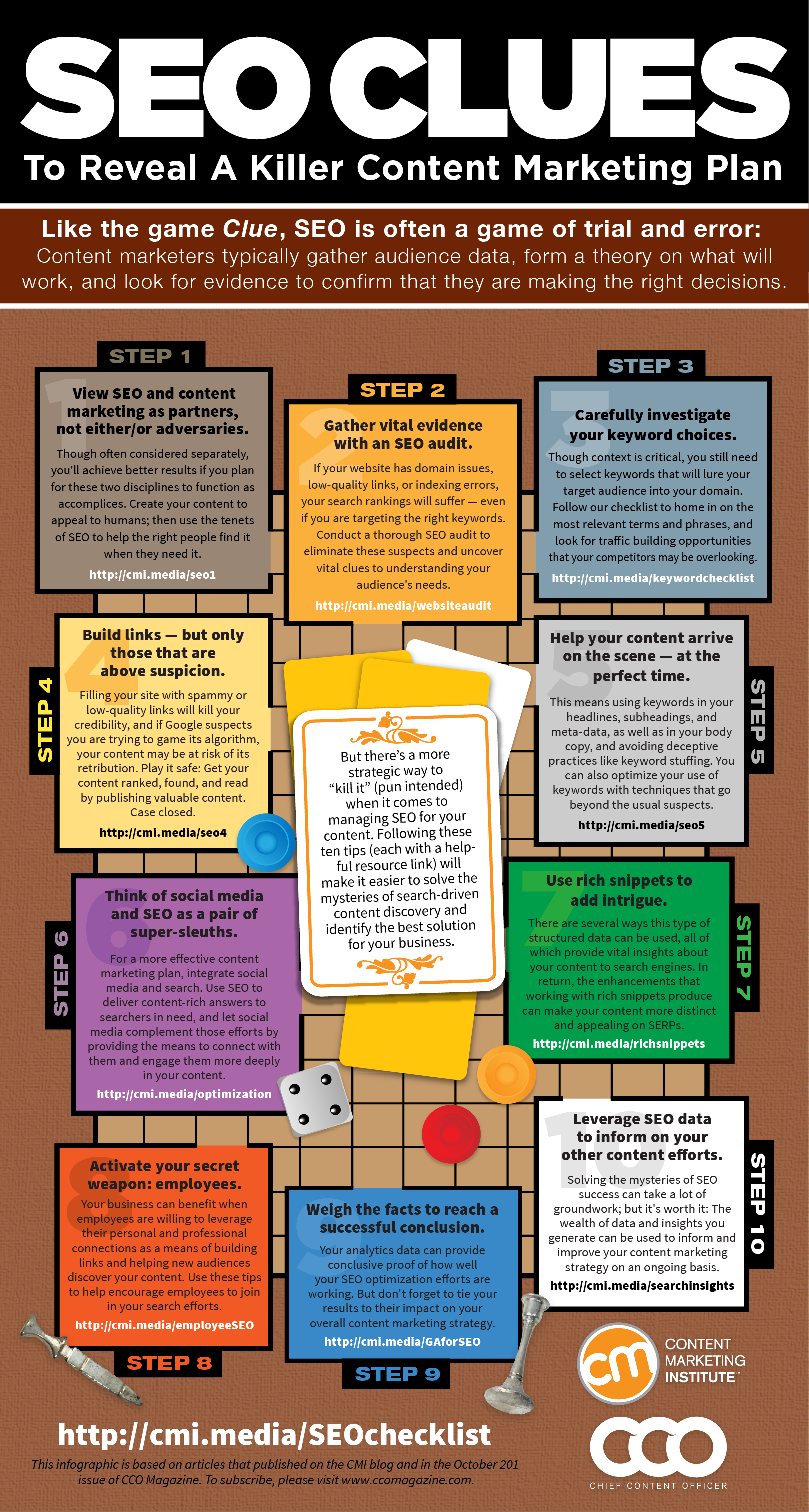
Optimizing for search engines: Optimizing your content marketing for search can feel like a game of Clue – a process of trial and error where you may encounter a lot of false starts and dead ends before finding the right path to success. But there are more strategic ways to plan and manage your SEO efforts so that your content draws in your target audience and delivers the value they are looking for.

The DIY tool: Following the 10 steps outlined in this SEO Clues infographic – as well as the additional tips that Tracy Gold offers in her ultimate SEO checklist – will make it easier to solve the mysteries of search-driven content discovery and improve your rankings for relevant searches.

SEO Clue - header image

Click to view full graphic

Code for the infographic

Measuring success: Your content is only as good as its ability to support your marketing and business goals. It’s not enough to just create and distribute the content you think your audience needs. You must also track and evaluate its performance on an ongoing basis. 

The DIY tool: Follow the simple plan outlined by CMI’s Marketing Director, Cathy McPhillips, for measuring content marketing effectiveness – including her KPI tracker template and a list of common goals and their associated metrics.

kpi tracker

RECOMMENDED FOR YOU:
Not sure which metrics will lead to the specific content insights you need? Check out this quick and easy ROI tip sheet

Go forth and conquer

While these tips, tools, and templates will help you start tackling many of the challenges involved in successful content marketing, they are no substitute for a thorough understanding of the principles and techniques they represent. If you have questions, or would like additional insights on any of these topics, let us know what information you are looking for by adding a comment.

To help you conquer content marketing throughout the year, subscribe to our daily or weekly email.

Cover image by Joseph Kalinowski/Content Marketing Institute

The post 2016 Content Marketing Toolkit: 23 Checklists, Templates, and Guides appeared first on Content Marketing Institute.

Saturday, January 2, 2016

Top 5 Video Websites And Why They Are Important For Your Business

It is imperative that businesses put themselves out there and engage with the consumer in order to drive success. Video production is an ever-increasing method by which businesses are marketing themselves in a new and fresh way. A study by Cisco predicted that video will account for 69% of all consumer internet traffic by 2017.

Video is naturally engaging and easy to digest and it could drive huge amounts of traffic to your site and create more business. Video has the potential to set you apart from competitors if it is done well, which is normally achieved through going to a professional advertising or marketing agency.

Video marketing can add a new element to your online and social presence, and using any of the following video websites could help you increase traffic to your site or simply boost brand awareness.

1. YouTube
YouTube is probably the most obvious choice when it comes to videos. With YouTube videos appearing more and more in Google searches, you can even improve your business’ search ranking through video marketing. YouTube has around 1 billion visitors a month, opening up endless possibilities when it comes to growing your audience and reaching your target market.

YouTube is the third most visited website worldwide, after Google and Facebook and brings in a weekly audience of more than 20 million people in the UK alone, therefore creating a huge platform for you to incorporate into your marketing strategy. A creative ad agency would help you implement this.

2. Vimeo
Vimeo is a video platform constantly increasing in popularity and has gained itself a reputation for high quality used by creative professionals. You may often see artists releasing new videos and other content through Vimeo, which has given the video site a credible background.

Vimeo offers a smaller and more niche community for more professional creatives. Its smaller audience can result in more engaged viewers. It has a clean layout, making the video the focus and nothing else.

3. Wistia
Wistia gives you the option to have full control over the branding of your videos and enables you to add sharing buttons and a clickable call to action. Wistia has an analytic package that includes a heatmap for every view; this shows exactly which parts of the video were watched, skipped or re-watched.
Wistia is a relatively new platform but its SEO features make it a great platform for your business.

4. Sprout
Sprout offers business video hosting solutions that provides a full analytics service and you can add call to action to capture valuable leads. You can also easily add an email collection form to build your contact list from your video marketing. This along with the ability to customise your playlists and videos makes Sprout a brilliant platform to start utilising video content. You can also customise the appearance of your video every time you embed it and there are a whole host of security settings.

5. Vine
Despite being an app, Vine is an important platform to consider. With social media becoming more and more important for business, Vine is a video app that allows you to create 6 second videos and share through your social media accounts. Targeting a younger and media-savvy audience, your business can use Vine to create eye-catching clips to help promote your brand.

It can be difficult to know where to start when it comes to video hosting but with a leading creative agency in video production and branding such as Creative Spark with its range of services, you could have a wealth of help by your side as you branch out into video production as a way of content marketing. Creative Spark offer a huge array of avenues to get into branding and advertising, whether it is through digital, print or video. If you are serious about using the advantages of these video hosting sites it may be worth looking to an advertising agency to help you get the most out of it!

Wanna learn how to make more money with your website? Check the Online Profits training program!


This post is courtesy of: http://www.dailyblogtips.com

This Week in Content Marketing: FTC in No-Win Situation with Native Advertising

FTC-nowin-native-advertising-podcast-cover

PNR: This Old Marketing with Joe Pulizzi and Robert Rose can be found on both iTunes and Stitcher.

In this New Year’s episode, Robert and I critique Forbes’ heavy-handed approach to blocking ad blockers and its promise of a “light ad” experience for visitors who agree to comply. Is there a better way to handle this? We think so. Next, we are pleasantly surprised by The Association of National Advertisers (ANA) decision to declare content marketing as the marketing phrase of the year and we share our thoughts on what marketers need to do to be successful with content marketing in 2016. We scratch our heads over The Federal Trade Commission’s (FTC) recent policy statement regarding native ads, and we explain why it won’t work. Finally, we try to make sense of Ev Williams’ proclamation that the future of media lies in platforms like Twitter, Facebook, and Medium. Rants and raves include a comparison of the audience-building potential of YouTube vs. Facebook and The Business Romantic’s refreshing look at business and life. We wrap up the show with a #ThisOldMarketing example of the week: Komputronik buys Benchmark.

This week’s show

(Recorded live December 27, 2015; Length: 1:03:32)

Download this week’s PNR This Old Marketing podcast.

If you enjoy our PNR podcasts, we would love if you would rate it, or post a review, on iTunes.

1. Content marketing in the news

  • Forbes blocks ad blockers (6:18): Forbes has begun denying access to some people with ad blockers on their devices, presenting them with a notice asking them to turn them off in order to see the requested content. Users who agree to do so are rewarded with an “ad-light experience,” in the hopes that they may be persuaded to remove Forbes from their personal list of ad-blocked sites. Robert and I think this is a heavy-handed approach; we brainstorm several ways Forbes could handle this situation in a much more positive way.
  • ANA says content marketing is this year’s word of the year (12:40): The ANA has announced that content marketing is this year’s marketing word of the year. It was selected based on votes cast by nearly 300 of ANA’s marketer members. Robert and I agree this is quite significant, considering that ANA’s membership has always been focused more on B2C than B2B marketing. We discuss why brands can no longer “dabble” in content marketing – they need to make a commitment to it in order to be successful.
  • FTC releases native advertising guidelines (21:28): The U.S. Federal Trade Commission (FTC) recently released an enforcement policy statement and business guidance that spells out its rules for native ads more explicitly than ever before. According to the policy, the FTC will examine a number of factors to determine if an ad is misleading. Robert and I agree that this policy appears to be all bark, and very little bite – in other words, it’s unenforceable. We explain why, and predict what will happen next.
  • Medium’s Ev Williams: ‘It’s going to make less and less sense to publish on the web’ (31:06): Ev Williams made it easy for people to say what they want online. But the man who created Blogger, then Twitter, and now Medium says the web is on its way out, at least as a place to publish your thoughts. In an interview with Peter Kafka on the latest episode of Re/code Decode, the Medium CEO said the future of media lies in platforms like Twitter, Facebook, and Medium. We discuss the perils of this strategy, which is no different than building an audience on other “rented” social media platforms. If you don’t own it, you don’t control it. We also explain why Williams is promoting this strategy.

2. Sponsor (41:40)

  • CMI University: Winter enrollment for CMI University’s online training curriculum is now open through January 4, 2016. Enrollment will be limited to the first 500 students. CMI University includes over 20 hours of specialized content marketing training, from planning to measurement. If you sign up before January 4, 2016, you will also get free Content Marketing World 2015 video-on-demand access (a $595 value) and free Content Marketing Show 2015 video-on-demand access (also worth $595). For all the details, visit http://cmiuniversity.com.

CMI-University

3. Rants and raves (45:31)

  • Joe’s rave: Matthew Patrick (MatPat), host of the incredibly popular Game Theory channel on YouTube, recently published an episode that asks, “Will 2015 be the end of YouTube Rewind?” This is an annual end-of-year recap video, which features many of the YouTube superstars re-enacting the year’s most popular memes. In this video, he does a fascinating comparison of the demographics of YouTube and Facebook, how each channel monetizes content and why it’s a bad idea to try to build an audience on Facebook. This video contains many lessons for content marketers!

the-business-romantic-book-tim-leberecht

4. This Old Marketing example of the week (53:52)

  • Komputronik buys Benchmark: Komputronik, one of the best-known Polish computer producers and distributors, acquired the benchmark.pl technology portal in 2007 for zl.2 million. This computer enthusiast website has given Komputronik a valuable, trusted channel to reach computer enthusiasts for nearly a decade. A visit to the Benchmark.pl website shows a wealth of recent computing and gaming news, articles, videos, and other content. Alexa shows it ranks among the top 10,000 websites in the world in web traffic. This is an excellent example of a manufacturer purchasing a popular media website in its industry to gain access to its large audience. It’s also a very good example of #ThisOldMarketing.

benchmark-pl-screenshot

For a full list of PNR archives, go to the main This Old Marketing page.

How do I subscribe?

itunes logo

stitcher logo

The post This Week in Content Marketing: FTC in No-Win Situation with Native Advertising appeared first on Content Marketing Institute.

Friday, January 1, 2016

Become a More Effective Marketer in 2016: 5 Questions to Answer

effective-marketer-2016-cover

Our annual content marketing research literally has thousands of data points our research team digs through each year. While the quantitative data is interesting, we get most excited about pondering ways to turn the findings into actionable ideas to help you improve your content marketing.

One of the key areas we focus on is effectiveness: What percentage of survey respondents say their organizations are effective at content marketing, and how has this changed since last year? And, more importantly, what can you do to become more effective at content marketing?

The chart below shows the percentage of responding marketers who rated their organizations a 4 or 5 in terms of effectiveness (on a scale of 1 to 5, with 5 being “very effective” and 1 being “not at all effective”) on our last two annual content marketing surveys.

On the survey, we define effectiveness as “accomplishing your overall objectives.” We refer to those who rate their companies a 4 or 5 as “most effective” or “best-in-class” marketers. As you can see on the chart, the proportion of marketers who report that their organizations are effective at content marketing has decreased.

Chart_Effective

Why is this? Many marketers are likely headed towards the “trough of disillusionment,” which Joe Pulizzi recently explained as the “moment all those who tried the shiny new thing realize it’s not so easy.”

The bigger question at hand: What can you do to be more effective?

If you want to feel more effective, review these questions to see what you should focus on in 2016.

Do you know what the goal of your content is?

Do you know what content marketing success looks like – and how it will move the business forward? In our survey, we asked, “In your organization, is it clear what an effective or successful content marketing program looks like?”

If you are like the majority of our survey respondents, you said “no.”

Not surprisingly, marketers who are more effective are more likely to have answered “yes” to that question.

Chart_Clarity

Our B2B research roundtable recently discussed the importance of having this clarity – and how you can get it:

  • Get buy-in from management on what they need to see to quantify your content marketing program as a success.
  • Understand what metrics support success as viewed by management.
  • Make it abundantly clear to anyone who is involved in content marketing what success looks like. This includes documenting this criteria – and communicating it on a regular basis. Not only does this keep everyone on the same page, but it also helps people stay on track when roles invariably change.

Are you focusing on the right metrics?

Even when marketers say they have clarity around content marketing effectiveness/success, this definition is often fuzzy.  Here are some examples of what marketers (who said they have clarity) said when we asked the open-ended question, “What does an effective or successful content marketing program look like in your organization?”

“A targeted webpage/white paper/video/webinar that speaks to a very targeted portion of our audience and can be optimized for search and used in other marketing campaigns.”

“Alignment with strategic objectives, simplified customer experience and strong call to action.”

“It balances the content needs of our different audiences with our own business needs with nothing that is overly sales like.”

While these are not bad goals, they are not quantifiable. And because they’re not quantifiable…how do you know if you have truly been successful? Furthermore, does effectiveness and success mean the same thing to everyone on your team?

Here are some examples of what clarity looks like at a few effective organizations:

“Generating a designated amount of leads.”

“Beyond increasing engagement by increasing follows, “likes,” and connections on social sites, content downloads, and contact inquiries are the ultimate measure of effectiveness.”

And even when goals are quantifiable, our research shows that in terms of the metrics they use, many marketers are relying on low-level indicators such as social shares and web traffic. As Joe discussed in his analysis of the Australian research, these are not bad metrics, but they aren’t necessarily moving the needle.

While many metrics are important, you should focus on: building subscribers (which is different than generating leads). Your audience is more valuable when it’s filled with people who actively want your content (just as it is for traditional publishers).

Are you creating content that stands out from what your competition is publishing?

If you want to build an audience, your content needs to be different than what others are providing. While the research doesn’t specifically address this, one anecdotal reason we see content fail is that it lacks a point of view or sounds like what everyone else publishes.

To differentiate your content, you need what Joe refers to as the content tilt. In short, it’s looking at your current positioning and tilting it so it’s different than what anyone else is offering. Asked another way: What content would your audience miss if it were gone?

As I’ve said previously, this is, hands-down, my favorite concept is his new book, Content Inc. – and it’s an approach I have used many times to figure out how CMI can fill a gap with our content.

RECOMMENDED FOR YOU:
You can read about all of the steps of the Content Inc. model in this free e-book, 6 Steps to Building a Content Inc. Empire.

How does this tie to the research? In essence, your content tilt should be the basis of your editorial mission statement (also called a content marketing mission statement.) As you see below, those marketers who have a documented editorial mission statement feel far more effective. (Learn more about editorial mission statements in this year’s B2B research roundtable.)

Chart_DocumentedStrategy

Are you giving your content enough time?

Even once you have a clear vision and a differentiated editorial mission statement, you need another ingredient – experience.

As you see from the data below, companies that are more mature in their content marketing efforts are definitely feeling more effective.

Chart_Maturity

Our anecdotal research backs this up as well. As the basis for Content Inc., Joe conducted dozens of interviews with people who have created successful businesses based on content. One of the threads that ran through each story is that it takes time, often between 15 and 17 months (and in many cases 18 months or more).


Creating successful businesses based on #content takes time, often between 15 and 17 months, sometimes longer.
Click To Tweet


Our advice: Be consistent and patient – and focus all of your energy into building an audience.

Are you communicating with your team?

Not only do marketing leaders need to have the vision and the strategy for what they want to accomplish with content marketing, but they need to communicate with their teams. As we see in our research, effective marketers are more likely to do the following:

  1. Document their content marketing strategy. Having a verbal strategy is not enough.
RECOMMENDED FOR YOU:
Download our 16-page guide that walks you through what questions your documented content marketing strategy should answer.

Chart_DocumentedStrategy

  1. Document their editorial mission statement. (See the details above.)
  1. Have frequent meetings – and get more value from those meetings.
RECOMMENDED FOR YOU:
Here are tips on how to have meetings that are more productive and less soul-sucking.

Chart_Meet

Want to dig into more of the research? Check our archives or see more insights.

Want to keep updated on the latest research, trends, and more? Subscribe to our daily or weekly email.

Cover image by Joseph Kalinowski/Content Marketing Institute

The post Become a More Effective Marketer in 2016: 5 Questions to Answer appeared first on Content Marketing Institute.