Friday, January 8, 2016

5 Easy Ways to Boost Your Instagram Followers

Instagram has become such an integral part of my life that it is hard to recall the pre-Instagram life. It feels like a match made in social media heaven. The best part about Instagram, according to me, is that, unlike Twitter, it is free of clutter and, unlike Facebook, it is sans useless post updates. The entire process is simplified on this engaging platform. No matter where I am, whether I am travelling, eating, or just killing time, Instagram is my thing.

Navigating for some interesting visual treat from some great brands and celebrities along with some silly updates from friends is what I love about Instagram. Clearly, I am not the only one in love as there over 400 million users. Today, Instagram has spread like wildfire, which has made it one of the most used social media platform in the world.

A marketing strategy is incomplete without exploring the prospects that Instagram has to offer. With users being obsessed with it, marketers just cannot avoid it. The marketers have mastered the de-cluttering Facebook and reached their desired audience and they have understood the limitations of Twitter’s 140 characters, but Instagram can be slightly tricky. In order to boost your followers on Instagram, you need to have some tricks up your sleeves. I have compiled a list of five easy ways to boost your Instagram followers.

1. Include Trending Hashtags
The way to understand Instagram is through its hashtags. Today, everything is about hashtags, most people use it on Facebook, Twitter, LinkedIn, and other social platforms. This is all thanks to Instagram. While posting a picture, people flood the description with hashtags. This simplifies the process of finding something instead of aimlessly wondering all over the social media, you just need to use the hashtags to see all of Instagram.

While trying to promote a brand or a company, most people get confused as to which hashtags to use. A simple way to solve this dilemma is to use the search option. Here you can find out if the hashtags are trending. A brand can also target a day of the year, for instance, you can use the popular hashtags rotating during the World Environment Day and try and make it relevant for your brand.

One of the strategies that you can adopt is to see, which hashtags have worked for your competitors. Furthermore, in the case of uncertainties regarding the hashtags being used, there is always the search option available.

Another aspect that marketers have an issue with is, to understand the number of hashtags to be used. Is using too much harmful? How much is too? These are some of the questions that you might have. There have been studies that have analyzed this aspect. The study tested with the help of users who had 1,000 followers or less. The studies revealed that posts with 11 or so hashtags had more engagement. But here you need to be reasonable and not overcrowd your post with hashtags.

2. Tag People

By this, I do not mean your loved ones. From a brand’s perspective, you need to tag people that hold some relevance to your brand. Here you need to tag people that are interested in connecting with you. Partnership is an excellent way to boost your followers. Mention other blogs in your post and they will eventually interact with you. Research and recognize the tags you need to use. Once you know, start adding these brands, blogs, or individuals in your post. But there is a line of balance that you need to maintain, otherwise this tactic might result in irritating people.

3. Interact by liking and commenting

As the title suggests, increase your interaction by liking and commenting on relevant posts. You need to reach out to your target audience and this is the best way to do so. This in turns encourages them to interact with your brand.

4. Make sure to include location

Sometimes users might search for images using keywords pertaining to location. Therefore, it is necessary to tag a location in your post. The more the popular the location is the better the chances of users coming across your post. This is an extremely simple way of adding more followers to your account.

5. Promote your account as much as you

Like any other social media platform, you need to promote your Instagram account to make your targeted audience aware that your account does exist. For reference, you can go back to the strategies that you used while building your Facebook or Twitter account. You might have promoted on your website through icons. You would have added blog links through your social media modes. Therefore, apply the same methods to promote and expand your Instagram account.

The first step in this direction is to link your Facebook account with Instagram to increase your followers. The other thing that you can do is hold Instagram campaigns through your most engaging social media platform. Make sure your friends, employees; brand followers are aware of your presence on Instagram. One way to accomplish this is by adding a link to your company Instagram in employee email signatures. Don’t forget to add the handle in your LinkedIn profile or business card.

Make sure a unique hashtags are used that identifies with your brand alone along with some for your campaigns. You need to take an aggressive approach while pushing your brand on Instagram. Follow these tips and before long your Instagram account will be cramped with followers.

Govind Agarwal is the co-founder and managing director at Submitedge. With his expertise in Search Engine Optimization and Social Media Marketing, he has worked with countless brands from around the world bringing them visibility and engagement on the vast sphere of the internet. Apart from being a marketing maven, Govind Agarwal also enjoys sports and reading. You can follow him on Twitter at – @_govindagarwal

Wanna learn how to make more money with your website? Check the Online Profits training program!


This post is courtesy of: http://www.dailyblogtips.com

The Dos and Don’ts of Guest Posting Opportunities

Content marketing has become the ultimate SEO buzzword, so it isn’t a surprise that marketers are using guest posts to build links. Guest blogging is the ideal way to get visibility and it allows you to develop relationships and get more web traffic. Google is making its algorithm more complex and tough with each passing day, which means that you have to follow strict standards of originality, quality and creativity when you decide to guest blog. There is no doubt that guest blogging is an excellent marketing method, but you can only reap its benefits when you choose the right guest post service. Choosing a good blog/website for getting your posts published is also important.

If you are making the guest posting efforts yourself, there are some things that you should pay attention to, and some, you should avoid when you are researching through the numerous guest blogging opportunities:

Things to Do

-Always seek out platforms where you can reach your readers. The blog’s niche doesn’t have to be identical to yours, but the audience should overlap and you should be able to offer something valuable to the readers that makes sense from the perspective of branding.

-Do some research to ensure that the blog you are considering has the right search engine ranking and appropriate page authority. Publishing guest posts on a low quality blog is going to get you penalized.

-Make sure the blog is active and gets visitors frequently. This can be judged by the number of activity and comments on the pages. You can also check the subscriber count of the blog to know how many people visit it frequently.

-Go through the various posts on the blog and see who has contributed to it. It is crucial to ensure that the posts don’t fall under the ‘spammy’ category.

-The blog shouldn’t accept posts from just about anyone. They should have strict guidelines and requirements for a guest post. If anyone can get his or her post published, the blog is probably not worth it.

Things to Avoid

Pursuing sub-par blogs is only going to waste your time. Most blogger outreach services as well as bloggers now understand that it is completely useless to publish on substandard blogs. When you are navigating through the various guest blogging opportunities, these are the things to avoid:

-Never publish on blogs that don’t have a clear subject matter or audience. Your goal is to get in touch with your target audience and this will only waste your time and resources.

-Avoid guest blogging on blogs that have excessive ads. Chances are that they don’t have a lot of visitors and subscriber count because people get annoyed with a lot of ads and they are less likely to visit the blog. Hence, your guest post will not get the exposure you desire.

-Blogs that have poor infrastructure, confusing design and navigation, a bad interface and offer a bad experience to users is another platform you should avoid.
-Don’t go for guest blogging on blogs that don’t have any social media presence.

-Only make an exception if it has a large following. Social media has become integral to today’s marketing strategy and a blog should have presence on the popular networks to make it a good choice.

Mariia Lvovych is a an experienced guest blogging and blogger outreach expert, entrepreneur, owner at HQGuestPosting.com

Wanna learn how to make more money with your website? Check the Online Profits training program!


This post is courtesy of: http://www.dailyblogtips.com

Onward & Upward: Go Behind the Scenes of Priceline’s Social Media

Thursday, January 7, 2016

Mobile Marketing Can Change Your Business

Any marketer that’s been paying attention knows that things change rapidly. And that what was considered niche, unattractive or downright impossible today can become the multi-million $ business of tomorrow.

Now, we are on the cusp of another major medium shift and smartphones are the culprits. They truly are game-changers.  Of course, internet users now prefer mobile phones, tablets and other mobile devices to access the web. Why wouldn’t they? It’s simple and convenient. But since mobile phones have become such an important part of our day-to-day lives, it’s only logical that business owners learn to harness the potential of mobile marketing.

Just What is Mobile Marketing?

Well, if you want an academic definition, the most referenced one is that of Andreas Kaplan, a marketing expert (especially on viral marketing and social media) and a Professor of Marketing at ESCP Europe.

He describes mobile marketing as being “any marketing activity conducted through a ubiquitous network to which consumers are constantly connected using a personal mobile device”.

In other words, whenever you market something by means of a mobile phone, smartphone, tablet, smartwatch or any other mobile device, you are mobile marketing.

The only question is how to choose among the multiple mobile marketing methods at your disposal? SMS, MMS, push notifications, app-based marketing, in-game mobile marketing, mobile tailored websites ads and images, QR codes, and location-based marketing- these are all viable options, but your success depends on your ability to figure out which one works best with your target audience.

Why Mobile Marketing?

I mentioned at the beginning of the article that mobile marketing will be a game-changer akin to other major shifts in marketing in the past decades.

But you might wonder why. Let’s look at some statistics.

In 2013, according to reports by comScore and Nielsen, users were spending 40% of their internet time on mobile devices. And at the end of 2009, Morgan Stanley made a prediction that in five years, internet users would prefer mobile devices to desktops to access the web. Unsurprisingly, these predictions turned out to be correct. And it seems that things are looking ever-brighter for those hoping to use mobile marketing. Comprehensive reports show that the trend is ever increasing, so much so that in 2015 alone, mobile phone internet traffic increased by 39%. And in January 2015, web-pages served to mobile phones comprised a third of all served pages. This means that mobile advertising must have grown also. And it has.

To put things into perspective, in 2009, internet advertising grew by 9%, while more traditional forms like newspapers, radio and TV went down 18.7%, 11.7% and 10.1% respectively. Billions of dollars go into mobile advertising every year and by 2017, experts foresee that mobile ad spending will reach just shy of $60 billion worldwide.

The Lingering Importance of SMS Mobile Marketing

Despite the fact that there are many unique mobile phone users out there, and in countries like India mobile is actually the main way people connect, not all of them are Smartphone users. It’s as simple as that. Yes, mobile is what you should focus on and hence the need to develop a coherent in-depth mobile marketing strategy.

But that strategy wouldn’t be complete or have maximum efficiency if you didn’t take into account the potential customers that you can reach only by SMS. And there’s loads of them.

Among multiple mobile marketing ideas, SMS marketing is a win-win. Of course you can choose a combined mobile marketing strategy: like SMS, in-game ads and QR codes, or whatever you think would work for you, based on the customers you’re aiming for. It’s important, however, that small business owners learn to track and monitor their effectiveness, Brit Tammeorg from TextMagic says.

But SMS should be an integral part of that strategy. Because apart from the data mentioned so far, there is other data consolidating this potential diversification of your mobile marketing strategy to include SMS, into a solid decision.

This has to do with the open rates of SMS messages, these rates being the frequency with which users open this type of messages. A report published by Singlepoint in 2010, called Conversational Advertising found that 99% of all text messages are read by the recipient and, what’s more, 90% of them are read within 3 minutes of being received.
This article from 2014 on business2community highlighted some important points, most importantly the fact that, as opposed to email open rates (which are close to 22%), text messages have a whopping 98% open rate.

Click through rates are also higher in the case of text messages, as an article from January 2015 shows. It was based on a survey performed by FunMobility and concluded that 36% of SMS recipients click on links they find in the message as opposed to just 3.2% of those that receive them in emails.

An American study performed by Shift Communications between the 26th and 29th of September 2015 got impressive results too. When they asked users if they read every SMS message they received, 82% of them replied “yes”! Unsurprisingly, women tend to read fewer text messages from unknown numbers as opposed to men.

SMS Mobile Marketing Tips

Luckily enough, planning an SMS marketing campaign is pretty straightforward. The key is to always remain a welcome presence as opposed to a nuisance for your customer.

In other words, would you like having a ton of messages dropped on you in a short span, making this your first interaction with a company? No. Then don’t do it as a company.
Would you like it if said messages came all of a sudden, without even asking you for permission? Of course not. Opt-ins are essential step.

And you definitely wouldn’t like it if the messages you got were completely un-personalized. Say offering you a bra if you’re a man, to give an extreme example. But keep in mind that even things that aren’t as blatantly faux pas as this can definitely irritate if they do not cater to the interests and needs of the individual. Being useful to your customers is what you need to strive for.

Here are a few ideas that are bound to ignite your marketing campaign:

  • Deals, coupons, freebies: these are excellent incentives for your customers, so offer them to SMS campaign subscribers.
  • Be useful: try to incorporate a sales pitch into a text that offers your customer relevant information (such as completion times for his/her requested service, updates on their delivery, information regarding items that were no longer on stock when they attempted to place an order).
  • Engage in interactive contests: use website/social media links to help your customers better connect with your business.
  • Urgency helps: creating a sense of urgency (for instance, having expiration dates for certain sales or offers) will encourage customers to respond faster.
  • Offer exclusive services: customers who choose to take part in SMS campaigns should be treated as members of a VIP club so offer discounts that no other customers receive.
  • Ask for referrals and promise freebies for top referrers via SMS.
  • One-questioned-surveys are great: they make customers feel involved and help you better cater to their needs. Win-win.
  • Use texts as follow-ups to other forms of communication.
  • Never forget to personalize the text.

SMS marketing campaigns are an oasis of opportunity. It all depends on your creativity. Just remember to keep it short, sweet and useful.

Either way, it’s clear that a marketer who wants to turn his or her small business into a resounding success must think of alternative marketing strategies that can help gain traction and brand awareness. Mobile marketing does just that. It’s reliable and as long as the SMS is personalized, takes the user seriously and shows proper respect, you’re bound to have positive results.

Wanna learn how to make more money with your website? Check the Online Profits training program!


This post is courtesy of: http://www.dailyblogtips.com

Keep Your Content On-Strategy With This Single Statement [Templates]

content-on-strategy-templates-cover

A lot of my clients and workshop attendees tell me that they don’t have a clear idea of what they hope to accomplish with their content. Or if they do have a clear idea, it’s not written down. Sound familiar?

That’s why I spend a lot of time helping content professionals put their strategies into words. One of the most powerful things we do together is boil down their words to a single statement: a core content strategy statement.


One of the most powerful things we can do is boil down words to a core #contentstrategy statement.
Click To Tweet


When everyone on your content team works from the same core content strategy statement, your organization has the best possible chance of getting the results you seek.

I’m not talking about an editorial mission statement or vision statement. Those types of super-high-level statements typically get crafted once and apply to everything everyone does from then on. A core content strategy statement is more flexible and more performance-oriented, and you can create as many as you want. You might create one for a given content marketing initiative or for a specific audience. You can make it broad or narrow.

I introduced the idea of the core content strategy statement in Why You Need Content Strategy Before Editorial Planning, which I ended with a promise to follow up with another article. This is it. Explore the three things you can do to keep your content ideas on-strategy every time:

  1. Create a core content strategy statement.
  2. Use the core content strategy statement to choose topics.
  3. Add the core content strategy statement to your editorial checklist.

1. Create a core content strategy statement

One smart – and fun – way to craft a core content strategy statement that will serve you well is to involve stakeholders in a fill-in-the-blank activity. I recommend using a Mad Libs®–type exercise. (Hat tip to content strategy consultant Sara Wachter-Boettcher for this idea.) Here’s a template that I use in my workshops.

core-content-strategy-statement-template_blank

Fill-in template for a core content strategy statement

This template includes the three key components of any content strategy:

  • Business goals
  • Target audience
  • Audience needs

If you want to create content that performs, your team needs to get clear on all three components for whatever kind of content you’re focusing on.

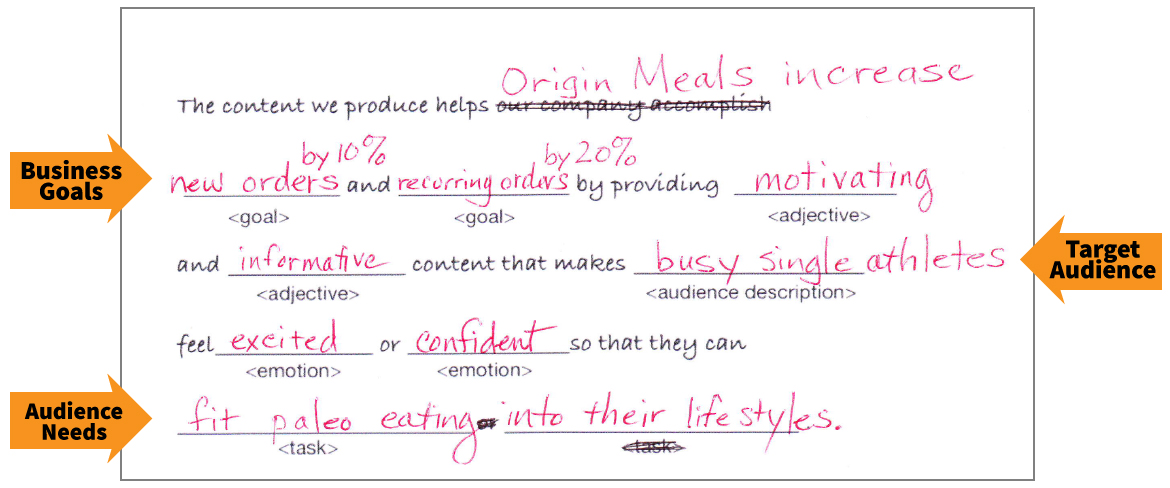
Here’s a completed example based on the business goals, target audience, and audience needs that I described for the company Origin Meals.

core-content-strategy-statement-template_filled
Example of core content strategy statement
Click to enlarge

For your stakeholder meeting, print at least one template per participant. Ask everyone to fill it out. Next, discuss all responses as a group. From there, finesse the responses into a single statement. Get all your stakeholders to agree to your core content strategy statement so that your team has a solid basis for brainstorming content ideas.

2. Use the core content strategy statement to choose topics

Use your approved core content strategy statement as a basis for brainstorming content ideas and choosing which topics to say yes to.

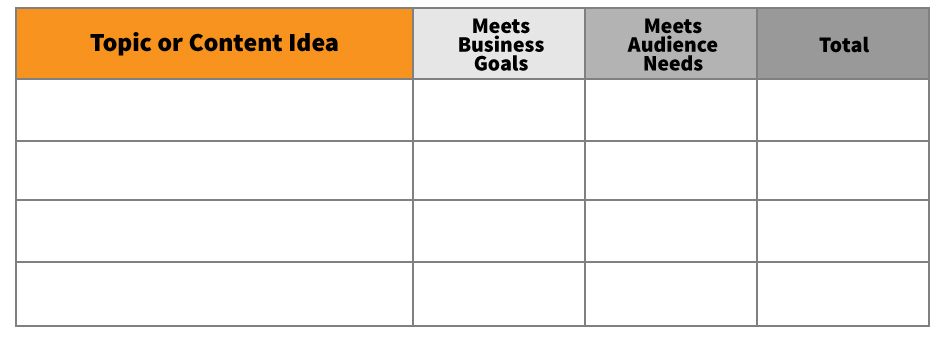
Bring together stakeholders to evaluate content ideas as a group. To make these sessions as productive as possible, I recommend using a content decision-making matrix. I use a matrix like the one shown, which enables teams to evaluate each idea based on how well it meets the stated business goals and audience needs.

decision-matrix-template-blank

Template for content decision-making matrix
Click to enlarge

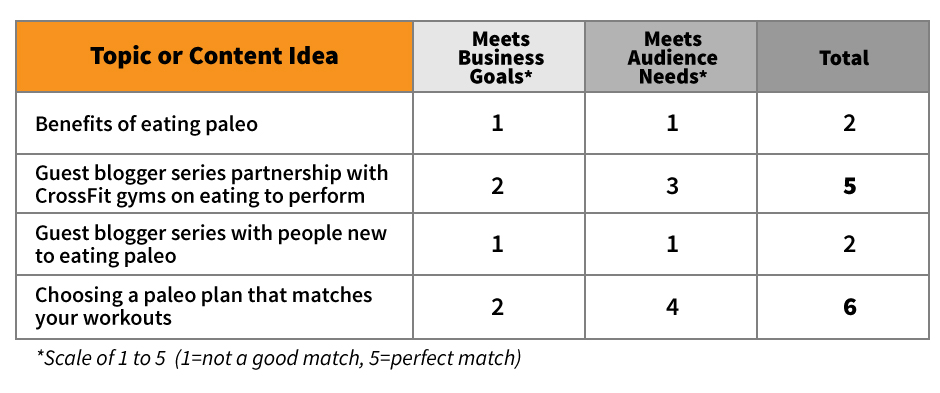
Show the matrix on a screen or whiteboard. Go through each topic or content idea as a group. Through discussion, have stakeholders agree to a score on a scale of 1-5 for each idea. A typical matrix looks something like this:

decision-matrix-template-filled

Example content decision-making matrix with scores
Click to enlarge

Generally, discard ideas with a total score of 3 or lower; they don’t align with your core content strategy statement, so they’re unlikely to perform well. Consider the total scores as one factor in deciding which ideas to pursue. Consider other factors, too, like the amount of time and money needed to execute the idea.

3. Add the core content strategy statement to your editorial checklist

Share your core content strategy statement with content producers and reviewers, and ask them to use it to guide their efforts. I recommend that you add the core content strategy statement to an editorial checklist to help keep the strategy top of mind. Some teams use this checklist as a tool for reviewers and editors to use to provide feedback to content creators. Include items in your list that address business goals, user needs, main messages, and calls to action.

Here’s an example of the kind of checklist items I have in mind. The core content strategy statement is in bold.

  • Supports the Origin Meals goal of increasing new and recurring orders by providing motivating and informative content that makes busy single athletes feel excited or confident so that they can fit paleo eating into their lifestyles
  • Addresses an information need or curiosity that our audience is likely to have.
  • Contains a prominent and appropriate call to action.
Make your checklist as detailed as needed to serve your team. For experienced writers, a short list may suffice. For people who haven’t done much writing for the web, you may want to add best practices like these:
  • Each paragraph expresses one key idea only.
  • Subheads and bullet points make the content more scannable for readers who skim.
  • The title and subheads clearly convey the main message.
  • The content is free of potentially confusing jargon, phrases that might not make sense to a portion of the target audience, and overly clever language.
  • Sentence and paragraph lengths are varied.
  • Calls to action start with an imperative verb.
  • Linked text communicates what users will find after they click.

Whatever kind of checklist works for you, I think you’ll find that putting the appropriate core content strategy statement at the top keeps your team focused on the right strategic goals, making it more likely that your content will perform well time after time.

Summary

I hope that the tools I’ve described – the fill-in template, the content decision-making matrix, and the editorial checklist – will help your team discover the value of defining a core content strategy statement and using it as a guide throughout your content development processes. I predict that when you do, you’ll spend less time on low-performing content and more time on content that performs well for your business and your customers. I’d love to hear whether this prediction comes true. Please let me know in a comment.

Want to expand your content strategy skills? Register today for the Intelligent Content Conference March 7-9 in Las Vegas.

Cover image by Joseph Kalinowski/Content Marketing Institute

The post Keep Your Content On-Strategy With This Single Statement [Templates] appeared first on Content Marketing Institute.

Wednesday, January 6, 2016

Looking for an Email Marketing Provider? Checkout SendinBlue

Over the years I have tested many (too many!) email marketing providers. Given that virtually all of my sites offer an email newsletter or list, I am always looking for new solutions in the market, to keep up to date with what companies are doing and offering.

One provider that I discovered recently and seems promising is called SendinBlue.

Why promising? First because they put a lot of emphasis on making it easy for those with no design skills. They offer a drag & drop designer and a template gallery that make it really easy to create and customize your email messages. And the result of that customization will always be mobile-friendly, which is essential these days.

sendinblue

Second, you’ll be able to personalize your sign-up forms and the content of each email you send according to the details of each contact in your list. This is a powerful feature because it can improve the engagement of your users and ultimately your click-through rate.

Another point that I always check when evaluating an email marketing solution is how they manage the deliverability of emails. This is crucial because if your users won’t receive your emails you’ll be wasting your money.

SendinBlue does IP pool management, allowing you to choose and manage your own IP address over time. They also use SPF, DKIM and DMARC protocols, which are the industry standard for security and authentication.

Finally, the tool works as an “all-in-one” marketing platform. In addition to sending marketing emails, many users take advantage of the platform’s tools for managing transactional emails, SMS messages, and trigger marketing (automation) – all from the same user-friendly dashboard, via the API or using SendinBlue CMS and eCommerce plugins.

The free plan allows you to send up to 9000 emails per month, and to store unlimted contacts. This is one of the best free plans I have seen around, and it should get you going for a while.

If you are looking for a new provider, or not happy with your current one, check it out!

Wanna learn how to make more money with your website? Check the Online Profits training program!


This post is courtesy of: http://www.dailyblogtips.com
How to Improve Your Page Ranking for a Specific Keyword

improve-page-ranking-cover

SEO does not always work the way we want. It is common for Google to rank a page for keywords other than the ones for which we would like the particular page to rank.

What can you do? How can you guide Google to improve the ranking of a page for the keywords you want?

The simple answer is that you need to make sure that Google “receives” the right signals from your page to optimize it, but this is not always easy.

A thin line separates optimization and over-optimization. Optimization is good, as it will increase the page’s rankings, while over-optimization is bad, as it can generate exactly the opposite results.

Let’s see how you can optimize a page for a keyword and improve its rankings in an efficient way by avoiding over-optimization mistakes.

Find baseline ranking

Before doing anything else, find out where your page ranks today for the keywords you want to improve. Without a baseline, you will not be able to measure progress.

You can do it manually (i.e., search for your keyword in Google and take note of your position) or use a rank-tracking tool that can do this automatically on a daily basis.

Caveat: Don’t expect to magically go from position 40 to position 10. Improvement comes gradually, but you need to know your starting point.

Explore variations

Type your target keyword in the Google keyword tool. You are looking for two things. First, find variations of your target keyword, especially long-tail keywords. Second, look at the competition for each of those keywords. You will use this data later.

Doing quick keyword research gives you a better idea of how difficult your keyword is and what other options you have.

Next, go to the Google search engine and type your keyword. Look at these three things:

keywords-suggested-google

  • Pages that appear on the first search engine results page
  • Suggestions for “related searches” at the bottom of the page

Revise and confirm expectations

The initial research – before you make any changes to the page – ensures that your expectations are correct. By expectations, I mean the end result that you want to achieve. Some pointers to consider:

  • Are your expectations realistic? If your target keyword has high traffic, it also has a lot of competition. Can you compete with those websites?

Take a closer look at the first 10 results. Are all results from high-authority websites? Is Google ranking a domain (i.e., the home page of a website) or a single page for the particular keyword?

Click the links and open the first five pages. Is that content better than yours in both quantity and quality? Examine each website more carefully. Are they “big” websites with lots of pages? Are they blogs? Are they corporate websites? Try to gather as much information as possible.

  • Why go to all this trouble? For one simple reason: Although in life nothing is impossible, in SEO not all things are possible.

I am sorry to be the bearer of bad news, but sometimes we don’t rank for what we want but for what is realistic.

The good news is that there is a way out, and let me explain. I would love to optimize my website to rank for “content marketing” but this is impossible. Take a look at the Google results for this keyword.

what-is-content-marketing-search

Unless my website can compete with the Content Marketing Institute, Wikipedia, Copyblogger, Quick Sprout, and the other high-authority websites, nothing I do will get me to the first positions. I can get a place on the second or third pages but that’s as far as I can go.

  • Should I give up and quit? Of course not, this is where the long-tail keywords and proper page optimization come to the rescue.

Go through the list of long-tail keywords you gathered and find keywords with significant volume but not such strong competitors.

In my example, “content marketing tips” is a good long-tail candidate and a better one is “content marketing tips for small businesses.”

Some may argue that the traffic gained from the long-tail keywords does not compare to that of the main keywords. This is true, but it’s a more realistic approach for keyword success. You don’t want to spend your efforts pursuing rankings you cannot achieve but rather focus on identifying keywords that can realistically improve your page’s results.

Don’t forget that high rankings for long-tail keywords build trust that gradually can result in better rankings for more competitive keywords.

Review on-page SEO

Now that you have set realistic expectations, you can start doing some real work.

On-page SEO is your starting point, particularly:

  • Page titles: Include your target keyword (or variations) but don’t do keyword stuffing. Mentioning your keyword in a natural way in the title is enough.

Google’s new RankBrain machine-learning technology is clever enough to associate different keywords and find relevant results, but you still should make sure that your keyword is in the title.

Example: Have a look at a nice example from Google.

Go to the AdSense home page and view the source code. Google is not using Google AdSense prominently in the page title but the page is optimized for the long-tail keyword phrase, “make money online.” Notice how the keyword optimization comes first in the title and then the brand name.

AdSense.source-code

  • Page descriptions: Google may choose not to show your description on the SERPs, but it is still important to provide a custom description for each and every page of your website, especially the pages you want to rank higher.

Accurately describe the page content and include variations of your target keyword.

Look at the AdSense example above and see how nicely Google adds variations of its target keyword into the description (e.g., learn how to make money online, content monetization, make money).

  • H1 tags: Review your HTML code (open the page, go to “View Source” and search for H1). Check that your page has only one set of H1 tags. The H1 tag is not necessarily the same as your page title tag, but it should contain variations of your target keyword.
  • Page content: Back in 2011, Amit Singhal (head of Google’s ranking team) published an explanation of what Google considers to be a high-quality website. It’s one of the most important documents when it comes to SEO because it describes what Google is looking for when assessing a page’s value. Things like content quality, originality, formatting, in-depth analysis, presentation, and author trust play an important role.

Assuming that you got all those behind-the-scenes tips correct from the beginning, you need to ensure that your target keyword (and variations) is mentioned in the content of the page. I am not suggesting that you stuff the keywords in the text or over-optimize, but you need to check that the crawler in the page title and H1 tags are consistent with the page’s content.

Some tools can calculate the keyword density and make recommendations, but you don’t have to go that far; mentioning your keywords a couple of times in your content is enough.

  • Structured data: Microdata, rich snippets, schemas are all names related to structured data. Although this is not yet part of Google’s ranking algorithm, it is trending and sooner or later will be part of the ranking process.

By implementing structured data, you make it easier for Google (and other crawlers) to understand what your page is about, improving your chances of ranking higher. Structured data is not only available for products or organizations, but it can also be used for articles and blog posts.

properties-schema.org

Think internal

When trying to improve the ranking position of a particular page, the rest of your site can help a lot: Use variations of your target keyword as anchor text on your other pages and link them to your targeted page.

Internal linking is great for SEO. Among other things, it can help Google identify the site’s important pages and their meaning, as the pages with the most internal links generally are the site’s important pages.

There is a misconception that you should not use keyword-rich anchor text in internal links, but it’s time to reconsider. Take a look at the internal links section in a search engine optimization starter guide released by Google a few years ago.

better-anchor-text

Among other things, it mentions: “In either of these cases, the better your anchor text is, the easier it is for Google to understand what the page you’re linking to is about.” I know that this is outdated information when it comes to external links but is still valid for internal links.

Take a look at how Google is using internal links in the Google webmaster blog. In a short two-paragraph blog, the writer uses more than five internal links, some of which are highly optimized.

using-internal-links

Relevance of the rest of the pages

Besides internal links, another measure is to make sure that related content is published on the website. What I mean by this is that you should create pages that target other related keywords.

Following the earlier example, the Content Marketing Institute ranks for “content marketing”: not only because the home page is optimized for that term but because a lot of the published pages are closely related to that term, which makes the home page ranking stronger.

While you should optimize pages on the site with relevant content for the page you want to rank higher, don’t think of just text. Use other types of content (infographics, videos, slideshows, etc.) and take into account the latest blogging trends, especially those related to publishing frequency.

Don’t forget about off-page SEO

off-page-SEO

Image source: Search Engine Land

So far, all the actions have to do with changes you can make on your website, but don’t forget about the role of other off-page SEO signals. Depending on how competitive your keyword is, you may have to carefully build a couple of external links to your page.

Identify highly relevant and trusted websites to incorporate your links. It does not need to be optimized because, unlike internal links, external links don’t use keyword-rich anchor text.

Your goal is not to confuse Google and make it believe that you are trying to trick the system by artificially building links, but to have it recognize that you are adding value to the other site’s content.

Use social media wisely

Another way to make that particular page known to other users and dramatically increase your chances of getting natural links is to promote it in social media networks.

Spend $20 on Facebook to boost your page, use Twitter’s promoted tweets, or Pinterest’s promoted pins to make the page visible to more people.

The bottom line is that you have to use any valid technique or means to get your content in front of as many eyes as possible that would be interested to reference your content from their blog or website.

These people are not necessarily your target audience – the people who are likely to buy your product or interact with your pages – but people who can influence your target audience (journalists, bloggers, writers for well-known publications, etc.)

Remember that your goal is not to get more sales or visits to the page but to improve its ranking.

Conclusion

Advanced SEO tasks, like trying to improve the ranking of a page for a specific keyword, take time. It takes time for Google to notice any changes on a published page, so don’t rush to conclusions too quickly.

The process is straightforward:

  • Optimize your page titles, descriptions, and content for the target keyword
  • Work on your off-page SEO
  • Monitor your ranking positions

What is important is to have progress and slow improvements with your rankings rather than doing over-optimization, gaining temporary high rankings, and then wondering how to get out of Google penalties.

Want to stay updated on SEO and other content marketing-related trends? Subscribe to the Content Marketing Institute blog for daily insight.

Cover image by Viktor Hanacek, picjumbo, via pixabay.com

The post How to Improve Your Page Ranking for a Specific Keyword appeared first on Content Marketing Institute.