Thursday, February 4, 2016

7 Tips to Supercharge Your Blog Growth in 2016

Do you know that a simple tweak to your blog can double, triple, or even quadruple your blog growth?

In 2015, I made slight changes to my blogging strategy and saw some massive results; for example, installing a simple plugin resulted in over a thousand extra subscribers to my blog every month, and I was able to get hundreds of subscribers from several of my guest posts even when people were crying that guest blogging is dead.

With the right plan, you can supercharge your blogging and take your blogging from nobody to superstar status. In this article, I share 7 tips guaranteed to supercharge your blog growth in 2016; these tips worked really well for me in 2015, and I plan to use them even more this year. Enjoy!

Tip #1: Revise Your Guest Blogging Strategy

While many people claim that guest blogging is dead, I got thousands of visitors directly from my guest posts in 2016, and I got hundreds of subscribers each from several of my guest posts. In fact, I got over 1,000 subscribers from one of my guest posts. That was in 2015, when many people regarded guest blogging – especially for traffic generation – to be dead. Here are some of my tips to help you create a revised, effective guest blogging strategy:

1. Choose Your Target Publication Wisely: While I did a bit of guest blogging in 2015, my most successful guest posts were on blogs much bigger than mine: blogs like JeffBullas.com with hundreds of thousands of monthly visitors, ThePennyHoarder.com with millions of monthly visitors, etc.

The key to success with guest blogging lies in making sure you choose a blog that has an audience big enough to impact yours, and to ensure that the blog has an audience that will be interested in your blog because there’s relevance between the topic of your blog and that of your host blog.

2. Submit Resource Content as Guest Posts: I’m a huge advocate of publishing resource content, but I decided to take it to another level in 2015: I started submitting resource content as guest posts to other blogs, and the result was massive. Several of my guest posts had thousands of shares, resulting in thousands of visitors and subscribers to my blog.

Here are just a few examples:

Resource content can be very powerful. Imagine what can happen when you amplify the power of your resource content by publishing it on a blog much bigger than yours.

3. Implement a Content Upgrade in Your Guest Posts: I believe guest posting should always be a win-win situation: both you and the host blogger should benefit. Oftentimes, it takes significant effort to create a winning guest post, and one of the best ways to make best of this is by introducing a content upgrade inside of your guest posts. I did this in 2015, and the worst that happened was that editors of some of the blogs moved my content upgrade to the bio section. Even with that, those guest posts resulted in hundreds of subscribers.

Whether it is in your bio or directly at the end of your guest post, having a content upgrade will always lead to more traffic and subscribers for you. My student, Clement Lim, can testify to this: he started noticing an improvement in traffic and subscribers from his guest posts simply by implementing content upgrades in them.

Tip #2: Increase Your Blogging Frequency

For a very long time people have been debating whether it is better to publish content more frequently or to simply focus on publishing quality content whenever you feel like it.

If observing the successes of highly successful blogger is anything to go by, we realize that “blogging when I feel like it” does not a successful blogger make.

Seven-figure blogger Neil Patel gets over a million visitors monthly between his two blogs, and he has repeatedly documented that increasing blogging frequency led to significant traffic gains. This was also corroborated by data from Hubspot that revealed that blogging more frequently leads to more traffic, and that it’s better to publish 16 or more articles monthly.

If you want to grow your blog in 2016, you need to work on your blogging frequency.

Tip #3: Publish More Comprehensive Articles

Resolve to publish more comprehensive articles in 2016; gone are the days where you can just slap articles of 500 words on your blog to meet some content schedule. Various sources have shown that content length matters, and high-profile marketer Neil Patel has repeatedly featured studies to show that content length influences traffic and blog growth. Neil recommends publishing content no less than 2,000 words.

Tip #4: Create a Resource on Your Blog

In 2015 alone, resource articles resulted in hundreds of thousands of visitors to my blog; in fact, most of these visits came from resources I had published years ago.

The average article on my blog has a short shelf life, and traffic usually dies down within months of publishing an article. Things are different with resource articles, though: with every resource article I publish, traffic never dies. In fact, after some time, with almost all of my resource articles, traffic starts to pick up, eventually surpassing the traffic the resource generated when it was first published and heavily promoted.

Here are some good examples of resource content to inspire yours:

The above examples include resources from 4 different categories: writing, education, web hosting, and marketing. It goes to show that you can create a resource for your blog no matter your niche.

Here are some tips:

  • Identify a common pain point in your niche that people need a solution to
  • Instead of giving people tips to solve this pain point, give them a solution. For example, instead of telling people to do outreach to promote their business, give them several outreach templates that they can use
  • Make sure your resource content is specific; the more specific a resource is, the more likely it will spread.

Tip #5: Install the SumoMe App

If the only thing you can do this year is to install and properly configure the SumoMe app, your blog will thank you for it. In 2015, installing the SumoMe app resulted in thousands of extra email subscribers from my blog EVERY MONTH. Here are two key SumoMe apps I recommend installing:

1. The Welcome Mat: The SumoMe “Welcome Mat” shows a full-page opt in form that takes over your screen immediately people visit your blog. They can either cancel the form, scroll down to continue reading, or opt in to your newsletter. Usually, though, a good percentage of your readers will opt in; I get an average of 4.4% conversion rate, site-wide, from the Welcome Mat installed on my blog. For me, that’s over a thousand extra subscribers monthly.

Below is an example of a Welcome Mat in action – screenshot taken from Zac Johnson’s blog:

Zac Johnson Welcome Mat

Here’s a screenshot showing options I’ve gotten through my Welcome Mat:

Bamidele Onibalusi Welcome Mat stats

Here’s a nice tutorial from WPKube.com on how to create a Welcome Mat.

2. The Scroll Box: The SumoMe “Scroll Box” introduces an optin form that is triggered when readers scroll through your blog; you can configure your optin form to trigger after readers scroll to a certain percentage of your blog. Because the form is only triggered when readers scroll, it will only appear to engaged readers, leading to an improved conversion rate.

Tip #6: Create a Content Upgrade

I created my first content upgrade early 2015 and, thousands of subscribers later, it’s contributed immensely to the success of my blog.

I wrote an article here on DBT about my experience with content upgrades early last year, and, needless to say, it’s a strategy I’ll be leveraging for increased blog growth this year.

Here are some tips to help you with your content upgrade:

1. It Does Not Have to be Complicated: Most people fail to create content upgrades because they assume that it has to be complicated. No, it doesn’t. Most likely, people aren’t interested in your free 165 pages ebook. Instead, they’ll appreciate your short report, compilation of your best blog posts, a quick resource or tool, or even a video.

2. You Don’t Have to Create New Mega Content: The first month of creating my content upgrade last year, I got 700 subscribers directly from the content upgrade; within two months, I already had 1,200 extra subscribers. This wasn’t because I published new content that was a big hit; instead, it was because I updated existing content – popular content I published years ago – to feature my content upgrade.

Simply update some of your popular old articles to feature your content upgrade, and you’re good to go.

Tip #7: Ensure a Faster Website Experience

Research shows that 40% of people will abandon your website if it takes longer than 3 seconds to load. It has also been established that Google uses site speed as a ranking factor.

A slow blog can cost you half of your traffic. Having a faster website leads to better user experience, more traffic, and improved search engine rankings, and it’s one way to take your website growth to the next level in 2016.

Bamidele Onibalusi is an entrepreneur, blogger and freelance writer. He helps people build profitable businesses through his blog, EffectiveBusinessIdeas.com

Wanna learn how to make more money with your website? Check the Online Profits training program!


This post is courtesy of: http://www.dailyblogtips.com

16 Common-Sense Reminders for Uncommonly Good Content

16-Common-sense-reminders-cover

I miss things that are right in front of my face. I spend long minutes scouring the parking lot for my car or searching the cupboard for a certain spice, only to realize – sometimes with the help of someone standing next to me – that the thing I want, need, and know like the back of my eyelids has been sitting in my line of sight the whole time.

Marketing can be like that. You want and need to create an exceptional content experience for your audience, and you know what it takes to make that happen, but you’re stuck, temporarily blind to some critical bit of common sense.

If only that bit could come along and nudge you.

This article may give you the very nudge you need most right now. Here, 16 experts presenting at the Intelligent Content Conference this March offer their common-sense reminders of things you can do to create uncommonly good content. Which one of these has your name on it?

Tell a rapport-building story

Exceptional content experiences come from exceptional storytelling. Some marketers focus too much on visual presentation (which is important) and not enough on building rapport.

Alp Mimaroglu, marketing consultant, Fortune 500s | @alpmimar

Bring people to the place where their goals meet yours

We all want to deliver the right content to the right people in the right place at the right time. Achieving this takes work – it may even seem impossible – but the formula is simple:

  1. Find the sweet spot where your audience’s (real) goals intersect your business’s goals.
  2. Determine the path that brings people to that sweet spot.
  3. Deliver each bit of content they need along that path – when they need it.
  4. Measure your results.
  5. Repeat.

Andrea Ames, enterprise content experience strategist/architect/designer, IBM | @aames

Get at the heart of a customer problem

The best content feels like it was designed for you. The author got at the heart of your most pressing problem and created something that provided the perfect answer. You can’t wait to share it because you want other people to get that feeling of connection.

Andrea Fryrear, content marketer and Agile evangelist, MarketerGizmo | @andreafryrear


The best #content gets to the heart of your problem & provides the perfect answer says @andreafryrear
Click To Tweet


Answer a question that matters to customers

You can’t be more interested in delivering the brand message than in delivering useful content. Get into the head of your target audiences. Answer a question that helps people progress along a personal journey.

Buddy Scalera, senior director, content strategy, The Medicines Company | @buddyscalera

Work from a shared content vision

In an exceptional experience, finding content is frictionless. Consuming content is a delight. The content itself is relevant and salient.

It sounds easy, but creating this kind of experience is hard. Behind the scenes, a company must define a content vision and orchestrate the data, technology, and people to bring the vision to life – and sustain it.

Colleen Jones, CEO, Content Science | @leenjones

Model your content to adapt

To create exceptional experiences with content that’s relevant and timely – flowing across channels and devices in a personalized, adaptive way – teams must embrace the processes, platforms, training, and practices that support intelligent content. You start with the content model, the master key that unlocks digital transformation.

Cruce Saunders, principal founder, Simple [A] | @mrcruce

Treat content as a product

Don’t deliver content in addition to your products. Deliver content as a product. This kind of content goes hand in hand with your traditional products and services to “super-serve” your customers’ needs in a way that only you can.

Greg Verdino, managing partner, VERDINO & CO | @gregverdino

Speak as a human

Speak with passion and empathy, as a human, without trying to be something you’re not.

Greg Yates, chief marketing officer, InvestingChannel | @gregyates

Connect with people’s emotions

Have a point of view. Be engaging. Be visual. Be interesting. Create moments that connect with people’s emotions.

Jake Athey, marketing director, Widen | @jakeathey

Create ongoing content that people look forward to

Marketers too often set their hopes on driving an incredible experience through one-off, disconnected releases. For me, an exceptional experience builds over a series of things – blog posts, podcasts, videos – that I make plans to consume.

If you want to produce this type of experience with your content, look at the makeup of a good story; end your pieces with a sense of “to be continued” that draws the audience forward to the next piece.

Jeff Julian, chief marketing officer, AJi Software | @jjulian

Understand your audience’s pain points and pleasure points

We do persona modeling and research to understand what our audience might find interesting. Social monitoring and community building are key components of this strategy. Exceptional content from a user’s perspective is content that resonates with pain points or pleasure points.

Josepf Haslam, senior director #SocialSEO, EducationDynamics | @josepf

Test and optimize, test and optimize, test and optimize

Your brand needs to continuously test its content – digital, print, all of it – optimizing to ensure it:

  • Sparks an emotional response (interest, excitement, fun)
  • Is driven by what your audience wants to read about, not by what your brand wants to talk about
  • Varies in formats
  • Is unique in some way
  • Is timely, relevant, and fresh

Continuous testing and optimizing are the best ways to protect and enhance your content investment.

Kat Robinson, director, strategic planning, Vertical Measures | @katrobinson1

Meet individuals’ immediate needs

Add enough value to your audience’s life to earn you content karma credits that circle back as business value for your brand. To add the most value, content must be relevant to the individual’s needs and desires – and it must be presented appropriately for the moment of consumption.

Content strategy boils down to this: Achieve these deceptively simple things – without going broke – in a way that also meets brand goals.

Noz Urbina, founder, Urbina Consulting | @nozurbina

Support customers’ goals throughout their journey

Delightful content experiences leave the prospect or customer thinking, “Now that’s how it’s supposed to work.” To deliver that kind of experience, content must act in ways that support the goals of customers throughout their journey. Adopting intelligent content enables an organization to do just that and more.

Scott Abel, president, The Content Wrangler| @scottabel

Tune in to your audience’s motivations

Understand what motivates your audience by answering these three questions:

  • Who are the target readers?
  • Why do those readers care about your product or service?
  • When people use your product or service, what outcome follows?

Exceptional content motivates people to take action.

Vishal Khanna, director of digital marketing, Wake Forest Innovations | @bediscontent


Exceptional #content motivates people to take action says @bediscontent via @cmicontent #contentstrategy
Click To Tweet


Deliver irresistible clarity and usefulness

Help people solve a problem with content so clear and so useful that the next time they have a similar problem, they come back to you.

Wendy Stengel, manager, web content strategy, National Association of Realtors | @wendywoowho

Conclusion

Which of these reminders is calling to you? Please tell us in a comment or share your own favorite common-sense tip for creating uncommonly good content.

To hear these pros share their expertise on content strategy for marketers – in person – register today for the Intelligent Content Conference.

Cover image by Joseph Kalinowski/Content Marketing Institute

The post 16 Common-Sense Reminders for Uncommonly Good Content appeared first on Content Marketing Institute.

Wednesday, February 3, 2016

Social Media and Branding

We think it’s safe to say that everyone probably uses some form or another of social media in their daily lives. No matter what forum, the techs in Silicon Valley make sure there is something to appeal to everyone. Social media, whether we like it or not, has become a part of our daily lives.

With social media, you have a voice and an opinion. You are able to share news with friends and family or create the image of what you want to be seen as. You promote businesses without even realizing it. You can leave reviews, check in, and share what you’ve purchased, all from your smartphone. This obviously helps all companies, from small businesses to big corporations.

When your “friends” see that you have eaten somewhere, that you found great deals at a boutique, or loved your salon experience, they are more likely to trust that business because the good review came from a friend or family remember. It’s today’s means of word-of-mouth promotion.

Now, obviously, this all applies to personal social media use, but what about the effect of social media for businesses? Unless you’ve been living under a rock for the past few years, you’re aware of the impact social media can have on your company and its brand.

Social media is a great tool to reach out to your customers and develop a brand successfully. However, you have to correctly use the tools to see positive results. Keep these things in mind when managing your brand and its social impact:

1. Strategy Development
This is where you determine what your brand will benefit the most from. Do you need to build brand awareness? Improve customer service? Are you trying to start online engagement?

Once you narrow down the following, you can better develop an appropriate strategy:

Know your audience.
You need to determine who your audience is, and their needs, before you plan to engage with them.

Network with like-minded businesses.
Build a good reputation with complementing businesses. You never know how far a mention or promotion on another’s business page will take you. Just make sure to always return favors.

Figure out the right platform for your brand.
It won’t do you much good if most of your target audience uses Facebook, and your company is only found on Twitter. Determine what platforms are best to promote your brand by researching what your audience uses, along with what others in the industry use.

2. Know the criteria for success
Lastly, make sure to have fun! No-one will want to engage with a stuffy account. The whole point of social media is to create fresh content that connects people in a fun way.

What you aim to do depends on your strategy. There are tons of options out there, such as host events, launching viral videos, etc. Just make sure to stay on top of trends and appeal to your market.

3. Have fun
Lastly, make sure to have fun! No-one will want to engage with a stuffy account. The whole point of social media is to create fresh content that connects people in a fun way.

What you aim to do depends on your strategy. There are tons of options out there, such as host events, launching viral videos, etc. Just make sure to stay on top of trends and appeal to your market.

About the author: EYStudios is best at creating e-commerce experiences that will delight your customers and run circles around your competition. While ordinary stores simply list a product, an EY design sells the product through pro-active merchandising and cutting-edge usability.

Wanna learn how to make more money with your website? Check the Online Profits training program!


This post is courtesy of: http://www.dailyblogtips.com

One Thing Is Killing Content Marketing and Everyone Is Ignoring It

One-thing-killing-content-marketing-cover

A few weeks before the start of the New Year I led a workshop on content marketing for about 50 small-business CEOs and operations managers. They came from all different industries. Some were consultants. There was a plumber and a representative from an HVAC company present. Pest management? Check. A few small manufacturing companies, a nonprofit, and a jewelry store rounded it out. In other words, it was a diverse group of companies.

What wasn’t diverse were the ways they were marketing their companies. Most had e-newsletters. All of them had Facebook pages. Every one of these senior leaders was concerned about search engine rankings.

Another consistent characteristic? Not one of them was happy with their marketing. This is not unusual. It’s predictable that senior leaders are often disappointed with their marketing. Why? Mostly because they believe it should be easier than it is. They also feel they are just one secret-sauce answer away from Utopia. I mean, how hard could it really be? (Don’t answer that.)

And that’s what I heard about their content efforts as well. Their blog posts weren’t getting much traffic or converting. Their email newsletters weren’t getting opened. Their customers were ignoring them on social media. Finding themselves on the first page on a search engine listing was equally hard.

Changing course

I’d heard enough. After the last complaint, I stopped my presentation. This is something I don’t normally do. I’ve been doing this particular workshop for a while, and the flow works well with small businesses. The last thing I wanted to do was alter course.

But I did alter it with this one simple question, “Is the content you are creating and distributing for your customers any different than anything else out there?”

I looked around at the business leaders. You could have heard a pin drop.

I repeated the question.

“Is the content you are creating and distributing for your customers any different than anything else out there?”

I then rephrased and asked the question to each one directly. I asked the jewelry store executive with the e-newsletter if what they sent to customers was any different. They sent coupons and articles that you could find literally anywhere.

I asked the plumber. He promoted content from the manufacturer on his YouTube page and his blog. I also found out that about 300 other plumbers used that same content.

I asked the financial consultant. He said he purposely kept his articles general because he didn’t want to give away any intellectual property without compensation. “How’s that working for you?” I asked.

“Not very well” was his response.

At one point in the workshop, I told them that if they aren’t going to take this seriously, they should all just go out and buy advertising (and I meant it).

Why should your customers care?

For the rest of the morning, we focused on answering one simple question: “Why should my customers care?”

That e-newsletter you are sending out. Why should they care?

Your Facebook post? Why should they care?

Your blog post, video or (God help us all) Snapchat?

You get the point.

Our job, as marketers, is not to create more content. It has never been about that. It’s about creating the minimum amount of content with the maximum amount of behavior change in our customers (hat tip to Robert Rose). For that to be possible, what you are creating has to be valuable, useful, compelling and, yes, different.


Marketers: Create the min amount of #content with the max amount of behavior change in your customers.
Click To Tweet


The content tilt

Somewhere along the line, we marketers became infatuated with the tools and less concerned about what we put inside them. This, my friends, has got to change.

Of the six-step process of the Content Inc. model (from my latest book), the most important step is the second, the content tilt.

The content tilt is that area of little to no competition on the web that actually gives you a fighter’s chance of breaking through and becoming relevant. It’s not only what makes you different, it’s so different that you get noticed by your audience. That audience rewards you with their attention.

The content tilt is what will separate you from everyone else in your market area. Andrew Davis, author of Town Inc., calls this “the hook” – a simple twist on a familiar theme designed to entrap or ensnare your audience. Without “tilting” your content just enough to truly have a different story to tell, your content will fade into the rest of the clutter and be forgotten.

How to find your tilt

The real goal of this little story was to get you to ask the question – Is my content different? The majority, like over 99% of marketers, do not have differentiated content. They are not telling stories that are different.

If you are like most marketers, then, your next question is “How do I make it different?”


One question marketers should ask before creating #content: Is my content different from my competition?
Click To Tweet


This is easier said than done, but it is possible to tell a different and compelling story looking at different data points. Here are some things to consider:

  • Audience – Are you really niche enough with your audience? “Pet owners” simply is too broad as a target audience. What about “homeowners who like to travel with a dog in their recreational vehicle and live in southwest Florida”? That may be too niche, but probably not. To be truly relevant with your story, you need to focus on a very specific reader. As Stephen Kings says in On Writing, you should think about this person every time you create content.
  • How you tell the story – Content marketing has been around for years and has been called many different things. But we at the Content Marketing Institute were the first to call it content marketing. That made a difference in how the audience responded.
  • Platform – One of the HVAC contractors in the workshop told me there are a thousand blog posts a day on energy efficiency. We also learned that there were few, if any, podcasts about saving energy. Opportunity? I’m not sure, but it’s worth a look.
  • Subject matter – Using tools like Google Trends, you can uncover breakout terms for which there are few instructional resources. Take this quote from Jay Baer as an example:

It’s like, ‘Hey I like knitting, and I’m going to start a knitting blog.’ Really! There are 27 other knitting blogs. Why would anybody read yours? What is different? What is unique? What is interesting? Why would anyone stop reading the knitting blog that they’ve been reading for the last three years and read yours ever? And if you can’t articulate that, you need to go back to the drawing board. And most people I find who haven’t been doing this for a while just don’t go through that competitive calculus, and it’s dangerous.

From the subject matter standpoint, knitting might be too broad. Are there certain types of knitting that are underserved, where you could be the leading expert in the world?

What if your content was gone?

Let’s end with this thought.

Let’s say someone rounded up all your content and placed it in a box like it never existed. Would anyone miss it? Would you leave a gap in the marketplace?

If the answer to this is no, then you have a problem (and this article is directed at you, bub).

We want customers and prospects needing … no, longing for our content. It becomes part of their lives … their jobs.

Today, it’s harder and harder to buy attention. You have to earn it. Earn it today, tomorrow, and five years from now by delivering the most impactful information your customers could ever ask for. “Good enough” won’t win the battle for customer attention. Be great.

Want to learn tips, trends, and more to help you tilt your content? Subscribe for the free daily or weekly CMI blog.

Cover image by Joseph Kalinowski/Content Marketing Institute

The post One Thing Is Killing Content Marketing and Everyone Is Ignoring It appeared first on Content Marketing Institute.

Tuesday, February 2, 2016

Convert Your Content Into Slides to Increase Website Traffic

convert-content-slides-traffic-cover

With so many kinds of content marketing, how do you choose the best methods? In my opinion, the more content methods you use, the better.

Why? Because more methods mean more traffic.

One of those powerful methods is slides. Using slides is such a strong method because you can virtually double or triple your level of traffic with only half the work. Plus, you reach an audience that is focused, engaged, and likely to convert.

What does it mean to convert your articles into slides?

What do I mean by converting articles into slides? First, let me be clear about slides.

Nearly everyone in the business world has seen or created PowerPoint or Keynote presentations. PowerPoint presentations are so commonplace and notoriously boring that the term “death by PowerPoint” is a thing.

Plenty of people know that PowerPoint errors persist, and try to correct the problem.

Even though people may make fun of PowerPoint and say that it is boring, they still use slides, read slides, and benefit from slide presentations.

The world’s highest-traffic slide presentation site is SlideShare.

highest-traffic-slideshare

LinkedIn’s SlideShare is basically a slide-sharing service. The platform allows users to upload and share their slide decks (PowerPoint, PDF, Keynote, or OpenDocument).

SlideShare is a content marketer’s dream come true. Here’s why:


.@SlideShare has a page authority of 79 and a domain authority of 95. In other words, it has killer #SEO
Click To Tweet


Obviously, there are a lot of benefits to using SlideShare. Yet, many marketers who use the platform do so only occasionally. This is a problem because the real benefits of SlideShare build up as you add more content.

Converting your articles into slides is as simple as turning a blog article into a slide format. Let me show you an example:

WordStream published this great article, 5 Psychological Tricks to Exploit in Your PPC Ad Copy, by Margot da Cunha on July 20, 2015.

WordStream-published-article

It’s a strong long-form piece of content from a recognized authority. The article has images and plenty of helpful advice.

Now, take a look at this:

WordStream-article-slideshare

Does it look familiar?

It’s a SlideShare presentation – 5 Psychological Ad Copy Hacks to 3x CTR – authored by Margot and uploaded by WordStream on Dec. 10, 2015.

The idea of the content is the same – theme, data, points, etc. The format is different.

For example, her SlideShare point states, “Spark Engagement through FOMO, Rewards, & Uncertainty.”

Margot-different-platform

But her article states, “Appeal to the I-Don’t-Want-to-Be-Left-Out Fear.”

Same idea. Same basic concept.

Two different platforms.

Margot was smart. Not only did she use this content on a blog and SlideShare, but she also used it in a webinar. Triple repurposing!

That is the basic idea. You take a great article that you produced on your blog, place the content into a slide presentation, and upload to SlideShare.

How do slides fit in with a content marketing strategy?

According to CMI’s definition, “Content marketing is a strategic marketing approach focused on creating and distributing valuable, relevant, and consistent content to attract and retain a clearly-defined audience – and, ultimately, to drive profitable customer action.”

Following this definition, SlideShare features some of the most powerful content available. Spend a few minutes browsing SlideShare, and you’ll discover the following:

  • Valuable content
  • Relevant content
  • Consistent publishers
  • Attractive content
  • Targeted audience
  • Conversion-focused content

One of the most common misconceptions about content marketing is the idea that it has to include blogging. Blogging is, of course, a really valuable form of content, but it’s not the only one.

In fact, some brands are excellent content marketers without a blog.

How does this work? Effective content marketing starts with identifying your target audience and understanding how they access content.

SlideShare has an audience of highly engaged users, many of whom are professionals on LinkedIn. The SEO authority of SlideShare’s site means that content featured on SlideShare is likely to have SEO value. The content itself is presented in a format that is easy to read and digest.

The bottom line is this: SlideShare is an excellent component of any content marketing strategy. If you’re producing blog or article content anyway, then turning it into slides is an obvious move. You’ll receive more and better traffic.

Why you should turn articles into slides

Besides more and better traffic, what other reasons are there to turn articles into slides? Here are some:

  • It’s easy. You’ve already done the exhausting brainwork of research, writing, development, and explanation.
  • It’s fast. It’s easy to waste time making slide presentations. If you have a presentation template and some handy images, it doesn’t take too long to place your article into a slide presentation.
  • It has a high ROI. Considering the time that you spend flipping an article into a presentation, you’re getting a massive return on your investment.
  • It produces traffic from a different source. SlideShare visitors may not be familiar with your brand or product. Delivering content via SlideShare is a great way to access new sources of traffic.
  • It offers searchable discovery. SlideShare users often search for their preferred topic using SlideShare’s search bar or categories. The content they see is the content they were looking for. The advantage for you is targeted and relevant traffic.

How do you do it?

I hope you’re convinced of the “should-I” reasons for conversion. Now, here are a few “how-do-I” pointers.

Obviously, SlideShare is a different platform with a different content model. Your ideas remain, but your format will change.

  • Adapt your outline into stand-alone points. Your article likely has an outline. Make sure that your outline is clear and can serve as a logical structure for your presentation.
  • Use one slide to feature your main point.
  • Use the next slides to develop your main point.
  • Make sure that each slide includes only one idea. Try not to use a lot of bullet points.
  • Use attractive images. Some designers favor a full-screen image for each slide. You might not have the time or resources to do so, which is fine.
  • Use a lot of slides – it’s OK.
  • Include a call to action at the end of your slideshow.

Let me share an example. If you wrote an article about the rise of mobile communication, one of your main headlines might be something like this: “Beyond Texting.”

Within this point, you discuss six types of mobile communication other than texting. You have six sub-points – voice, images, videos, money transfer, dating, and image recognition.

This outline works perfectly for a SlideShare presentation:

Main point: Beyond Texting

Main-point-beyond-texting

This main slide includes a preview of the upcoming six sub-points.

Sub-point: Voice

Sub-point-voice

The Voice sub-point slide is image-intensive. The only text is a single sentence about the voice functionality of four popular mobile apps. The images reinforce the point.

Sub-point: Images

Sub-point-Images

This second sub-point uses a lot of color and imagery. The slide communicates the large number of users and information shared via Snapchat. While the slide could have been adapted from a full paragraph in an article, it contains only 19 words.

The full presentation is 29 slides. The seven main points are coherent and focused. The slides that follow are image-rich and data-driven. It’s a compelling and focused presentation.

And here’s the great thing. You can create all kinds of presentations from all kinds of articles. In fact, if you want, you can create several presentations from a single article.

Of course, not every article can be so easily converted to a presentation. For example, the articles that I write on Quicksprout and NeilPatel.com are usually between 1,500 and 4,000 words. These are tactical, how-to posts with detailed instructions on executing content and SEO strategies. The nature of those posts does not lend itself well to a presentation format.

Conclusion

With a bit of creative thinking and some familiarity with SlideShare, you can unleash a whole new component to your content marketing strategy. The more content tactics that you can understand, use, and master, the more effective your content marketing becomes.

As you continually refine, streamline, and improve your content, you will grow into an unstoppable marketing force. Converting blog articles into slides is one such way to augment your content marketing strategy, showcase your thought leadership, and drive tons of fresh traffic to your website.

Have you tried converting blog articles into SlideShare presentations? What do you think?

Ready to convert to an email subscriber at the Content Marketing Institute for daily or weekly insight to help you improve your content marketing success? Sign up today.

Cover image by Joseph Kalinowski/Content Marketing Institute

The post Convert Your Content Into Slides to Increase Website Traffic appeared first on Content Marketing Institute.

Monday, February 1, 2016

Check Out the StudyBay Affiliate Program

As you probably know affiliate marketing is one of the most profitable monetization methods online. That is because you’ll actually be selling a product or service, on behalf of another company. On top of that you won’t have to deal with delivery or customer service, as the company itself takes care of everything else when you refer a client.

The challenge is finding the right affiliate programs. Some have small commissions, others don’t convert well, so on and so forth.

If you have a blog or website related to the education niche, you should check the StudyBay affiliate program. It’s a platform for freelance writing services, and you can earn by referring both writers and customers.

3

Here are some of the promotional materials you’ll have access to if you join:

– banners
– orders form
– links
– landings
– keywords

Commissions range from 40% up to 60% on the first order of any client you refer, and you get 15% on all subsequent orders, so if your referral keeps using the service, you’ll keep earning commissions.

Another cool things is that you’ll have complete control over your stats. Their control panel gives you all details about transfers, orders and profits for the day. You can also check the details of each order, and even create different streams for different types of traffic.

Their affiliate program stats are impressive:

– Conversion rate of 57%
– 9.5 is the average number of orders from customers
– Everyday payouts to affiliates with several payment options

If you have a site that is in a related niche, check it out!

Wanna learn how to make more money with your website? Check the Online Profits training program!


This post is courtesy of: http://www.dailyblogtips.com

Big B2B and B2C Companies: Fix SEO and Content Marketing Strategies [Study]

B2B-B2C-Fix-SEO-and-content-marketing-cover

Big companies can make huge gains with reasonably small adjustments to their SEO and content marketing strategies. The opportunities are staring them in the face. They just need to update existing content and be willing to create new website pages.

In my new study, Big Businesses Fall Short with SEO and Content Marketing, I took a close look at the Fortune 100 to size up how they’re dealing with basic SEO tactics for their website content. Their performance isn’t surprising on some levels. They command No. 1 rankings on Google and often fall safely on the first page of Google search results.

The problem is that too many popular keywords aren’t making it to the first page.

What they’re doing wrong

In my analysis, I evaluated the 500 most-searched keywords per company based on Google ranking and search data tracked by SEMrush. On average, 19.4% of the Fortune 100 keywords ranked between 11 and 20 on Google (the second page).

Sure, scores of the most popular search words aren’t the least bit relevant to the Fortune 100 companies. “Quiz” attracts an estimated 1.3 million annual searches on Google. Does Disney really expect to benefit if it moves up from No. 15 to No. 5 in a search for that word? Boeing would hardly pursue a No. 3 ranking for “long-term forecast,” which has about 25,000 annual searches on Google (Boeing ranks 20th for the phrase).

What about the popular keywords that could match their lead, sales, and branding goals?

semrush-google-rankings-fortune100-screenshot

Image source: Online Marketing Coach based SEMrush/Google data.

Merck ranks 14th on Google for “Lisinopril” for  its PDF about Prinivil, a prescription drug for high blood pressure and congestive heart failure. Merck misses out on a ton of traffic because it doesn’t even bother to include branding with the company name and logo until the bottom of the final page in a PDF that’s focused on every aspect of Prinivil.Image source: Online Marketing Coach based SEMrush/Google data.

Here are some key findings from my study on missed opportunities that diminish the Fortune 100 companies’ search engine ranking results:

  • 56% don’t even use keywords in their SEO titles for their home pages.
  • 23% of Fortune 100 companies don’t use a meta description on the home page that could appear with search engine results.
  • 89% generally don’t name images with keywords with dashes (they prefer ineffective underscores and generic or jammed words).

Image names need keywords w/ dashes. Underscores and generic names aren’t effective #SEO via @mikeonlinecoach
Click To Tweet


What’s at stake with SEO and content marketing? Prominent companies could support profitability ambitions instead of sometimes squandering opportunities.

big-companies-fall-short-seo-content-marketing-infographic

It’s in (or not in) the SEO page title

Here are examples of how four companies don’t put SEO to work for their titles:

  • <title>The DOW Chemical Company – Home </title>
  • <title>BERKSHIRE HATHAWAY INC.</title>
  • <title>Marathon Oil Corporation</title>
  • <title>Google</title>

Even Google rejects the advice it offers on its Search Console for website developers and other marketers on how to create effective SEO titles:

“Page titles should be descriptive and concise. Avoid vague descriptors like ‘Home’ for your home page, or ‘Profile’ for a specific person’s profile …


Page titles should be descriptive & concise. Avoid vague descriptors via @mikeonlinecoach #SEO
Click To Tweet


The title of your site’s home page is a reasonable place to include some additional information about your site – for instance, ‘ExampleSocialSite, a place for people to meet and mingle.’ But displaying that text in the title of every single page on your site hurts readability and will look particularly repetitive if several pages from your site are returned for the same query.

In this case, consider including just your site name at the beginning or end of each page title, separated from the rest of the title with a delimiter such as a hyphen, colon, or pipe, like this:

<title>ExampleSocialSite: Sign up for a new account.</title>”

Some companies do a better job:

  • <title>Ford – New Cars, Trucks, SUVs, Hybrids &amp; Crossovers | Ford Vehicles</title>
  • <title>Citi | Responsible Finance – Financial Ingenuity – Global Bank</title>
  • <title>Welcome to Walgreens – Your Home for Prescriptions, Photos and Health Information</title>

Unfortunately, with their interior pages, 71% of Fortune 100 companies merely repeat their visible content header (like the headline) and use that for the SEO page title. The problem is that the headers are often general, which means the SEO page titles don’t benefit from keyword variations.

In this example, the headline words “Meats & Livestock” don’t reflect the investment context of the content. As a result, the SEO page title is very basic: <title>INTL FCStone – Meats/Livestock</title>

Meats-livestock-seo-title-basic

It’s in the broken links

SEO and content marketing lose their effectiveness if the content doesn’t deliver. GE, for example, has a products page with several links to more pages. But one of the main pages is a broken link to a separate GE website for “Appliance Filters & Accessories.”

GE-broken-links
Not-found-search-result

It’s striking a balance

Nationwide stands out among Fortune 100 websites for how to maximize its SEO efforts. It still underperforms but can improve. Whoever led the SEO strategy made a significant difference for the company.

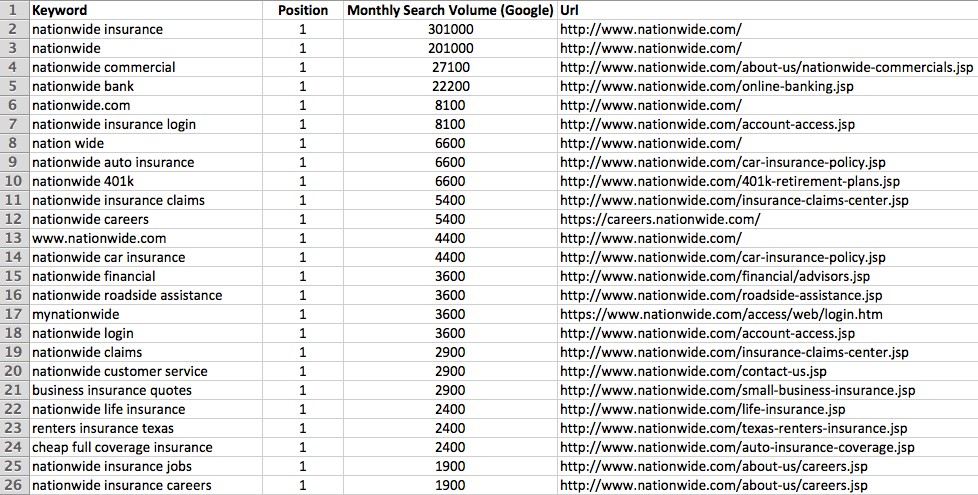
With the U.S. data from SEMrush, I took a sampling of 10,000 keyword phrases among the 200,000 that SEMrush tracks for the insurance company Nationwide (based on desktop computer searches). Of those 10,000, Nationwide has more than 2,400 No. 1 rankings on Google. Here are some examples:

Nation-wide-SEMrush-date

Nationwide’s calls to action likely are effective based on their colors, size, and location in the design:

Nationwide-cheap-car-insurance

So how is Nationwide underachieving? Keyword phrases that could help its bottom line are trapped on the second page of Google results. On an annual basis, the company misses out on a bigger share of millions of potential website visitors for phrases like “cheap car insurance” and “cheap insurance.”

Nationwide-Insurance-auto-cheap

Nationwide does rank well for related keyword phrases that typically aren’t searched as often, including:

Nation-wide-keyword-phrases

5 ways to do SEO the right way

Nationwide and other large businesses should strongly consider taking these five steps to improve their search engine visibility.

  1. Take stock of your stature.

Enterprises have inherent advantages that should be exploited for SEO strategies. Large companies have firmly established websites that contribute to their authority (it’s not uncommon for their domain names to be 30 years old).

Even better, they attract hundreds of thousands and sometimes millions of inbound links from other websites. Many of those sites are credible in their own right. When the company gets an inbound link from them, the website can get a ranking boost from search engines.

The sheer size of a large company website reinforces its value to online searchers. Search engines don’t just recognize the number of pages and files. They factor in the overall source code and website structure, including internal links that point to specific content.

All of those variables – from the website age to inbound links – set the stage for high search engine rankings for large enterprises. They just need to fully optimize their websites to make headway with their search engine presence.

Some marketers argue about the significance of including a keyword phrase in a domain name. I still believe it makes a difference. But 99 of the Fortune 100 websites include only branded keywords. The only exception is HCA, which includes “healthcare” in its domain. Unfortunately, the great domain can’t make up for the website’s SEO shortcomings.

Hospital-Corporation-of-America

  1. Look at the data.

For years, I’ve heard marketers say it’s not worth focusing on search engine rankings because conversions are what matter at the end of the day. Well, you can’t convert a website visitor who doesn’t know your website content exists.

Companies should explore their search engine rankings, website traffic, and conversions, including the response forms they receive and other engagement metrics like phone calls and downloads.

Nearly all of the Fortune 100 websites have at least some kind of home page call to action – some are marginal. UPS is among the worst. A tiny “location” reference isn’t what I expected to see.

UPS-CTA-location

Sure, it gets better on the next page. But the first impression is horrific.

UPS-next-page-better

Sometimes home page text is tough to read, diminishing the value of a call to action. Tesoro should update its design.

Tesoro

Other enterprises like Halliburton don’t waste time. The company features several calls to action that appear quickly but last long enough to trigger interest.

Halliburton-CTA

  1. Size up the challenges.

With SEO and rankings, one of the biggest problems is that too many keyword phrases compete for the same page. It happens all of the time because of the content. Companies like Nationwide could settle for a variety of rankings for any given page.

For example, Nationwide could adjust its content to get more keywords to rank for its popular Cheap Car Insurance Quotes page:

nationwide-cheap-car-insurance-quotes-screenshot

However, when you mess with the content and the SEO page title, some of the high-ranking keywords could be modified and their rankings could fall. If you tinker with an existing page, monitor the impact with rankings and changes in conversions tied to the page.

In other words, be careful as you adapt your content to go after a highly searched keyword phrase. If your site jumps from No. 14 to No. 6, that would be great. The gains might outweigh the impact on another keyword phrase that ranked No. 19 and falls to No. 27. The keyword phrase that was ranking 19th may not have been driving significant leads and sales anyway.

With your data analysis, you always need to look at:

  • Keywords
  • Rankings
  • Website traffic
  • Conversions
  • Content
  1. Create new content

Sometimes it’s best to simply create quality content around preferred keyword phrases that need a ranking boost. Content marketers have many opportunities to produce content. Need some ideas? Check out Content Marketing Institute’s 75 Examples to Spark Your Marketing Creativity, which includes these two successful examples:

  • IBM’s Big Data and Analytics Hub with blogs, videos, podcasts, reports, infographics, and animations
  • Autodesk’s Line//Shape//Desk microsite with everything from client-relations advice and marketing guidance to customer stories and software tricks

Your many new content options to help with SEO include:

  • FAQs
  • How-to guides
  • Articles
  • Case studies
  • Q&As with industry leaders, including your own subject matter experts
  • Industry trends and resources
  • White papers
  • Videos with transcripts
  • Executive briefs
  • Excerpts from e-books
  • Executive summaries from surveys and studies
  • Testimonials

When you publish content, be sure to get the SEO fundamentals in order, such as:

  • Keywords in URL
  • Keywords in the SEO page title
  • Keywords in the visible page header
  • Keywords in the content
  • Links to the content from other related and/or high profile pages on your website
  • Images named with keywords
  • Meta descriptions with calls to action
  • Internal links

When publishing #content, be sure to include keywords, internal links, meta descriptions via @mikeonlinecoach
Click To Tweet


  1. Measure the impact and adjust

If you add new content, then chart your rankings, website traffic, and conversions related to those new content pages. Your new page will rank for other keywords in addition to your focus keyword phrase. Regardless, your goal should be the same: The target keyword phrase should rank higher than it does for older content.

Some Fortune 100 companies struggle because they apparently are satisfied with the website traffic they do receive. Or, they’re not good at noticing problems in the first place.

How does your company diagnose SEO and content marketing efforts? What steps do you take to ensure that your content ranks as high as possible?

Learn more about how to build your content strategically at the Intelligent Content Conference March 7-9 in Las Vegas. Register today.

Cover image by Joseph Kalinowski/Content Marketing Institute

The post Big B2B and B2C Companies: Fix SEO and Content Marketing Strategies [Study] appeared first on Content Marketing Institute.