Tuesday, May 10, 2016

Interactive Content: The Good, Bad, and Wicked Cool

interactive-content

Quick confession: I am addicted to taking BuzzFeed-style online quizzes.

Yes, I know they are designed to artificially inflate the site’s page views and engagement metrics; and I fully realize that the results will likely be vague and unsatisfying. But somehow, I don’t care. In fact, any time a company offers me an opportunity to see a bit of myself reflected in its content, I find myself more drawn to that company, and more willing to explore what else they have to offer.

Isn’t that the exact result all marketers hope for when they create content?

The increased potential for engagement is a compelling reason why marketers should consider adding interactive content – quizzes, assessments, customization tools, games, and other participative features – to their marketing arsenal. But that’s certainly not the only advantage these tech-enhanced content formats can offer.

Let’s take a deeper look at interactive content, how it works, and how it can be used to help you achieve your marketing goals.

Value proposition of interactivity

Interactive content enables users to personalize and participate in the content presented to them. By helping consumers see themselves in the brand’s experience, the technique offers the potential to deepen engagement and drive greater satisfaction.


Interactive #content offers the potential to deepen engagement & drive greater satisfaction via @joderama
Click To Tweet


Common interactive formats: Enterprise marketers who are looking to make a big splash with their audiences can tap into a host of compelling content features, ranging from the simple to the surreal. Here are just some of the most popular interactive formats along with a few suggestions on uses:

  • Calculators and configurators – Frequently used by e-commerce companies and automotive brands, these tools can help your customers estimate and compare the costs of various product features, as well as evaluate the benefits of purchase options they may be considering.
  • Quizzes, polls, and surveys – Use them to test your audience’s knowledge or opinions on a relevant topic and then generate a shareable “report card” so they can compare their results to those of their peers.
  • Multi-touch photos and videos – Giving consumers a 360-degree view of the goods, services, or experiences you offer (think cars, clothing, or resort vacations) helps them virtually try before they buy, making the experience more tangible and potentially leading to greater satisfaction with their purchase decisions.
  • Interactive e-books – If you publish long-form content, such as white papers or research reports, creating a navigable version can help readers locate the most relevant sections more quickly.
  • Live chats, diagnostic tests, and troubleshooting tools – These techniques can be used to enhance online customer service, increase a brand’s ability to respond to customers’ inquiries and issues, and reduce wait times for technical support by phone or in person (more on this in the U-Verse example below).
  • Assessments – Particularly well-suited to moving prospects through complex sales processes, these comprehensive surveys can be used to offer personalized information and benchmarks that your audience can use to track their progress toward a relevant goal.
  • Interactive infographics and data visualizations – Creating an animated, navigable infographic or other dynamic visualization that drills down to stats can help you position the data in a context that will be easier for your audience to understand and internalize.
  • Content wizards and recommendation engines – Acting as an online tour guide to your content library, content wizards use an initial assessment to understand your site visitors’ needs, and then serve up the content that’s most likely to satisfy them.
  • Interactive timelines, heat maps, and map overlays – Authoritative and influential brands can lend their events some added gravitas by placing them in the context of relevant history (like the Art Gallery of New South Wales did)…

…or geography (like Guesty’s Airbnb service map does).

  • Virtual reality and augmented reality overlays – Use these technological advances to take your audience into a world of your brand’s unique creation and enable them to experience life in a way they may never have imagined would be possible. (See the Expedia Dream Adventures example below.)

Interactive examples at every funnel stage

Leveraging high-tech advances like scrolling video or virtual reality can certainly help your brand break through the noise of a crowded content landscape. But “cool factor” aside, interactive content doesn’t have to be flashy or feature-rich to contribute to your top content marketing goals. With a little ingenuity, even the simplest formats can be instrumental in helping you identify and address key consumer pain points, guide consumers through a complex purchase process, or increase sales.

Brand awareness

As I just mentioned, interactive content doesn’t have to be high-tech to contribute to your marketing goals. But it doesn’t hurt to add a little pizzazz when it comes to associating your brand name with the unique, memorable, or even life-changing experiences that you are uniquely qualified to provide.

Example: Expedia and St. Jude’s Hospital’s Dream Adventures

Expedia recognizes just how powerful an impact travel can have on a person’s worldview. Though cancer-stricken children undergoing treatment at St. Jude’s Children’s Research Hospital may not be able to experience the energizing effects of travel firsthand, Expedia has found a way to bring the world to them. As the above film demonstrates, through the use of virtual-reality camera technology, interactive live-streaming, and a specially built screening room, Expedia’s Dream Adventures takes St. Jude’s patients on explorations of places like jungles and exotic seascapes, and helps them transcend their physical limitations by expanding the boundaries of their imagination.

Engagement

Providing key insights and advice that help consumers make more informed decisions always reflects well on a brand’s value proposition. Interactive content formats like augmented-reality apps, 360-degree video tours, and interactive brochures and e-books are ideal for helping your education-hungry prospects to explore available options, select their priorities and preferences, and truly experience what life might be like as one of your satisfied customers.

Example: Tourism Australia 360-degree experience

Tourism Australia
Riffing off its tagline that Australia is a place “you don’t just visit, you feel,” the official website for Australia’s tourism agency has created a series of stunningly realistic 360-degree scrolling videos that simulate an action-packed vacation experience at some of the country’s iconic adventure spots. From swimming with a pod of playful dolphins in Tasmania to snorkeling along the Great Barrier Reef to feeding marsupials on the shores of Kangaroo Island, each video is designed to entice tourists to explore Australia’s exotic shores for themselves – virtually first, and then in person.

HANDPICKED RELATED CONTENT:
How to Measure Engagement the Right Way

Lead generation

With the help of the right copy, a landing page, and a carefully constructed call to action, interactive content can help you draw in leads and prospects, and entice them into forging a more meaningful connection with your brand.

Example: Orbitz’s Perfect Match Quiz

orbitz perfect match quiz

As ion interactive co-founder Scott Brinker describes in his recent Intelligent Content Conference presentation, Orbitz for Business created a quiz that shows business travelers just how compatible they really are (or aren’t) with their travel service provider. Users whose results indicate dissatisfaction are served a message that’s personalized to the pain points they provided and a little encouragement to consider Orbitz as a solution to improve their travel-planning experience.

Lead nurturing

Done well, interactive content can also offer marketers invaluable information about their user base, which can be instrumental when applied to the lead-nurturing process. 

Example: NetProspex Data HealthScan

Netprospex data health scan

NetProspex, a B2B data and contact management company, created a data health scan tool in conjunction with The State of Marketing Data interactive white paper about record completeness. Not only did the white paper achieve a high click-through rate, the assessment (which required registration to access) provided the company’s marketing team with vital information on how each prospect answered each question.

Sales

You may think of interactivity as little more than a fun, attention-grabbing feature that has little impact on a brand’s bottom line. But don’t discount the bottom-of-the-funnel benefits these versatile tools can offer, particularly when it comes to bringing consumers to the last, vital step in their purchase process. Interactive content tools like solution planners, product configurators, and price calculators can help consumers prepare their desired product profile, reconcile any last minute cost considerations they may be struggling with, and even complete their desired transaction with confidence that they have found exactly what they’ve been shopping for.

Example: Target’s House on Hallow Hill

As a seller of seasonal novelties and holiday decor, Target knows a few things about invoking the spooky spirit of Halloween. To inspire and assist consumers’ efforts to deck their own haunted hallways, the retail brand created a mysterious storytelling adventure using an interconnected series of clickable videos.

Each room visitors explore in The House on Hallow Hill displays merchandise Target sells to help party planners set the right mood – such as a skull-themed cantina fiesta or a ghoulishly moonlit graveside gathering. But before “House” guests are allowed to escape, they are invited to click to visit Target’s online Halloween shop where they can browse, select, and purchase the decorations they saw inside.

Retention/loyalty

Even after consumers have converted, you’ll want content to extend their engagement, provide support, and ensure that they are satisfied with their purchase over the long term. Interactive features like diagnostic tools, webinars, and live chats can be instrumental in helping customers learn more about working with the products they’ve purchased, troubleshooting any issues that may arise, and staying connected so they can share the positive experience they have had with your brand.

Example: AT&T U-Verse’s UFix service troubleshooting tool

AT&T U-verse

AT&T U-Verse recognizes the importance of responding to customer-service inquiries quickly and resolving phone, television, or Internet connectivity issues promptly. Its UFix diagnostic system was designed to offer customers on-demand, self-service access (both online and on mobile devices) to some of the same troubleshooting tools its own call-center technicians use. The tool helps the company cut down on wait times by enabling customers to check for local service outages, diagnose the most likely cause of the problem, follow step-by-step instructions for managing simple fixes, and schedule a home visit when on-site support is needed.

What to consider before incorporating interactivity

If interactive content is so versatile, powerful, and immersive, why don’t all content efforts incorporate these techniques?

For starters, interactive features can be more expensive and time-consuming to produce than their static content counterparts. Yet, this isn’t always the case: For example, some interactive elements – like quizzes, polls, or heat maps – can easily be generated with the help of online software tools and templates.

In addition, some of the most innovative or tech-forward interactive techniques may require specialized coding and design expertise to develop and deploy or specific equipment to create and manage – resources that not all marketers have at their disposal. Again, third-party software and services may be able to shoulder some of this burden; so brands looking to “go big or go home” should carefully consider whether it will be best to build or buy the capabilities required.

Then there’s the user side of the equation. Interactive features often have longer load times than simple text or static images do, which can suck up more bandwidth than your audience may wish to devote to your content. Not to mention that some features may need to be optimized for use on a specific browser, device, or platform, which can create a frustrating or disappointing experience for users who are accustomed to accessing content in any way they choose.

And while consumers likely enjoy playing around with interactive bells and whistles from time to time, these content efforts don’t necessarily guarantee increased or sustained interest in your content, let alone improved marketing results. For example, some users may just be looking for a straightforward experience or a specific piece of information. Requiring these consumers to click, swipe, give personal information, or jump through a bunch of hoops to get what they want can have the opposite of the intended effect – driving them away instead if increasing their engagement.

Tips for getting the most out of interactive content

Make sure you have a compelling reason to use interactivity.

Interactivity should enhance the natural appeal and longevity of your message – not serve as a substitute for real substance. If these features won’t give your brand an advantage – like making it more relatable, engaging, useful, memorable, or distinctive – it may not be worth the extra time and expense.


Interactive #content should enhance your message not serve as a substitute for real substance via @joderama
Click To Tweet


HANDPICKED RELATED CONTENT:
Content Marketing: Forget About the 5%

Match the interactive format to its intended function.

When planning to work with interactivity, ask yourself what attributes of your products/services are most useful for helping your customers address their pain points. Then, work backward to select an appropriate interactive format based on how well it suits your message and fits in with your content mission and strategic goals.

Why invent when you can iterate?

Interactive content efforts don’t always have to be built from scratch. Instead, try taking some of your top-performing blog posts, white papers, or images and repurposing them as interactive versions.

Take advantage of interactivity tools.

Third-party software can make these features more cost-effective to create and easier for marketers to manage. For example, Google Maps’ JavaScript API enables users to create custom map overlays and provides step-by-step instructions for doing so.

Consider working with interactive content platform providers.

Not only can they help with the heavy lifting in developing tech-enhanced content, they can also configure to integrate the performance data you gather with your marketing automation systems, CRM tools, or other content management solutions you have implemented.

Plan ahead for how you will measure the impact of your interactive content.

Downloads, social shares, and data generated through Google Analytics (e.g., bounce rates, time spent on page, traffic sources, and conversion rates) can help you set initial performance benchmarks. But for a more fully rounded view of performance, you may want to set up more sophisticated analytics capabilities, like click tracking, engagement scoring, and behavioral tagging.

Conclusion

Interactive content is a powerful, versatile way for marketers to enhance their content’s reach, impact, and performance. But with higher-than-average resource requirements and such a vast array of formats and functionalities to consider, businesses will want to carefully weigh the pros and cons against their content mission and goals before trying to incorporate interactivity into their marketing mix.

Adding interactive content to your content marketing game? Consider adding some other ones from the 2016 Content Marketing Playbook.

Cover image by Joseph Kalinowski/Content Marketing Institute

The post Interactive Content: The Good, Bad, and Wicked Cool appeared first on Content Marketing Institute.

Monday, May 9, 2016

Sharpen Your Content Marketing: 4 Ways to Model the Buyer’s Journey

4 Ways Model Buyer's Journey

The arc of your buyer’s journey is like the arc of a story. Each buyer, each story is unique. There is no one-size-fits-all model of the journey.

But that doesn’t mean you shouldn’t use buyer journey models to optimize your content marketing. The right model for your buyer’s journey adds tremendous clarity and insight to your content marketing strategy.

You can visualize your audience, where they are in the process, what information they might need at that time, and which information advances them to the next level. That means you can deliver relevant content to your prospects when they want it, the way they want it – and isn’t that what every content marketer strives to do?

If you are looking for a buyer’s journey to emulate, here are four models to consider.

1. Easy-to-convince model

Simpler models reflect purchases that require less consideration, such as:

  • Impulse buys driven by reflex or habit
  • Purchases by brand loyalists
  • Buys from one decision-maker

For example, Andrew Davis’ model of the buyer’s journey adapted from McKinsey reflects a cyclical, nonlinear buyer’s journey.

The Client Journey Model

A moment of inspiration leads to a trigger. That trigger may lead to an immediate purchase. If the customer experience is positive, then a loyalty loop may be created – which manifests as a subscription or as repeat purchases.

For easy-to-convince buyers, content marketers succeed by generating moments of inspiration, then reminding buyers of those moments to trigger purchases. For example, Red Bull creates inspiring content on extreme sports so when users see extreme sports, they thirst for Red Bull.

In more complex purchases, triggers lead buyers to add a brand to a small set of sellers they’d be willing to buy from – their considered set. Buyers actively evaluate these sellers and choose one to buy from. Note that 57% of corporate executives reach a decision before they contact sales, according to a survey by the Corporate Executive Board.

What I like about Andrew’s model is that the buyer’s experience from the first purchase clearly informs all future purchases. Many buying journeys are like this: cyclical and repeatable.

2. Before-and-after model

MXM uses a straightforward linear model for its customer journey, which reflects six stages.

MXM Customer Journey

Click to enlarge

This buyer’s journey model adds a layer to represent the buyer’s information needs at each step, including company and product brands, relevant content, influencers, pricing, product, store locators, and so forth.

Carefully considered purchases call for even more rigorous models of the buyer’s journey. When consumers buy a new house, car, or investment plan, most of them put in lots of research, time, and effort. After all, they’re making some of the biggest financial commitments they’ll ever make. They research everything online. They ask their families and friends for opinions at each step.

Yet business buyers may be risking even more – their reputations, jobs, or careers. That’s why the stakes are so high in carefully considered, big-ticket B2B purchases.

This model also adds peripheral vision. It extends beyond the purchase – adding the buyer’s experience and loyalty to the customer journey. That’s important because, when customers have a good user experience, they are far likelier to make repeat purchases. By the same token, bad user experiences may derail future purchases.

3. Circular model

The model from Anthony Christie at Level 3 shows six stages in a B2B customer’s journey. Its cyclical process fits carefully considered, big-ticket sales of products and services purchased repeatedly, for example, telecom services that connect companies to cloud-computing resources.

Level 3 Circular Model

This model emphasizes what employees need to do at each step in the buyer and user journey. I particularly like that the model:

  • Speaks in the simple language of the customer, not in marketing jargon
  • Makes customer expectations clear to employees in sales, marketing, customer service, operations, and accounting – all of whom play key roles in the customer’s journey.

In big-ticket B2B sales, marketers need to supply crucial content to nudge the buying committee forward. To address the differing needs of various committee members, you may need to build separate buyer’s journey models for each key member.

Remember that each member has different priorities, worries, and pressures affecting their decision. For example, the users of the product want maximum performance, IT wants good technical support, and the purchasing team wants the lowest price. It takes different content to satisfy each of these information needs.

That’s why it’s critical to understand the personas of each member on the committee – and be clear about who holds decision power and which content is relevant to each.

When you’re selling to individual decision-makers, your job is easier – since you only need to understand and serve one buyer persona. Determine which information that buyer needs at each step, which media they prefer, and then deliver content accordingly.

4. Consistency model

Consistency in content over time is the path to winning credibility. However, it’s tough to maintain consistency of message in B2B marketing for big-ticket products or services. That’s because a purchasing process may last months or years, especially for things that will be used at least five years – such as infrastructure, process equipment, a headquarters building, laboratory, or manufacturing plant.

Consistent messaging helps get all the members of a large buying committee aligned around your offering. Expect members of the committee to compare notes about what you said when you’re not in the room.

That’s when inconsistency in marketing messages leads to questions and delays. Those questions and delays frequently lead a committee to postpone a purchase decision.

Consistent messages make it far smoother to pass muster in a large buying committee.

Cognitive neuroscientist Dr. Carmen Simon found that when your message stays consistent over time, people’s brains store it in their “place cells.”

Place cells store information about things that don’t move (like your home). Unlike other memory storage in the brain, place cells never run out of capacity. That’s why consistent messages are much more likely to be remembered and believed than inconsistent messages.

If your company uses too many different messages or changes them frequently during a months-long buying process, your brand is less likely to be remembered and believed. That makes it much harder to achieve the trust needed to close a big-ticket sale.


Your brand is less likely to be remembered & believed if you don't have consistent messaging.
Click To Tweet


Here’s a buyer’s journey model I designed to help you keep your message consistent throughout a long buying journey undertaken by a large buying committee.

Buyer's Journey Model

Click to enlarge

This model takes a linear approach. If your business is based on subscriptions or repeat purchases, you can adapt this model to cyclical purchases.

This buyer’s journey includes four layers:

  1. What are buyers trying to accomplish at each step? As they move forward with a purchase, they do four things – recognize needs, evaluate options, resolve concerns, and negotiate contracts.
  1. What are buyers’ behaviors during each step? Buyers ask certain questions or seek confirmation at each step to move forward toward making a deal.
  1. How can marketers nudge buyers forward? Help buyers recognize problems, compare and differentiate solutions, reduce risk, and reinforce their decisions.
  1. Which content marketing tactics do buyers prefer at each step? Deliver your content in the formats that your buyers prefer. Remember, these preferences change during the buying process.

(Note: The tactical preferences in the fourth layer are based on the 2015 Eccolo B2B Technology Content Survey, which applies to big B2B technology purchases).

Conclusion

These four models are designed to help you think through what’s happening in the hearts and minds of buyers as they take each step in the buyer’s journey. By identifying the most helpful model for your buyer journeys, you can create and deliver content that will resonate with your buyers at their particular stage in the decision-making process.

Expand your content marketing journey with CMI’s 2016 Content Marketing Playbook.

Cover image by Negative Space, Unsplash, via pixabay.com

The post Sharpen Your Content Marketing: 4 Ways to Model the Buyer’s Journey appeared first on Content Marketing Institute.

Sunday, May 8, 2016

The Miles Davis Approach to Content Marketing Strategy

miles-davis-approach-content-marketing

If you’ve ever met me or seen any of my photography then you know I have a passion for rock ‘n’ roll. But as every good marketer knows, it’s important to continually expand your horizons. Lately, I’ve been doing that by diving into the genre of classic jazz.

The more I listen to and study jazz, the more parallels I see between sophisticated jazz and great content. Maybe you can compare great jazz with pretty much great anything – but the other day, I was listening to this excellent NPR profile of Miles Davis’ Kind of Blue album, and I kept having aha moments in relation to my own work. See if you can relate.

There are good reasons that Kind of Blue is one of the most influential albums ever recorded, and they don’t all have to do with pure musical talent. The story behind this landmark record and its universal appeal can be broken down into several critical lessons for content marketers.

The following are key lessons for keeping your content marketing strategy more hotsy-totsy than wet blanket.

1. Leadership = Team + Vision

Miles Davis was an international star by age 32, the highest-paid musician of his generation. He arrived at that place for two reasons other than his ability to play a sweet trumpet solo: 1) his ability to spot great talent, and 2) his understanding of where the music industry was and where it could go.

For Kind of Blue, Davis gathered six little-known musicians who would become legends in their own right. Tenor saxophonist John Coltrane’s name today is nearly synonymous with jazz itself. But back in 1959, Coltrane was a virtual unknown. Pianist Bill Evans said in a 1979 interview that no one really understood what Davis saw in Coltrane. “That’s the genius of (Davis’) leadership,” Evans said.

In 1959, Davis was looking for a follow-up to the bebop style of jazz, which had pretty much run its course. He took a cue from his friend George Russell who had been developing a new, simpler form of jazz improvisation. Instead of packing multiple chords into a single measure, “modal” jazz challenged musicians to explore a single chord for 16 measures or more. Davis introduced the cool new sound on Kind of Blue. People lined up to hear it.

Lessons for content marketers:

2. Challenge your players

Davis was known for his love of a good musical puzzle. According to the NPR profile, in 1958, he gave Evans a paper with the symbols for “G minor” and “A augmented.” Using that suggestion, Evans built “a cycle of chords as a meditative framework for Blue in Green,” the central track on Kind of Blue. The Blue in Green track became one of Coltrane’s great modal solos.

“If you put a musician in a place where he has to do something different from what he does all the time,” Davis wrote in his autobiography, “that’s where great art and music happens.” You hear that theory play out in the Kind of Blue album’s initial So What track, where the bass starts with the melody: “dum-de-dum-de-dum-dum.” You’ve heard it a million times, but if you play bass, you’re acutely aware of the implications. An album that starts off with a bass-line melody? That never happens.

Lessons for content marketers:

  • Let your team members take simple directions and run with them.
  • Introduce surprises and deviations from the routine every chance you get.
  • Let your supporting players take the lead sometimes.
  • Don’t let your team (or your customers) get too comfortable.

3. Freedom is the best master

The musicians on Kind of Blue had little idea of what to expect when they walked into the recording studio because Davis called for almost no rehearsal. As Evans noted in the original liner notes, Davis just gave the band sketches of scales and melody lines on which to improvise. The rest was up to them.

The modal structure also allowed for greater freedom in the melody line, so that the artists could express themselves more spontaneously in their solos. As the album proceeds, the players invent novel responses to each other. They take calculated risks without a score to fall back on. You hear them negotiating with each other rather than stifling unexpected ideas.

You are free to do anything, as long as you know where home is. —George Russell

Davis clearly went into the creation of Kind of Blue with the idea that he wanted to capture an element of surprise and spontaneity that he found missing in other recordings. One of the most incredible things about this album is that all the tracks are first takes. They had no practice sessions, and they had no takes. Crazy.

Lessons for content marketers:

  • Put together your dream team, make sure they know where you want them to end up, and then trust them to create great content.
  • Not all content can be improvised, but no idea should be nixed just because it sounds “off” at the time.
  • Spontaneity can be a value in and of itself, offering a freshness and authenticity that is nearly impossible to create with a carefully crafted script.

4. Never stop experimenting

Jazz at its core is about taking chances, risking failure, and, in the process, creating something beautiful that will last for generations. Kind of Blue was an experiment in modal jazz that succeeded beyond all expectations, but that wasn’t the only aspect of experimentation on this album.

Davis was constantly learning from different styles of music, and Kind of Blue demonstrates that proclivity with its range of classical, African rhythms, flamenco, and American gospel. He was a master at making the familiar unique by adding an unexpected twist.

In the track All Blues, Davis plays a standard 4/4 blues in 6/8 time, so the music feels like a waltz. As NPR explained in its feature, “Evans said that was part of Davis’ genius – creating a simple figure that becomes much more. The setting allowed alto saxophonist Cannonball Adderley to return to his big-band roots.”

He combined Cannonball and Bill Evans. That’s far out! —soprano saxophonist Steve Lacey

Lessons for content marketers:

  • Indulge your appetite for learning new things.
  • Know your team members and play to their strengths, but also help them expand their repertoire.
  • Just because an idea is familiar and comforting doesn’t mean you can’t make it better by adding your own special something.

5. Stay cool

Kind of Blue is the epitome of sophisticated jazz, blending “uptown” and “back alley” in a delicate, perfectly balanced sound. But when it was released, the musicians themselves were surprised by the instant recognition it received. To them, it was the result of a couple of great sessions with Davis, and that was plenty.

The secret to the success of this album lies in its simplicity. Music historian Dan Morgenstern remarks on the fact that it contains not a single unnecessary note, “You can keep coming back to it – it doesn’t wear out its welcome.”

The album entered the musical consciousness with the delicacy of a feather, and the power of genius. Soprano saxophonist Steve Lacey remarks, “It was so subtle, it just sorta slipped in. It didn’t’ startle us.” And yet, the whole jazz scene changed overnight.

This music never flaunts its genius. —Stephen Thomas Erlewine

Lessons for content marketers:

  • The simple almost always outperforms the complex.
  • Promotion is important, but success is really about doing your best work.
  • Strive for new and remarkable content, rather than promoting a particular agenda, and people will listen and share it.

#Content promotion is important, but success is about doing your best work says @JasonMillerCA
Click To Tweet


As one of the greatest musical statements of the 20th century, Kind of Blue is the very definition of creativity, spontaneity, improvisation, and experimentation – all the elements of a successful content marketing strategy. Whether or not you’re a jazz enthusiast, it’s worth a listen, just for the content marketing lessons.

With inspiration from Miles Davis, you can create your own content marketing album. Get CMI’s 2016 Content Marketing Playbook to help.

Cover image by Joseph Kalinowski

The post The Miles Davis Approach to Content Marketing Strategy appeared first on Content Marketing Institute.

Saturday, May 7, 2016

This Week in Content Marketing: Red Bull Is Not in the Content Marketing Business

red-bull-content-marketing-podcast

PNR: This Old Marketing with Joe Pulizzi and Robert Rose can be found on both iTunes and Stitcher.

In this episode of This Old Marketing, Robert and I share our thoughts on an article about the future of big media. It’s on life support and needs to make some major changes to survive. Next, we discuss new research that reveals what motivates people to subscribe to publications and wonder why an article that aims to clarify native advertising terminology doesn’t do so. Finally, we agree that marketers can learn a lot from Marriott’s savvy CMO, who has spearheaded a number of brilliant content initiatives for the travel giant. Rants and raves include a bright future for audio content, the diminishing human attention span, and the rise of digital agencies within the world’s largest consulting firms. We wrap up the show with the origin story behind Red Bulletin magazine.

This week’s show

(Recorded live May 2, 2016; Length: 59:55)

Download this week’s PNR This Old Marketing podcast.

If you enjoy our PNR podcasts, we would love if you would rate it, or post a review, on iTunes.

1. Content marketing in the news

  • Your media business will not be saved (5:12): According to Joshua Topolsky, founder of The Verge, big media is in big trouble. Faced with the democratization of publishing and wave after wave of digital innovation, it has responded the only way it knows how: Trying to reach ever-larger audiences and then attempting to monetize them as much as possible, often using clickbait. Topolsky says the solution is high-quality content delivered consistently to a well-defined audience. Robert and I agree that media and marketers need to focus much more on quality and much less on quantity. We need to stop glorifying busy-ness as an end unto itself.
HANDPICKED RELATED CONTENT:
You Are Publishing Too Much (and Failing)
  • Digital subscriptions driven by customer perception of exclusivity (14:24): What do customers want from digital publications? New research from Publishing Executive and MarketingSherpa sheds light on what motivates them to subscribe. Robert and I focus on one curious finding from this study: The more a publication’s point of view aligns with our worldview, the less likely we are to subscribe to it. Our interpretation? We want to be challenged in our thinking.
  • Native advertising definitions continue to confuse (22:14): Many people use the terms native advertising, branded content, brand journalism, and sponsored content interchangeably, which causes a lot of confusion. This article from MediaPost cites a set of definitions from Joe Lazauskas, editor in chief of Contently, to help readers make sense of this confusing lexicon. But it does nothing to clarify it. Robert and I dislike the way Lazauskas equates native advertising with content marketing. Here’s Roberts’ take on the lexicon of digital marketing.

  • Metrics meet magic – How Marriott CMO Karin Timpone reaches next-gen travelers through incredible content (30:19): In this fascinating interview on the Contently blog, Marriott’s CMO explains how the travel giant is using content to drive ROI. She also provides insights into its world-renowned media operation. I love the way in which Timpone explains how Marriott focuses on its most valuable customers, and how it has made the connection between increasing customer engagement and profitable behavior. Any CMO who wants to justify content marketing will benefit from reading this interview.
HANDPICKED RELATED CONTENT:
The Secret to Content Marketing ROI

2. Sponsor (34:38)

  • Marketo: No matter what rumors you’ve heard – email is not dead! It continues to be a top-performing marketing channel – as long as you stand out. Check out Marketo’s Highly Effective Email Marketing Lookbook to get inspired with nine new email types to stay front and center with clever, catchy, and bold content. Download the Lookbook here: http://cmi.media/pnr129

marketo-highly-effective-email

3. Rants and raves (36:40)

  • Joe’s rave: I love Edison Research’s latest Share of Ear study, which shows that 20% of audio is consumed on smartphones; 34% of survey respondents said they listen to some audio content on their mobile devices at least once per day. But only 7% of that content is podcasts. I believe this points to a huge upside potential for podcasts and other forms of audio content. I’m already seeing this in the year-over-year growth in the number of downloads of the audio versions of my books.
  • Robert’s rant and rave: Robert is peeved about an infographic that perpetuates the myth that the average human attention span is shorter than that of a goldfish – 8 seconds. He checked the research and learned that it refers to the amount of time spent on the home page of a website. He believes this time span has diminished because people have become numb to bad content.

attention-span-infographic

Click to enlarge

  • Robert likes a Forbes article that describes how consulting firms like Deloitte, Accenture, KPMG, and PwC have become a dominant force on Madison Avenue. Tech companies like IBM are also forming their own digital agencies via acquisition. Talk about a quiet revolution!

4. This Old Marketing example of the week (47:51)

  • Red Bulletin: I recently had an opportunity to hear Robert Sperl, editorial director of Red Bull’s magazine, explain its origin story. In 2005, Red Bull was a major sponsor of Formula One racing. The company wanted to deliver a printed race guide with the results of each race immediately after the event. Prior to each race, they gathered inside stories about the drivers and fun facts about the history of each race and assembled and pre-printed the bulk of each magazine ahead of time. They brought a Heidelberg press to the track. As soon as the race was over, they quickly printed the results and distributed the magazines containing them to attendees as they were leaving the race – an astounding feat. In 2007, Red Bull decided to evolve this publication into a men’s lifestyle magazine. They launched Red Bulletin in five countries, with 70% international content and 30% content localized to each region. Today, Red Bulletin magazine is published in five languages and is distributed in 10 countries. It prints and distributes 2.3 million copies of the magazine each month, including mailing it to 550,000 paid subscribers. Red Bulletin is an excellent example of This Old Marketing.

The_Red_Bulletin

Image source

For a full list of PNR archives, go to the main This Old Marketing page.

Cover image by Joseph Kalinowski/Content Marketing Institute

How do I subscribe?

itunes logostitcher logo

The post This Week in Content Marketing: Red Bull Is Not in the Content Marketing Business appeared first on Content Marketing Institute.

Friday, May 6, 2016

The Audience Takes Charge

audience-takes-charge-cco

“Ad blocking is not something we control; it’s something the consumer controls.”

Mike Donahue, ad agency veteran and former executive vice president of the American Association of Advertising Agencies is talking to a roomful of leading marketers at the Wharton School of Business.

“If we don’t start to change this business,” Donahue continues. Then he pauses for a moment and takes a different tack. “If you don’t like change, you’ll like irrelevance a lot less,” he concludes.

Ad blocking is just one sign of the recent popular rebellion against advertising. Such signs suggest irrelevance is where much of the ad business has been headed for the past 20 years.

Donahue was one of many industry leaders expressing deep concern at the recent annual meeting of Wharton’s Future of Advertising Program, whose global advisory board includes academics, agency executives, clients, experts from the major digital platforms (like Google and Facebook) and others. The program is one of the country’s most important forums for marketing thinking.

Blocking ads is the most visible and (to the industry) most terrifying symptom of the powerful phenomenon at the heart of the Internet: audience control. The Internet has exploded across the globe primarily because it gives audiences unprecedented and irreversible control to choose the media they will consume – how, when, from whom, and in whatever form they wish.

The Internet has thoroughly revolutionized the media business. Now it’s doing the same to everything else, giving people more control over their cars, homes, offices, refrigerators, thermostats, and so on. Such control is the addictive gift the Internet gives.

An embarrassment of audience antagonism

Audience control has created a uniquely embarrassing moment for adland. The audience (formerly known as “consumers” or “users”) has a stunning set of digital ad-avoidance tools that includes DVRs, streaming audio and video, news-aggregation widgets, ad blockers, browser extensions that disable the ad industry’s privacy-invading, data-gathering trackers, and lots more.

This puts advertising in the same boat as “real” media companies – entertainment and news outfits like NBC Universal, Disney, Netflix, The New York Times, Def Jam, Random House, and so on. If you don’t create stuff that really matters to people – stuff they actually want to see and hear – you will be ignored, avoided, and blocked.


If you don’t create stuff that matters to people, you will be ignored, avoided, & blocked via @KirkCheyfitz
Click To Tweet


It was not until late last summer, with the steady rise of ad-blocking software, that the ad business was finally forced to admit it had a problem.

Digital advertising’s trade group – the Interactive Advertising Bureau – first blamed everyone but the ad business, declaring ad-blocking “highway robbery.” In adland’s self-deluding narrative, “consumers” signed an unwritten, perpetual contract in the 1950s requiring everyone to tolerate annoying, interruptive ads in exchange for free content. The audience, however, can’t recall having made such a stupid deal. The IAB soon turned tail, declaring the ad industry had “messed up” by ignoring the audience’s needs and desires. The confession sounded hollow, frankly. (If you’re curious, judge it for yourself.) IAB chief Randall Rothenberg recently doubled down on IAB’s hubristic message, accusing ad blockers of trying to “constrict … freedom of speech.”

Waking up decades after the alarm goes off

There is, of course, no excuse for this mess. A hint to the audience’s insurrection actually arrived some 17 years ago with the Cluetrain Manifesto, a declaration of the sweeping social and commercial revolution the web was spawning. Cluetrain’s authors thought they were stating the obvious, but their manifesto and subsequent book created a sensation.

The-Cluetrain-Manifesto-bookcover

Image source

The manifesto set forth 95 theses – new rules of digital media and the new audiences being collected by the Internet.

Thesis 74: “We are immune to advertising. Just forget it.”

Thesis 75: “If you want us to talk to you, tell us something. Make it something interesting for  a change.”

This was one of the first of an uncountable number of warnings issued over time to the media industry, including the ad business.

It was 2001 when Yoram Wind, a globally known marketing expert, first wrote about the rise of “empowered and skeptical” audiences online. Wind, known to everyone as Jerry, is the senior Wharton professor and consultant to industry who founded and leads the Wharton Future of Advertising Program.

Wind sees ad blocking as the audience’s reasonable response to “dumb, destructive ads that are meaningless.” He believes the industry must welcome ad blockers and try to make them smarter so audiences can still choose to see marketing messages that meet their personal interests. He has a low opinion of one industry response, which has been to encourage technology that defeats ad blocking so people can be forced to see ads. “The thing they want to avoid doing is trying to block the ad blockers,” Wind says. “It’s the dumbest thing they can do.”

The rest of the media business has been struggling longer to cope with the consequences of advancing audience control. Half the newspaper business has disappeared because the audience learned to curate its own news online. The music business failed to sell music in the form the audience wanted; digital streaming took over by allowing people to compile personalized playlists, one song at a time.

The wake-up calls keep arriving. But the backers of traditional ad-supported TV, the lifeblood of the old ad industry, seem to remain holdouts, firmly believing TV spots are largely immune to the consequences of audience control. They remind me of climate-change deniers on a hot winter day.

During a keynoter at CES, NBCUniversal CEO Steve Burke called advertising without TV spots “unthinkable,” Advertising Age reports. Burke added, “People are going to want to watch great television on a great television set.” Yes, Steve, but that doesn’t mean they’ll much longer tolerate having the great experience continually interrupted by Viagra, Geico, and even stupider advertisers.

The latest news is that ad-supported TV and arbitrary bundles of paid programming on cable are under heavy assault from the web. To make up for falling ratings and rates, both cable and broadcast increased ad time per hour. Now the audience is forcing a retreat to fewer ads. The revolution is being led by Netflix, Amazon, and the like, all of which give people what they want: Complete control. No interruptions. No stupid TV spots. No ads at all, in fact.

Hey, kids, what time is it?

The news media business got theirs. Then the music business; the book business. Now it’s advertising’s turn.

This is not a positioning, messaging, or PR problem. This is a fundamental product problem. Translated into the language of advertising, “The consumers are rejecting our products.”

As everyone with any sense is saying, the time is past due to put the audience first. That may sound easy; it isn’t. It means that it’s far more important to find out what really matters to the audience than it is to ask a client what message it wants to deliver. Ad blockers exist because too many clients and agencies want to deliver too many messages that don’t matter to a single real person.

If you want to serve your clients, you must be a ferocious advocate for their audiences.

The Internet uncorked the genie of audience control. It is never going back in the bottle. It’s time to deliver really valuable experiences to “empowered and skeptical” audiences. It’s time for compelling stories, honest information, standing for something more than the next sale and being something more than a series of product claims.

Welcome, as I always say these days, to the Post-Advertising Age.

Perspectives from industry

As ad-blocking grows, how will brands get their messages seen and heard? Some industry experts share their thoughts:

Adam Penenberg, leading tech journalist; professor of journalism at New York University; and author of numerous books, including Viral Loop: From Facebook to Twitter, How Today’s Smartest Businesses Grow Themselves:

“The use of ad blockers has more than tripled over the past three years to 181 million users today and the growth rate is torrential. Think about it. People hate ads so much they’re willing to go to the trouble of downloading a chunk of software just so they can escape them. That’s a bad position to be in.

“Here’s a thought: Don’t hijack my screen (desktop, mobile, and otherwise) with unwanted come-ons in windows that require the dexterity of a mohel or a diamond cutter to close. It’s lazy and you’re just engendering ill will. The trick is to give me something I want or might like. Don’t rely on lazy ad banners and inane TV spots. Add value to my life. Tell me something I should know or would enjoy hearing about. In exchange I’ll grant you my interest – until you get boring or ask me for money like a subway panhandler. If you publish an article that is like real journalism, warts and all, that reveals something intriguing about the world, I might even buy your thingamajig.

“Either that or pay me. My time and attention have value.”


Don’t rely on lazy ad banners and inane TV spots. Add value to my life says @Penenberg #contentmarketing
Click To Tweet


Rob Rasmussen, independent creative consultant; former chief creative officer, Story Worldwide; and creator of the legendary Beta-7 digital campaign for Sega (named “non-TV campaign of the decade” in The Book of Tens):

“The answer is simple: stop behaving like a used-car salesman. Even if ads were not blocked, they tend to fall on deaf ears. It is all about attraction versus persuasion. Know thyself and act accordingly. In doing so your brand becomes the message and you will develop a fervent fan base that will eagerly seek out your goods and services. Those fans themselves become your ads and tell everyone they know.”

Benjamin Crook, marketing director for Unilever (USA) at The Baking, Cooking and Spreads Company:

“First, you need a powerful insight into a core part of your audiences’ lives – a struggle, a joy, or a fear. Next, you must portray it so vividly and truthfully that people see themselves in the portrayal and react emotionally. That strong emotional tension needs a fix or release. And this is the most important part: deliver the solution in a way that is interesting, useful and timely.

“Traditional ways of talking at consumers are no longer useful; they are intrusive. Brands must now play a key role in people’s lives to help resolve their deeply felt needs at critical moments – when the tension is most in need of resolution. Brands must be both relevant and timely to build a relationship and ultimately brand affinity.”


Brands must be relevant & timely to build a relationship & ultimately brand affinity via @BenCrook
Click To Tweet


Joseph Plummer, senior figure in advertising research; adjunct professor of marketing, Columbia University; and former chief research officer, Advertising Research Foundation:

“My concern long-term is more with what I call ‘mental ad blocking.’ This comes from the continual dependence by marketers and their agencies on a mental model of advertising called ‘interrupt and repeat.’ This was the model that emerged with the rise of paid advertising in mass media, particularly radio and television in the 20th century.

“The cluttered, interrupting nature of this model, both online and offline, together with the poor quality of most ads, pushes consumers into ‘mental ad blocking.’ I worry this can lead to a loss of respect and trust for brands across all possible platforms.

“I am encouraged that more and more brands are adopting a mental model of ‘engagement,’ which respects the customer, is open to two-way dialogue and understands the creative interaction of content and context. This has led to three new ways to think about advertising in the 21st century:

  1. Advertising as a service. Brand communication that helps customers solve problems, improve their daily lives, help others improve their lives and learn new things is being used more and more because it has goals beyond exposure and transaction only.
  1. Storytelling. Topics and experiences that matter to customers are integrated (or connected) in the brand stories in meaningful ways.
  1. Advertising on demand. Some brands are recognizing that exceptional advertisements are valued due to their helpfulness or entertainment value. In this new approach, consumers are actively looking for or sharing with others ads they value. They are engaging with valued ads when they want to for their purposes.”

Disclosure: Cheyfitz is a member of the Global Advisory Board of Wharton’s Future of Advertising Program.

This article originally appeared in the April issue of Chief Content Officer. Sign up to receive your free subscription to our bimonthly print magazine.

Cover image by Joseph Kalinowski/Content Marketing Institute

The post The Audience Takes Charge appeared first on Content Marketing Institute.

Thursday, May 5, 2016

From 2 Hours to 2 Minutes: How This CMI Duo Blew Away a Tedious, Unscalable Content Task

cmi-duo-unscalable-content-task

If you’re looking for smarter ways to use content technology in your marketing, I hope that this story inspires you as it has me. It’s about two of my colleagues at the Content Marketing Institute – IT Director Dave Anthony and E-media Manager Laura Kozak – who put heads together to automate a tedious, unscalable website task, saving Laura time and improving the experience for the CMI audience.

The story in a nutshell

Here’s the short version of the story. Dave and Laura figured out how to automate a task that had been getting more and more painful to do manually. Every other month, when a new edition of CMI’s magazine, Chief Content Officer (CCO), came out, Laura would drop everything and spend nearly two hours updating the CMI website.

As part of the running conversation Laura and Dave had for a couple of years about automation opportunities, they took on the challenge to streamline the CCO updating process. Her bimonthly effort now takes two minutes.

What excites me about this story

Before I go into what Laura and Dave did, I want to tell you what makes this story exciting. Its value goes beyond saving a couple of hours every other month. Dave puts it this way:

This project is about more than a specific pain point. It’s the outcome of a mindset.

That mindset is an intelligent content mindset. (In fact, it was at the Intelligent Content Conference that Dave told me this story.)

Since joining the CMI team over a year ago, after working as a technical writer for over two decades, I’ve been looking for marketing stories involving intelligent content – the back end of content strategy. Most intelligent content examples come from technical-communication departments (documentation, support, and training). Those examples, however worthy of attention, don’t resonate with marketers. Marketers need stories that they can map onto to their own goals, processes, and tools.

Dave and Laura’s story comes straight out of content marketing.

Their implementation details look nothing like the DITA/XML details I’m familiar with from my tech-com experiences, but the underlying principle remains the same: When you put computers to use doing what they do best, you free up people to do what they do best.


When you put computers to use doing what they do best, you free up people says @marciarjohnston #intelcontent
Click To Tweet


The bottom-line impact in this case is small. In itself, the time Laura saves every two months isn’t exciting. (Well, it is exciting to her and Dave. “Dave saved me,” she says – to which he replies, “Laura’s the real hero. I’m just pushing buttons until cool things come out.”) What’s exciting for the rest of us is the promise that automation holds for streamlining our own content processes.

OK, now for the story. Read on to find out what Laura used to do, what she does now, and how Dave applied intelligent content principles – with a little help from WordPress and some PHP scripting – to practically eliminate her task.

The old (manual) method

“The old way was such a drain on my time,” Laura says. Every time a new edition of CCO came out, she went into the WordPress administrator interface and updated three CMI web pages. Under the circumstances, she was making the updates in the most efficient way possible. The task typically took almost two hours.

Here’s what she used to do.

  1. She opened the CMI home page and swapped in Version 1 of the new CCO cover: tilted, on top of a stack.

Home

“I didn’t mind swapping in this image,” Laura says. The home page’s unique setup made this edit trickier than it would have been on a simple HTML page, but this step in itself didn’t take her long or cause her much pain.

  1. She opened the CCO summary page and swapped in Version 2 of the new cover (no tilt, no stack) and, in two places, updated the link to the new edition.

CCO_Summary

Like the home page, this page (a simple HTML page) took little time to edit. “It was just one more thing on my list,” Laura says.

  1. She opened the CCO archives page and added the latest cover to the prime spot – top left.

CCO_Archives

This was the painful step, the step that prompted Laura to turn to Dave in the first place. Before she could add the new cover, she had to bump down snake-style all the other covers. One. At. A. Time. (If you’ve ever edited HTML tables, you know that they were not designed for efficiency.) She started at the bottom and worked her way up, cutting and pasting the covers from one cell to the next, one cell to the next, one cell to the next. Here’s how she describes this effort:

On a good day, if I did everything perfectly with no distractions, this table took me a half hour. Usually it took more like an hour because I messed up. I pasted something too far down or lost track of where I was and had to start over. It was a nightmare.

And the nightmare grew less and less endurable as the number of covers steadily increased.

To make matters worse, Laura could do none of these three steps ahead of time. Either she dropped everything else to make the updates on publication day or she handled the chore belatedly.

The new (automated) method

Today, thanks to Laura and Dave’s collaboration, whenever a new CCO edition is ready to publish, Laura has to enter only a few bits of information – on one screen, at her convenience. No need to edit multiple web pages. No need to cut and paste. No need to drop everything else on the day of publication. What used to take her up to two hours to accomplish now takes her two minutes.

Here’s the new method:

  1. Laura opens a blank CCO Edition “post” and fills in the year, month, and URL of the new edition. (This is not a blog post but a custom post type that Dave created in WordPress for this purpose, as described under “A geeky peek,” below.)
  1. She sets the “schedule for” date.
  1. She uploads the new cover – one image file – and selects it as the “featured image.”

CCO_EditionPost

Click to enlarge

All information to update the website for this CCO edition is now in one place. In other words, when Laura saves each new edition’s post, that behind-the-scenes post becomes the single source for all the data needed for that update.

When the go-live date arrives, WordPress pulls the information from this behind-the-scenes post into all three user-facing web pages – CMI home page, CCO summary page, and CCO archives page – automatically.

The tilted, stacked cover on the home page no longer needs a separate image. “The background is the fanned stack, and the feature image is laid on top and rotated to fit,” Dave says. “VoilĂ  – no more fanned image!”

This data “also stages the specific CCO editions to be surfaced in ‘related content’ areas of the site,” Dave says. “That’s one of the superpowers of intelligent content.”

A geeky peek

Dave likes the challenge of fully understanding a problem that technology could solve and then figuring out how to solve it. Here’s how Laura describes his approach:

Dave’s good at taking a step back and looking at the larger process. He takes my requests and one-ups them. He gives me solutions I hadn’t even dreamed of. I ask for a, and he gives me a, b, c, and d.

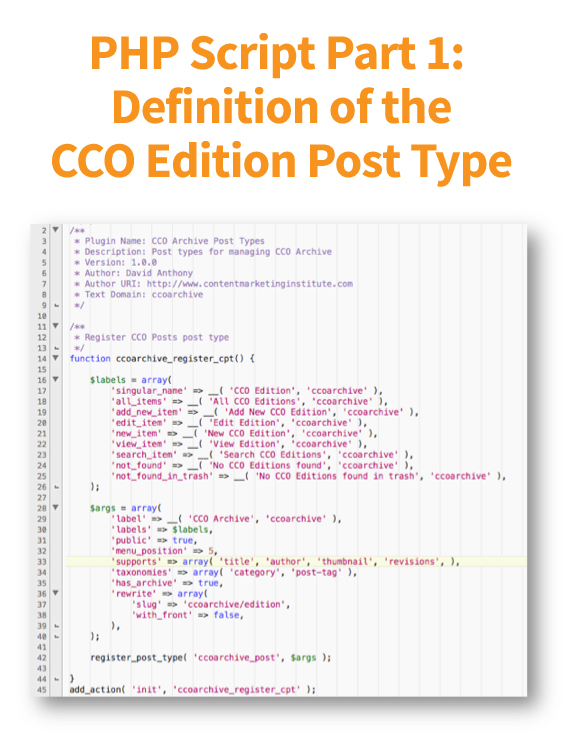
The way that Dave delivered that “a, b, c, and d” was through a PHP script that created two things:

  • A custom post type
  • A layout loop

You can see the full PHP script in black-and-white TXT form here. You can see the two relevant parts separately, in color, below.

About the custom post type

WordPress comes with a set of what it calls post types, including blog posts, pages, attachments, and a few others. (It would be more accurate and less confusing to call post types “content types” since only one of the default post types is technically a post – as in blog post. The misnomer “post type” harks back to WordPress’s origins as a simple blogging platform.)

Anyone can create a custom post type. The CCO Edition post type that Dave created for Laura enables her to simply fill in some data in a few fields (as shown above) instead of updating three HTML pages manually each time a new CCO edition comes out.

Dave defined this custom post type in the first part of his PHP script:

PHP1

Click to enlarge

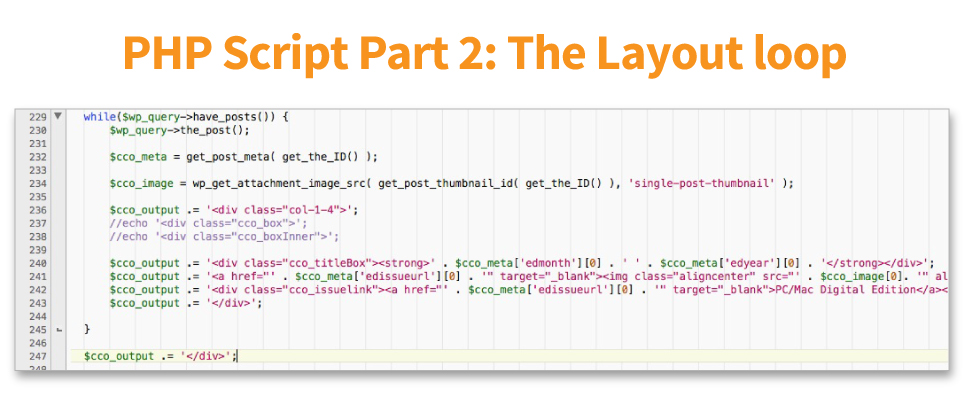
About the layout loop

The second part of the PHP script constitutes the layout loop – a dozen or so lines of code that enable WordPress to lay out the magazine covers on the CCO archives page automatically.

PHP2

Click to enlarge

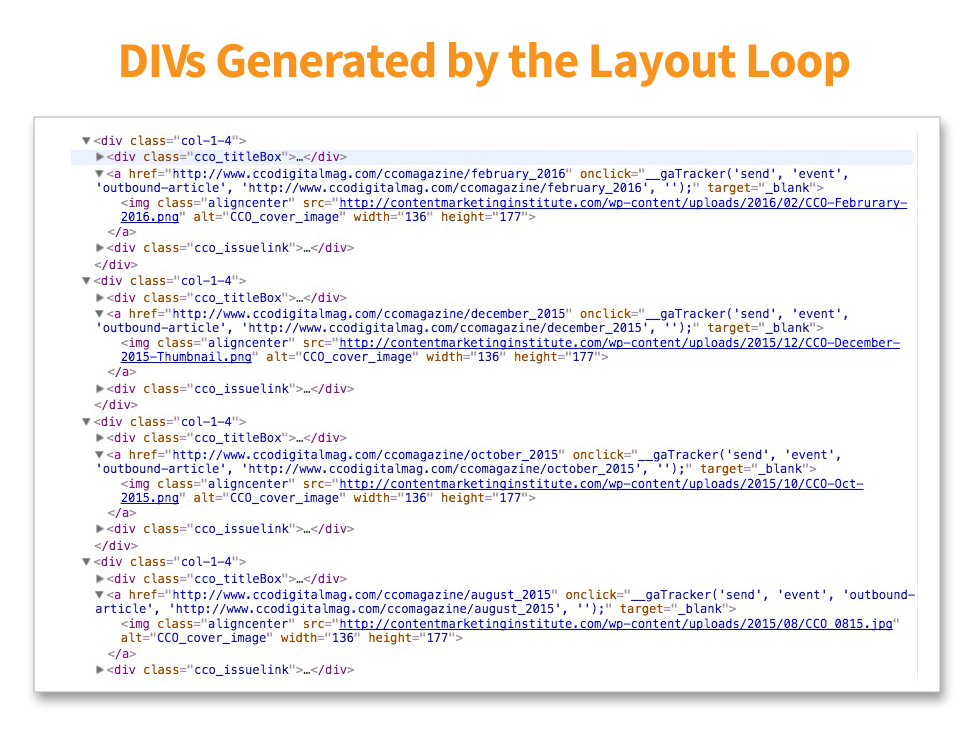
The layout loop generates fresh HTML code whenever someone visits the CCO archives page. Well, not every time. People occasionally see a cached version of the page. You get the idea, though: The page is now created on the fly. The old static table with its four cells per row has been replaced by a dynamic set of DIVs, shown below.

Divs

Click to enlarge

For Laura, this approach means no more cutting and pasting; the layout loop does all the work.

Users get a better experience, too. Unlike the old table rows, which always displayed four covers in a row no matter how squished they might get, the DIVs display either four covers in a row or one cover at a time – depending on the size of the browser window or the screen – thanks to the responsive-design instructions Dave added to the cascading style sheet.

covers

Conclusion

Dave and Laura’s collaboration reduced her bimonthly CCO-updating effort by something like 98%, essentially blowing away the task. If you read this whole article, you know how they did it. You also know that, as often happens with intelligent content approaches, users ended up with a better experience as well.

What are your own versions of Laura’s CCO update? What time-sucking manual tasks keep you from doing what your business most needs from you?  What sympathetic IT colleague might help you automate those tasks, freeing you up to do more creative work?

I hope that Laura and Dave’s story inspires you to explore these questions. As you do, you may find yourself in the happy position of having to answer this question: What will you and your content team do for your organization with your new-found time?

Want to boost your content marketing strategy skills or knowledge? Sign up for our Content Strategy for Marketers weekly email newsletter, which features exclusive insights from CMI’s chief strategy officer, Robert Rose. If you’re like many other marketers we meet, you’ll come to look forward to his thoughts every Saturday.

Cover image by Joseph Kalinowski/Content Marketing Institute

The post From 2 Hours to 2 Minutes: How This CMI Duo Blew Away a Tedious, Unscalable Content Task appeared first on Content Marketing Institute.