Wednesday, July 6, 2016

How to Measure Performance to Improve Your Content Marketing

Performance-Improve-Content-Marketing

As organizations toy with various models to create and distribute content effectively, two questions commonly arise:

  • How do we know which type of content is the right content for our audience?
  • How can we determine the success of this content?

If you are struggling to generate an effective content marketing plan, one that uses measurement and analytics to drive optimization and conversion, you are not alone.

In this article, you’ll learn:

  • Why measurement planning is important
  • A two-pronged approach to measure the impact of your content marketing
  • Simple scenarios that illustrate this plan

Why measurement?

Measuring the performance of content helps maximize sales leads, conversions, and return on investment. Integrating measurement into your content marketing strategy seems like an easy win. After all, measurement allows you to:


Measuring #content performance maximizes sales leads, conversions, & #ROI says @patrickadgarvey
Click To Tweet


  • Understand how individual assets are performing
  • Learn which pieces of content naturally relate to one another
  • Test and validate where content should be placed in the buyer’s journey
  • Determine which metrics gauge the most accurate performance of content
  • Understand all possible paths to ROI/conversion to inform future content marketing plans

While knowing the benefits of a measurement plan is important, the power of optimization is realized in its approach.

Two-pronged measurement

To effectively create and deliver content, you need to design a plan that generates visibility into how content types perform within specific segments, channels, and positions in the buyer’s journey. We have chosen to break this plan into two parts.

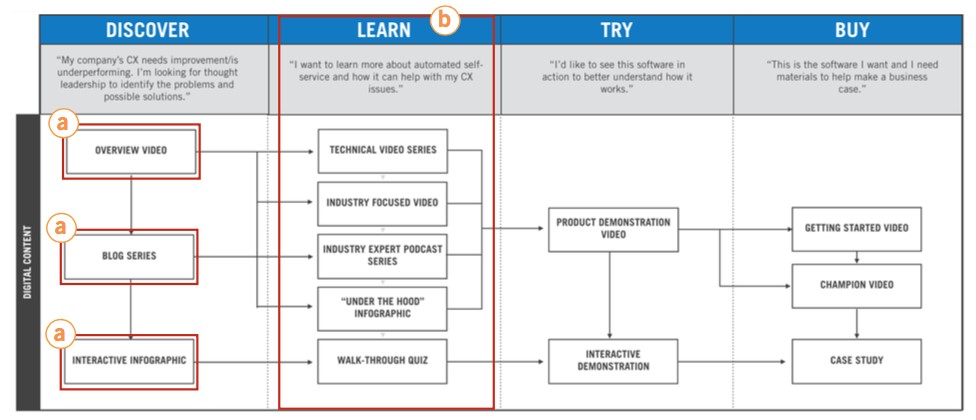
First, determine the most relevant metrics for each piece of content, establish benchmarks/goals, and continuously measure performance against these marks — this allows you to understand the impact of each asset (as shown in “a”).

You also should look at your aggregate assets in each phase of the buyer’s journey (as shown in “b”). This data helps identify a return on your efforts by journey phase.
Aggregate-Assets-Buyer's-Journey

Click to enlarge

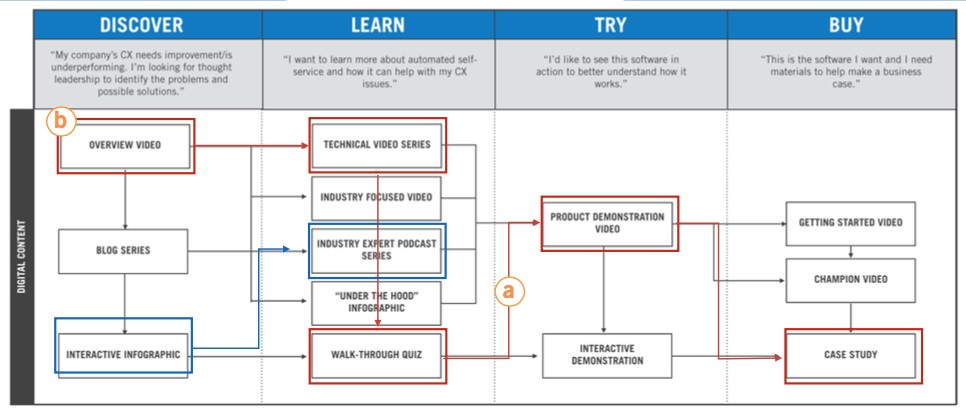
Second, understand an asset’s impact on conversion. Measure whether a specific piece of content leads audiences to the next phase of the buyer’s journey — the journey oath analysis (as shown in label “a” in the chart below).

While blind spots always exist in this analysis, creating a baseline understanding of how users progress from one asset to another helps you determine which content might align best with the buyer’s journey.

Another important type of conversion impact understanding is entry point analysis, (label “b” in chart below), which helps you understand which first touch is the most promising.

In the example shown, the majority of traffic is sent to the interactive infographic, but that does not necessarily mean the infographic is the most valuable first touch in driving conversion. It may play out that the overview video produces the highest number of people that complete the journey.

These two types of analyses help you measure journey progression, and will allow you to deliver content in a way that generates the largest number of quality leads that your sales team can then effectively nurture and convert.
Entry-Point-Analysis

Click to enlarge

Measuring individual assets and journey progression creates a window into the overall effectiveness of your content marketing programs. These analyses set the basis needed to monitor and manage each segment’s performance, and allow you to support/drive your decision-making process. To help illustrate what I mean, let’s review a few simple scenarios.

Simple scenarios

In this sample content map, arrowed lines represent possible user paths based on planning and assumptions.

Sample-Content-Map

Click to enlarge

In the discovery phase, measurement of the overview video typically would focus on traffic and engagement. Common metrics of an overview video to measure traffic would be impressions, clicks, and click-through rate. Measuring engagement would involve play rate, watch time, and inbound links.

However, these metrics are nearly meaningless without a benchmark or goal. To establish a goal, use an existing benchmark as a starting point. If you do not have a benchmark, make an estimate and make this a benchmarking moment. Conduct ongoing measurement to evaluate performance against your goals and benchmarks.

I should note that not all metrics for an asset have to be the same even if they are the same type of content (i.e., videos). You may find different metrics help evaluate success better than others, across different channels.

For each asset in the content map, you should define metrics that allow you to gauge its own performance as well as how well it drives customers to the next phase of the buyer’s journey.

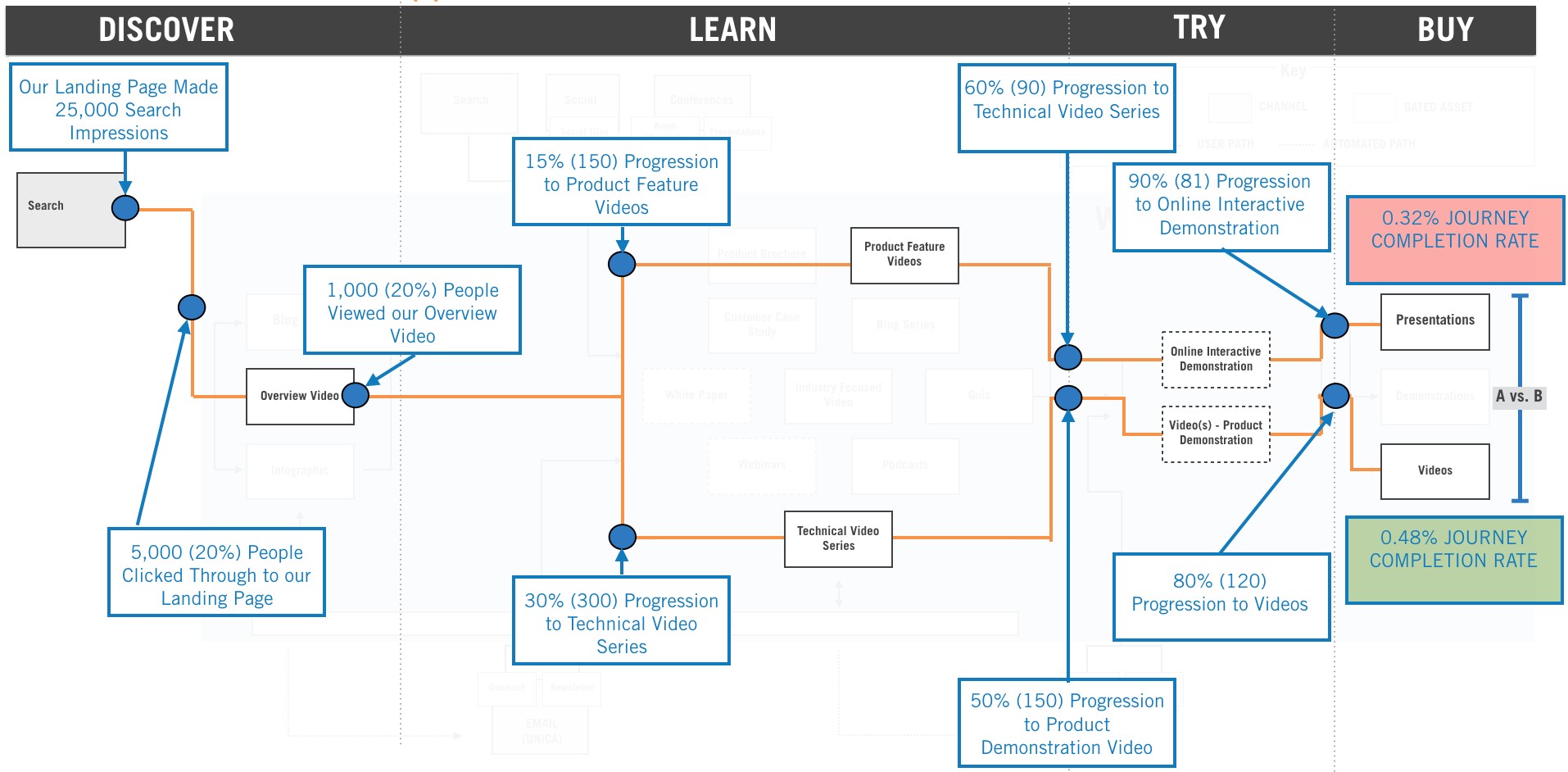
In the close-up version of the sample content map below, you can see which paths provide the greatest performance and customer conversion. With this knowledge, you can drive a larger portion of a target segment through the most desirable path.

In this case, video viewers in the buy stage have a higher journey completion rate than the presentation viewers. With this knowledge, the content marketing strategy should be updated to funnel a larger number of people to the video series to drive an even higher conversion rate, increasing the ROI.

This example shows how content measurement can drive content marketing decisions.
Content-Measurement

Click to enlarge

Conclusion

By integrating a measurement strategy into your content marketing efforts, you generate visibility through data to help facilitate content delivery in a way that generates the largest number of high-quality leads and empowers your sales team to effectively nurture them.

Ultimately, data will arm you with power — power to make and confirm the necessary marketing decisions, and power to take advantage of market opportunities before your competitors even notice them.

Want to continually improve your content marketing programs? Sign up for the daily or weekly email from CMI that includes tips, insights, and trends to help you grow your success.

Cover image by cohdra, Morguefile.com, via pixabay.com

The post How to Measure Performance to Improve Your Content Marketing appeared first on Content Marketing Institute.

Tuesday, July 5, 2016

9 Mistakes You Might Be Making With Your Content Marketing Strategy

mistakes-content-marketing-strategy

Content marketing is one of the most effective marketing strategies available today. All you need is to write a few thousand-word articles several times a week, produce masterful, in-depth, search-engine-optimized, intensely visual, user-focused content, and unleash it with the grace of an industry maven and the power of a market leader.

Easy peasy.

If only.

Content marketing is the modus operandi for modern digital marketers, but doing it right is no easy feat. And the future is challenging.

But there’s hope.

As I’ve executed content marketing over the past few years, I’ve spotted a few common and easy-to-make mistakes that many marketers make. If you can nip these mistakes in the bud or make some improvements, you’ll be a force to contend with in the wild world of content marketing.

Mistake 1: Your content isn’t great

No matter when your content is published or who you are writing for, poor content is not going to be well received.

If you are lucky, Google will simply sandbox the page or bury it on Page 49 of the search results. In all honesty, having no one read your poor copy is better than having someone read it and share it for the sake of making fun of it.

In the event that your content is read, your reader isn’t going to get much use out of it. A reader who has to battle through spelling or grammar errors is going to focus more on those problems than on your overall message. Even worse, this person isn’t likely to subscribe to your email list or your online services, or choose to buy any of your products.

I understand the problem. I really do. You hear about content marketing. You decide to do it. But pressed for time and pressured for results, you simply churn out a few blog posts, hoping that it will work.

But it usually doesn’t work — at least not with the results you wanted. Instead of gaining traffic, you simply have a spent budget, tired marketers, and a disappointed executive glaring at you.

Better content will get results.

How do you improve your content? A few things should be obvious — consistent style, no typos, images, etc. But, here’s a quick process from Backlinko to help you visualize your future (better) content.

It’s called the skyscraper technique: Find great existing content and make it better. In other words, improve on the best. Boosting your content quality should be priority No. 1 for excelling in your content marketing efforts.

Mistake 2: Your Content Isn’t Useful

A well-written article that doesn’t solve a problem or answer a question isn’t going to get a much better reception than a poorly written article gets.

If someone is looking for advice on how to get rid of an ice dam and you give them information about how ice affects the gutter, that person isn’t learning from you how to get rid of the ice dam.

Sure, it’s nice that you have explained why the problem exists and detailed the consequences of not taking care of it, but you haven’t answered the reader’s question. This person now has to search elsewhere for that information, which means you may have lost a sale or the chance to build a relationship with this individual.

How do you improve the usefulness of your content? This requires getting in the head of your users, identifying the questions that they are really struggling with, and answering those questions directly with your content.

Ann Handley’s excellent process will put you on the path to creating super-useful content.

Step-By-Step-Directions

Image source

Mistake 3: You’re selling instead of teaching

The focus of content marketing is to educate first and sell second. Ideally, you don’t mention yourself or your business until the call to action at the end of the article or video.


The focus of #contentmarketing is to educate first & sell second says @neilpatel
Click To Tweet


Your goal is to teach your reader how to solve a problem and who to reach out to for help. If readers or viewers want to know how to change a car battery, they should know how to do so by the end of the article or video.

Your goal is to have people share your content to help you or your client look like an expert who gets paid to perform related services or sell related products.

Mistake 4: You don’t come off as an expert on the subject

When creating content for the purposes of marketing a product or service, you have to know what you are talking about.

If you read an article about baseball bats and the author mentioned how they would help you hit more touchdowns, would you trust that source? (The answer to that question should be no.)

Therefore, you have to take great pains to make sure that you know what you’re talking about and seem credible to your audience. If you can’t do that on your own, it may be good to work with an outside source who can.

Mistake 5: You don’t know what you want the content to achieve

Do you have a concrete plan for what you want a specific piece of content to do for your company?

For instance, you should know if you want your latest video to go viral through social media or whether it will be fodder for a landing page. If viral is the goal, you may need to create a video that’s more upbeat or vibrant that will get people thinking and talking about that content and sharing it with ease. If the content is meant for a landing page or a corporate site, you may focus more on selling yourself or what you have for sale.

Mistake 6: Your content isn’t evergreen

You want your content to provide value both today and long into the future. Evergreen content is anything that provides a basic overview of a topic or provides information that is just as true 10 years from now as it is today. An example may be an article about Earth that says it is the third planet from the sun and it takes 365 days to complete an orbit. Another example would be an article about the moon being Earth’s only natural satellite.

These facts won’t change and are accurate whenever you decide to publish them. Such content is valuable because you can use it in a blog post today, an e-book tomorrow, and as part of a webinar or as social media content a week, month, or year from now.

Evergreen content allows you to market to your customers and possibly increase revenues without having to spend any time or money on new marketing materials.

Mistake 7: Your content isn’t ideal for your audience

When creating content with the ultimate goal of marketing a good or service, you have to know who your audience is. Understanding and targeting your audience is crucial to a successful content marketing campaign.

Here’s the mistake, visualized:

Content-Centric-VS-Audience-Centric

If you’re on the left side of this spectrum, you’re doing it wrong.

First, identify your target audience. Know them. Research them. Figure out what they want.


Identify your target audience. Research them. Figure out what they want says @neilpatel #contentmarketing
Click To Tweet


Tip: Creating content for the right audience will probably force you to produce super-focused content. That’s good. This level of content will drive the most focused and engaged potential customers.

Audience-Centric-Content

Image source

In some cases, you will target a niche or narrow market within a broader market, which has its own expectations when consuming content. For instance, you may decide that your target market is 25- to 45-year-old males. However, within that group are individuals with different educational backgrounds, economic backgrounds, and other variables that will play a role in how they respond to content.

While using basic language may cater to a younger person with no education or experience, it may turn off a highly educated executive with years of experience with a given product or service. Therefore, your best bet may be to create multiple pieces of content that may contain the same overall message but are slightly tweaked to meet the needs of each segment of your target market.

Mistake 8: Your content isn’t optimized to your target social channel

Marketing your content on social media is a great way for it and yourself to gain exposure. However, no two social media channels are the same. Those who use Twitter tend to like to share links or have the information condensed to a basic overview. Those who use Facebook want content that they can “like,” comment on in depth, and share with their friends who may have similar interests.

The audience on Twitter and Facebook may vary wildly from what you will find on LinkedIn or other professional networking sites. While you may be able to get away with snarky or edgy content on your Twitter account, you may want to maintain a more professional tone when using a social media site catered more toward professionals.

Mistake 9: You aren’t using SEO to enhance marketing efforts

Too often, content marketers and SEOs are at odds over how their disciplines mesh. I am both an SEO and a content marketer, and I see the two blending magically.

SEO is what will help drive traffic and decrease the cost of customer acquisition efforts. However, SEO is more than just using keywords or phrases in the hopes of landing on the top spot in the SERPs. In addition to knowing which keywords you are targeting, you have to use them consistently throughout your page, which includes using them in title tags and in paragraph headings.


#SEO is what will help drive traffic & decrease the cost of customer acquisition efforts says @neilpatel
Click To Tweet


Furthermore, you should know how to optimize content for Twitter, Facebook, and other social sites. Doing so could increase the odds of readers finding out about you or what you have to sell by finding your social media pages as opposed to an article, video, or landing page that you created.

Conclusion

When done properly, content marketing is one of the most effective — as well as cost-effective — ways to market your goods, your services, or yourself.

By creating content that people can relate to, learn from and share with others, you increase the odds of becoming seen as a credible source in your industry. This will make it easier to acquire leads, increase sales, and get future content read and shared by increasingly larger audiences.

What mistakes have you seen in content marketing?

Want to prevent yourself from making more mistakes or fixing the ones you’re already committing? Subscribe for the free daily or weekly CMI newsletter with tips, trends, and insights to make your content marketing program even more successful.

Cover image by Joseph Kalinowski/Content Marketing Institute

The post 9 Mistakes You Might Be Making With Your Content Marketing Strategy appeared first on Content Marketing Institute.

Monday, July 4, 2016

Use stats to convince your client or boss of the benefits of WordPress

Even though WordPress is used by over a quarter of all websites on the Internet it’s still avoided by most small businesses.

WordPress is free, simple, and powerful. It’s behind some of the biggest and most popular websites there are.

It’s so popular in fact that some developers specialise in using WordPress because it is so flexible and simple.

Here are some statistics about WordPress that you should share with your clients or your boss to convince them that WordPress is the way to go.

There are some impressive stats associated with WordPress that are going to be enough to convert even the most stubborn boss or client.

WordPress powers the Internet

One impressive statistic right of the bat is that, as of half way through 2016, over 26% of all websites (yes, every website) is powered by WordPress.

1.1 million WordPress powered websites are created every six months. WordPress is becoming more popular by the day as people begin to realise how simple and easy it is to use.

Their CMS makes it super easy to create and run a website. WordPress powers one third of the top 1000 websites on the Internet.

Even though WordPress has a bit of a reputation for being a blogging platform the truth is that many major websites also use WordPress and not just the neighbor next door with her mommy blog.

Wouldn’t your client want to tap into it? Just show them how many people are using and working with WordPress websites and you could have them convinced right away.

WordPress is used by major websites

Your client’s opinion is probably just as misguided as most CTO’s and CMO’s in the corporate world are; they think that WordPress is just a blogging platform and is only good for personal blogs and small hobby websites.

That’s an opinion that is very far away from the truth. There are loads of big-name corporations and well-known household hold brands that use WordPress too.

Here is a shortlist of some of the major brands that are taking advantage of the WordPress CMS:

  • The Wall Street Journal
  • Forbes
  • CNN
  • TechCrunch
  • Mercedes-Benz
  • Samsung
  • Microsoft
  • And many more!

These are all websites that bring in millions of visitors a month. Even a list as small as this is bound to impress a client and convince them that WordPress is worth a look after all.

WordPress is a CMS that can handle a website of any size.

WordPress comes with plenty of options

Something else that is bound to please your clients is all of the customisation options that WordPress comes with. People like to perpetuate the falsehood that every WordPress website looks the same.

This just simply isn’t true. You only need to take a look at all the customisation options on offer to realise that no two WordPress websites need to look the same. For the majority of people it’s impossible to tell that a website is run on WordPress by looking at it because a WordPress website can look how you want it to.

WordPress.org currently has over 45,000 free plugins that have been downloaded over 1,300,000,000 times. Plugins can be used to customise a site to meet your needs. There are also many more premium plugins available for a small fee. There are plugins for almost everything.

Plugins help to make a website SEO friendly, stop spam, organise content, and customise your site with design and accessibility features.

WordPress.org also lists over 1,800 free themes. Just like with plugins there are a number of commercial themes that you have to pay for. There are also third party themes and apps that, while not listed on the WordPress site, are still compatible with the WP platform.

These thousands of themes and plugins give you all the tools you need to make a truly unique website that is perfect for your needs.

WordPress is frequently updated

Everyone should, rightly, avoid any platform, service, or site that doesn’t receive regular updates and has security flaws. Luckily WordPress has a great community that works around the clock to keep WordPress secure.

WordPress receives a major update every 152 days on average. All of these updates are free. Some of the bigger themes and plugins are also constantly updated so they always work.

WordPress 4.5 is the current version of WordPress and it has been downloaded more than 24,000,000 times.

In most cases when a WordPress website is compromised, then it’s not because of the platform itself but rather because of poor website management like:

  • Using an unreliable web hosting
  • Not updating WordPress and its components.
  • Using weak easy to “brute force” usernames and passwords.
  • Installing plugins from sources that aren’t trusted.

Research from Wordfence, a WordPress security firm, states that if you protect yourself against the two major methods attackers use to hack a website, namely via WordPress plugin vulnerabilities and using brute force attacks, then you are accounting for over 70% of the problem.

Combined, these measures will reduce the risk of being hacked to a minimum and make WordPress as safe as any other website and content management system out there on the market.

WordPress is the most popular CMS

If your client still has doubts about WordPress then inform them that the WordPress CMS is used by almost 59.4% of all content management systems, making it by far the most popular CMS in the world.

To show the dominance of WordPress; second place goes to Joomla, which has a 6% market share. That’s a difference of more than 50%. WordPress is the biggest and best for a reason; it’s so user-friendly.

Any product or service that is that dominant is bound to be incredible at what it does for a reason. Show your clients around WordPress and show them how easy it is to use.

Conclusion

Using stats is one of the best ways to sell your client or boss on going with WordPress. WordPress is the right choice and these stats have more than enough firepower to back up your argument.

WordPress is so popular that it just makes sense to use it as a content management system. Show your client or your boss the numbers and show them around WordPress and you’ll leave them wondering what took them so long.

This post was contributed by ReviewSquirrel.com, a website dedicated to helping small businesses start or grow their website or online shop.

Wanna learn how to make more money with your website? Check the Online Profits training program!


This post is courtesy of: http://www.dailyblogtips.com

The Content Marketing Book of Answers: Managing Your Content

managing-your-content

Most experienced content marketers recognize that any goals that their content helps them achieve are likely the result of hard work and planning – much of which, ideally, gets done at the start. But that doesn’t mean even the most seasoned experts don’t have questions when it comes to how to set their team up for optimal success, or how to keep their content operations running smoothly.

In my previous Book of Answers post, I addressed some of the most common questions the CMI team is asked when it comes to forming a content marketing strategy. But there’s still the matter of how to support that strategy with the right infrastructure. This time I’ve tracked down some answers on the essential skills, team resources, and operational processes you need to establish to enable your content engine to perform at its best for a long time.

Building your team

An efficient, effective, and well-organized team is your most important asset. Once you’ve put the right resources to work in the right places, you proceed with the confidence that many of the day-to-day content marketing tasks will be divided and conquered as skillfully as possible.

How can businesses select and structure their content resources properly? Read on for insights on some of the most common team-related issues.

Q: What roles do most content teams need?

Content marketing varies based on an organization’s vision, mission, and industry. If you are focused on creating videos, you would need different roles than if your strategy revolves around a blog.

Fundamentally, however, brand publishers function similarly to their media industry counterparts; the easiest way to set up your team for success may be to fill the key editorial roles you might find in a typical newsroom. For example:

  • Editor-in-chief (chief content officer) – This person leads the strategic direction, development, and management of the company’s content marketing program. The CCO’s primary responsibility is to determine how to approach content to achieve the company’s goals, though this person may play a high-level advisory role in making some of the tactical decisions involved.
  • Managing editor – Whereas the CCO focuses on strategy, the managing editor leads its ongoing execution, including working with the creative team to manage the day-to-day workflow, and ensuring that content is delivered on schedule and in alignment with the editorial mission.
  • Writers and editors – These creative-focused team members produce the content assets, routing them through the necessary review and approval processes, and making sure all quality, style, and strategy standards are met in preparation for final publication.
  • Designers – Also part of the creative team, designers typically own the way content efforts will look, feel, and function in their final published form. Their responsibilities can include other visual considerations, like logos and branding.
  • Producers/webmasters – These team members are in charge of the technical details of the publishing process — from working with the content management system to set up templates and build content pages, to managing the final scheduling and publishing process, to ensuring that all site content is functioning properly, both behind the scenes and from the perspective of the audience.

Find more answers: Of course, the content marketing process doesn’t end when the story gets published — plenty of other tasks are involved in ensuring that your content reaches the right people and drives the intended actions, including SEO optimization, community and influencer management, audience development, and more. Check out this post on the 10 Most Critical Content Marketing Roles to see what other capabilities you’ll need to account for.

HANDPICKED RELATED CONTENT:
New Era of Marketing Requires New Skills

Q: What skills should we require of potential content team members?

Considering how many companies today are creating content for their audiences, it should come as no surprise that good writers are in high demand. Of course, skilled storytelling is only half the battle. Your team also needs to excel at all the tasks that lie on the marketing side of the equation. These skill sets include:

  • Social media management capabilities – Understanding of the social landscape, and the ability to monitor and participate in relevant conversations within your social communities and among other key influencers.
  • Audience development experience – Proven expertise at what it takes to build and grow an audience, including lead generation, lead nurturing, and customer relationship management.
  • Experience with key analytics, tracking, and measurement techniques – An understanding of what to measure, how to measure it, and how to make that data actionable is critical to maintaining a high-performing content program.  
  • Data analysis – Knowledge of how to separate the signal from the noise, understanding of what the performance data is saying, and ability to translate it into sound decision-making.

In addition, because content marketers often need to be the pulse of marketing innovation, certain “soft” skills also might serve your team well, such as:

  • Intellectual curiosity – Content marketing is a dynamic and ever-evolving field. For your content efforts to stay in step with important industry and audience trends, it’s helpful to have someone on your team who loves to read, learn, and apply new skills and techniques to the work they do.
  • Listening skills – To perform at its best, content marketing needs to be a two-way conversation that puts your audience’s needs ahead of your own. This isn’t possible if you aren’t willing to hear what they have to say.
  • Willingness to break new ground – To be truly creative means being open to experimentation — and accepting that you might not always succeed at your new endeavors. Look for someone who is willing to try new things and is able to learn from their inevitable missteps.
  • Comfort with emerging technology – Digital tools and systems evolve. It’s helpful to have someone on your team who is comfortable with being on the cutting edge and helping other team members get up to speed.
  • Ability to communicate well with others – Content marketing is a team sport. It helps to have good negotiating and people skills in your corner when the need arises to resolve team conflicts, or to communicate and justify programs to upper management.

Q: Is it better to work with in-house teams or outsourced talent?

When it comes to content marketing, there’s no definitively right way to build a competent team — it all comes down to what goals you are trying to achieve and what your plans are for reaching those goals. Fortunately, with a well-thought-out strategy, even a team of one can achieve considerable success.

Still, even the most effective content marketers are likely to feel some pressure to keep up with the growing demand for valuable content, which can result in the desire to add more resources to their arsenal.

How do you know whether to build up your in-house capabilities or buy into the proven expertise of an agency or freelance specialist? Here are a few questions that may help you come to the best decisions for your business:

  • How much control do we need to maintain over our messaging? For example, if your content could involve trade secrets, proprietary information, or other confidential (or controversial) ideas, it may be better to keep your efforts in the family.
  • Will our organization’s time be better spent on hands-on creation or delegation? Remember: Outsourcing doesn’t necessarily mean handing over the keys to your content empire and walking away — you still need to manage that relationship.
  • What level of industry expertise will our content require? An in-house team member will be deeply immersed in all the details of your brand and its audience on a daily basis, and will likely have ready access to subject matter experts. But it might take an agency or freelancer some time to develop a comparable level of industry experience, topical expertise, or network of reliable influencers.
  • How quickly do we need our program to start producing results? Naturally, no one wants to sacrifice speed for effectiveness. But if you have a particular need to hit the ground running, it may be more efficient to onboard a fully functioning content engine, rather than building your internal capabilities from the ground up.

Find more answers: Need a little more guidance on whether or not to hire a content marketing agency? Kathryn Hawkins outlines some additional situations where leveraging an agency’s content expertise might come in particularly handy. 

Q: How do we find the best content creator(s) to work with?

Regardless of whether you decide to hire in-house or rely on freelance writers, you still need to carefully vet your candidates.

Good content creators can come from many backgrounds and fields of experience. Rather than looking for someone who has held a certain job title or has followed a particular career path, look for signs that the candidate is capable of balancing creativity with strategic thinking, and can bring a sense of personal passion and drive to every initiative they touch.

For example, when it comes to rising above the industry’s current talent crunch and finding suitable content creators to add to your team, Unthinkable founder Jay Acunzo suggests focusing on the following four criteria above all others:

  1. Portfolio – The quality of work is more important than what company or what industry they produced it for.
  1. Working style – Content creators need to comfortably interact with various personalities and work well with content team members, as well as colleagues who operate in other functional areas. How well they might fit in with your company’s culture is a surprisingly important consideration.
  1. Adaptability – The best content marketers are often those who can demonstrate that they are strong “mental athletes” — professionals who are capable of learning new skills quickly, are open to experimenting with new tools and techniques, and are comfortable changing direction on a dime in response to an emerging opportunity or a shift in trends.
  2. Attention to detail – Though hard to test for, this skill is particularly useful. Beyond its value when it comes to maintaining high quality standards, it can enable your content creators to uncover and explore untapped opportunities for your business to gain a competitive advantage.

Find more answers: Vetting and on-boarding freelancers comes with its own unique set of considerations. Check out this guide from Barry Feldman for tips and advice on sourcing, selecting, and managing your freelance content creators.

Q: Where should our content team fit within our organization?

As the name implies, content marketing typically sits in the marketing department. However, content marketing frequently affects and involves many disciplines within the organization — including sales, public relations, product management, customer service, and even human resources. Since every company will have its own unique collaboration processes, reporting hierarchy, culture, and communication style, you are unlikely to find a single right way to structure your content team for optimal success within the organization.

However, a number of different models emerged from a CMI report on content marketing operations for the enterprise, which may help you discover a hybrid approach that would work best for your needs:

  • All-in, ad hoc models work well within organizations that are “beginning the shift.” But once your content marketing department is more established, you may want to dismantle this silo for better integration with other content creators across your organization.
  • Engaging external content marketing agencies and in-house “agency-like” teams seems to work best with large companies trying to mature and/or experimenting with different models.
  • Assignment of channel managers works best when there is a primary-owned media platform (e.g., a blog).
  • A central strategist model seems to work effectively when the business already has executive buy-in and the effort is to fundamentally transform the team.

Find more answers: If you are concerned that siloed content creation models might hinder cross-functional synergy and efficiency in your organization, try this common denominator approach, which can help you tackle departmental tunnel vision.

Setting your standards, policies, and operating procedures

Think of the management practices you adopt as the key to keeping all the moving parts of a content engine humming along harmoniously. Remember: Your team members can’t achieve their content goals if they don’t have the right systems in place to stay focused on their responsibilities, or a clear understanding of how the role they play fits into the “big picture.” In turn, your business can’t expect to realize its big-picture goals if there’s a breakdown anywhere along the chain of command, or if the content engineers haven’t been given the right blueprints for construction and maintenance.

Q: What can we do to enable our team members to work well together, and ensure that their efforts will be as efficient and productive as possible?

Creative people like writers and designers typically function well autonomously — the nature of their work requires a measure of freedom to allow new ideas to surface. Yet, those ideas also need to be channeled in the right direction marketing-wise if they are to produce tangible value for your audience. To strike the right balance, your team members will likely benefit from having an established framework for managing both the creative process as well as the strategic and tactical tasks involved in executing on it. For example:

  • Developing content topics and story ideas
  • Assigning writers, and managing the submission and review process
  • Editing, designing, and readying content assets for final publication
  • Scheduling and publishing/distributing content across all the designated channels and platforms
  • Tracking and measuring performance
  • Optimizing content

Typically, these tasks can be tied together into an editorial workflow — an overview of all the steps involved in all content marketing projects.

For example, take a look at what’s involved in this sample blog post workflow shared by Scott Severson:

  • Editor assigns post topic to writer (email)
  • Writer creates draft (Word document on team’s server)
  • Writer notifies editor it’s ready (email)
  • Editor tracks edits in document (Word document on team’s server)
  • Editor asks question of writer (email)
  • Writer answers question in document (Word document on team’s server)
  • Writer lets editor know answer was included (email)
  • Editor reviews post, accepts changes (Word document)
  • Editor sends to legal for review (email with Word attachment)
  • Legal makes changes to one paragraph (new Word version)
  • Legal sends approved file to editor (email with new version attachment)
  • Editor reads through changes, saves to team server (Word on team’s server)
  • Editor notifies proofreader the post is ready for review (email)
  • Proofreader updates file (Word document on team’s server)
  • Proofreader notifies blog production manager post is ready (email)
  • Blog manager realizes meta description wasn’t included from writer (Word document)
  • Blog manager contacts editor and writer about missing meta description (email)
  • Writer replies to all with description (email)
  • Blog manager updates post and schedules publication (WordPress)

Not only does a workflow give your team clarity on who’s involved in content marketing, what specific tasks need to be completed, and in what order they should ideally be tackled, this structure can help identify opportunities to streamline your process or to make temporary adjustments in response to an unexpected delay or rush request.

Once you have an outline of your basic workflow, it can serve as a template that you can modify for other types of content you create. You can also integrate it with certain content management systems, which can enable your team to automate the routing process and make sure each content piece goes through the editorial process.

Find more answers: Want more details on how to create and manage your content workflow? Read Raechel Duplain’s deep-dive post on the full workflow development and documentation process she uses.

Q: What additional tools might help make our content marketing operations run more smoothly?

Strategic and workflow decisions aside, content marketing success often boils down to the small details that make your content efforts distinct, relatable, and relevant — in other words, the unique way your business will craft its content to build awareness, engagement, and loyalty within your audience.

For example, here are a few of the top considerations when it comes to creating content that stands apart from the competition:

  • Your unique perspective and point of view on relevant topics
  • Your brand’s voice, tone, and overall communication style
  • The topics you will cover and how frequently you will deliver content (i.e., weekly, daily, monthly)
  • The content types/formats you offer
  • The overall quality of your content (i.e., factual accuracy; topic significance; timely, useful discussions; the inclusion of tips, and actionable advice)

To communicate and maintain these desirable points of distinction in the content you create, here are a few tools you may want to work with:

  • Editorial style guide: This document outlines all the editorial criteria that make your content distinguishable as uniquely yours. It is a particularly useful resource to share with content creators who function outside of your core team, as it can help them understand the tone, voice, and grammar standards they will be expected to uphold in order to maintain a consistent level of quality across all your business’ content pieces.
  • Editorial calendar: This document can be as simple as a spreadsheet of the topics you plan to cover (and when) and on which channels over a given period, or as sophisticated as a comprehensive, real-time solution for managing all your editorial assets as they are routed through your workflow — or it can lie somewhere in between.

For example, the CMI team uses a multi-tabbed spreadsheet that’s based on the editorial calendar template below to track and manage our blog post assets from conception to completion. Click the image below to download your own copy, which you can customize to your team’s specific content needs (go to “File > Download As >” and select the format you would like).

cmi-editorial-planning-template-2_10_16-600x383

Click to download

  • Contributor guidelines: If you plan to work with multiple content creators, you should outline your criteria for accepting submissions, including the stylistic, technical, and topical requirements for your content program. This document can also be used by your company’s content creators (both those within and outside the marketing team) to make sure everyone is on the same page when it comes to acceptable ideas and approaches and those that might fall outside your content niche.

For example, take a look at CMI’s contributor guidelines, which can serve as a model for setting your own contributor criteria.

  • Channel plan: This governs how, when, and on what specific platforms you will publish content, as well as any rules of engagement that your organization has outlined for interacting on those channels.

For example, the cheat sheet template below can be used to outline the basic characteristics of your channel usage plan:

channel-plan-cheat-sheet-600x458

What other questions are still on your mind?

How to build your team and provide its members with the infrastructure and support they need are among the most important content marketing considerations any organization can face. But all the planning and prep work in the world won’t bring success if you don’t have the right content to feed into your engine once it’s built. Look for a future Book of Answers post to address some top questions about content creation. But in the meantime, if you need more information about teams and operations, please share your questions in the comments.

Want daily or weekly assistance to improve your content marketing programs? Subscribe to our free CMI newsletter.

Cover image by Joseph Kalinowski/Content Marketing Institute

The post The Content Marketing Book of Answers: Managing Your Content appeared first on Content Marketing Institute.

Sunday, July 3, 2016

A Template to Simplify Your Editorial Reporting 

template_editorial_reporting

We all have the best of intentions to communicate regularly with our teams about what content is working well in editorial. Yet, too often those intentions become overwhelmed by the day-to-day activities.

A systematic approach to editorial reporting, however, can make action possible. And after all, we know that a documented content marketing strategy enables content marketing programs to be more effective. Imagine what a documented editorial reporting plan could do for your team.

I’ll admit that I was as guilty as the next person who leads a content team. While I talk regularly with everyone on our CMI team, my formal updates on our content progress were hit or miss.

Enter my new, systematic editorial update. It’s a Google Slides presentation that details our key metrics – and more importantly, explains how the team can use every piece of data to take action. A work in progress, this collaborative document answers the editorial team’s questions while keeping me accountable.

From my perspective, having a structure on how to report progress has saved me time, and I’ll be more easily able to track trends month over month.

Notes and cheat sheet

Before we dig into specifics, here are a few things to consider as well as a quick checklist of the data for your reference:

  • I don’t include data for the sake of reporting data. Each slide includes an orange box that explains how I use this data.
  • I don’t want everybody on the team to have to go to five sources to get the information they need. Each slide includes a source line so everyone knows where the data originated.
  • I am considering two versions of this update — one for the editorial team who likes a lot of details, and a shorter, simpler version for other company teams so they can understand trends. Right now, I use a single presentation for all.
  • While you can use this as a template, you need to customize for what is important to your team.
  • In general, I look at year-over-year performance instead of month over month to account for the varying number of days per month (e.g., it’s easy for March numbers to surpass February’s because March has two or three more days) and seasonality (e.g., our numbers always dip over the December holidays).
  • Make your update as “cookie cutter” as possible so someone (who is not you) can help collect the data. Of course, you need to add the analysis.

With that, I present our template for the editorial status (special thanks to creative director, Joseph Kalinowski, who designed this template.) If you want to save a copy to customize:

  • Go to File > Make a Copy and save it as a new Google Slide presentation.
  • Go to File > Download As > Microsoft PowerPoint to save it as a PowerPoint presentation.

CMI-Editorial-Status-Report

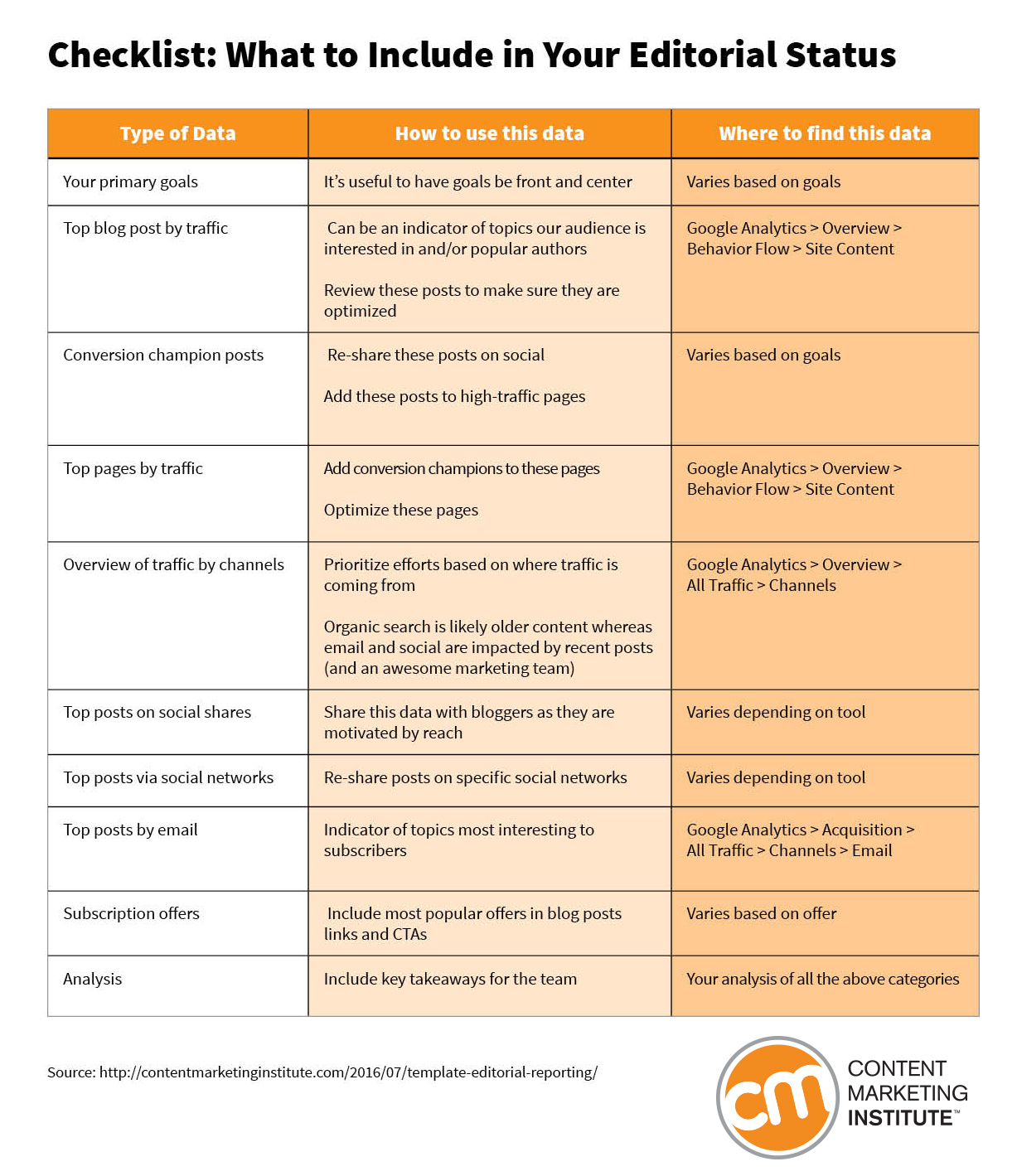
Below is a quick look at what to consider including in your editorial status report. Read further down for more details of each.

WHAT TO INCLUDE IN YOUR EDITORIAL CHECKLIST

checklist-editorial-status

Click to enlarge

Update on primary goals

The initial slide should include an update on the main goals for your content marketing program. What impact do you want your content efforts to have on your business? (Understanding what success means is a key differentiator between effective marketers and their less effective peers.) For CMI, these are things like email subscribers, CCO subscribers, event registrants, and CMI University students.

How to use this data: Even though your editorial may not directly impact all of these goals, it is helpful to have these metrics front and center so people are thinking about how the content they create will impact these goals.

How to get this data: This will depend on what goals you are tracking and what systems you are using. (A lame answer, I know, but it gets much more specific as you read on.)

Top blog posts by traffic

These are the blog posts of the reporting month that get the highest amount of traffic on the website.

How to use this data: High traffic can be an indicator of topics the audience is interested in and/or popular authors. We also review these posts to make sure they are optimized.

How to get this data:

Google Analytics > Overview > Behavior Flow > Site Content

BONUS TIP: On a quarterly basis, I run this analysis for top blog posts that weren’t published in that month as well as our static web pages. I want to make sure these perennially popular pages are getting regular tune-ups.

Also, ask are there opportunities to link to this high-performing content? And what are people clicking once they are on these pages?

Conversion champion posts

Conversion champions are posts that convert better than other posts. Of course, conversion will mean different things to you, but at CMI, we track new email subscribers.

How to use this data: If you track just one piece of data per month, this would be it. While it’s interesting to see what posts are getting traffic and social shares, what really helps reach your goals?

At CMI, we prioritize posts based on re-sharing on social because they are great candidates to add to high-traffic pages.

How to get this data: How you get this info varies, and it will likely require some manual work. For a great explanation, see No. 2 in this post from CMW speaker Andy Crestodina: 3 Internal Linking Strategies for SEO and Conversions.

Top pages by traffic

These are the website pages (not posts) that get the highest amount of traffic. While these pages are unlikely to change from month to month, these are key to your tracking to keep them on everyone’s mind.

How to use this data: The editorial team pays close attention to these pages to answer:

  • How are bounce rates trending? Are people sticking or leaving from these pages?
  • Are there opportunities to link to high-performing content? (See conversion champion category above.)
  • What are people clicking on once they are on these pages?

How to get this data: Google Analytics > Overview > Behavior Flow > Site Content

Overview of traffic by channels

I like to look at how traffic is coming to the website by channels. I use the same breakdown that is presented in Google Analytics:

  • Organic search
  • Direct
  • Email
  • Social
  • Referral
  • Other

How to use this data: The channel report is interesting for a few reasons:

  • It helps you focus your promotion efforts. If certain channels are bringing in the bulk of the traffic, focus on those.
  • You can look at year-over-year trends to see how your efforts are helping. For instance, are any sources seeing a drop in traffic? If so, why may this be?
  • Organic search traffic is typically traffic coming from older content whereas email traffic (and often traffic from social) is likely a better indicator of how your most recent content is performing.

Of course, many organizations, including CMI, have marketing teams that play a huge hand in the success of their content so this data is not something specific to editorial.

How to get this data: Google Analytics > Overview > All Traffic > Channels

Top posts on social shares

While I don’t think social-sharing metrics are all that critical, it is interesting to see which posts are shared most on which networks – so team members can continue to share specific posts that perform well on those platforms.

How to use this data: Lisa Dougherty, who manages our blog, shares our top posts with the team each month. While these updates had focused more generally on top posts, she is now calling out which posts are most widely shared on which social network so our team can customize what they share where.

How to get this data: If you have collected social metrics, you know that they vary from source to source (what you see on your website is likely different than what is reported in BuzzSumo or TrackMaven, for instance.) Instead of focusing on the absolute number, pick one source of truth and then track the relative performance.

BONUS TIP: Use one slide per social channel to give people on your team details on what to share on the proper channel.

Top posts via email

I also started looking at which posts are getting the most traffic from our daily and weekly emails.

How to use this data: Email is a key channel for us at CMI, so in addition to tracking how much traffic is getting to the site via email in general, it’s useful to see if any types of posts are resonating especially well with our subscribers.

How to get this data: Acquisition > All Traffic > Channels > Email
NOTE: Primary dimension needs to be Landing Page.

BONUS TIP: You can track which pages are getting the most traffic from organic search, but this often does not make much sense on a monthly basis as it takes time for posts to generate search volume.

Subscription offers

If you are getting email subscribers through gated offers, how are these people coming into the system?

How to use this data: The editorial team can see gated offers are most effective and use in blog post links and calls to action.

How to get this data: This will vary depending on your systems.

BONUS TIP: If your gated offers aren’t drawing as many subscribers as you would like, consider making them freely accessible on something like SlideShare.

Analysis

Once we curate all of the data, the fun part begins. I analyze all of the data and look for trends on topics and themes that our audience is interested in. I report on a few things:

  • What trends are we seeing this month? Are these new or a continuation of what we have been seeing?
  • Are any authors performing really well?
  • What isn’t working so well? (We recently added this category. While I hesitated to call out the poor performers, it is good for everyone to know and learn from.)

Other ideas

Of course, your editorial status can also include other things pertinent to your team. For instance, our status also includes:

  • Current and upcoming projects: As part of the monthly editorial update, we include a quick run-down of any major changes or projects coming down the pike so the team is in the loop.
  • Top Click to Tweets: In the past several months, we started including Click-to-Tweets in our posts, which is a widget we use to call out tweets that readers can easily share with one click. Are these worth the time and what type of tweets are tweeted most often? We also consider where these tweets were placed in the post. Do the first tweets get tweeted most often?
  • Keywords to consider for posts: Our SEO consultant, Mike Murray, gives us a monthly update of how our search is trending. As part of this report, he provides suggestions for keywords we may want to consider creating content for as a way to round out our editorial.

I’d love your thoughts. Is this useful? What types of information do you include in your status?

Want to be part of our conversion analytics? Subscribe today to receive the free daily or weekly newsletter.

Cover image by Joseph Kalinowski/Content Marketing Institute

The post A Template to Simplify Your Editorial Reporting  appeared first on Content Marketing Institute.

Saturday, July 2, 2016

This Week in Content Marketing: Facebook Slowly Eats Media Companies for Lunch

PNR_Episode137-01

PNR: This Old Marketing with Joe Pulizzi and Robert Rose can be found on both iTunes and Stitcher.

In this week’s episode, Joe and Robert discuss how Facebook has cleverly tweaked native advertising to benefit its users and give brands greater insights into ad performance, but it may represent a death blow to some publishers. Facebook is also paying media companies and influencers to create content for its streaming video service; in the short term, this appears to benefit brands. In other news, native advertising is booming, but brands and publishers still aren’t very strategic in their use of it. Finally, Tronc (the former Tribune publishing company) ties its fate to video embedded in its news stories, but lacks a bigger vision for its future. Rants and raves include a farewell to Garrison Keillor’s A Prairie Home Companion radio show and the pervasive power of print. This week’s This Old Marketing example: Steelcase.

This week’s show

(Recorded live June 27, 2016; Length: 1:01:01)

Download this week’s PNR This Old Marketing podcast.

If you enjoy our PNR podcasts, we would love if you would rate it, or post a review, on iTunes.

Today’s Episode Sponsor – Ahrefs (ahrefs.com) has a 30% off special for PNR listeners, plus a 14-day free trial. Go here for more – http://cmi.media/pnr137a

1. Content marketing in the news

  • Did Facebook just deliver a crushing blow to native advertising? (10:03): For the increasing number of publishers that rely on native advertising to make ends meet, Facebook may have delivered a brutal blow. According to FastCompany, Facebook now requires that publishers sharing native ads must tag the brand in the post. This makes native ads more transparent to users, but makes it possible for brands to see just how much publishers are marking up their ads. Robert and I agree this will drive margins way down, and may result in brands cutting out the middle man to boost posts themselves. This article is paired with the next one.
  • Facebook makes a deal to pay for media companies, celebrities for Facebook Live (15:34): Facebook Inc. has inked contracts with nearly 140 media companies and celebrities to create videos for its nascent live-streaming service. The arrangements are a way to encourage publishers to produce a steady stream of high-quality videos until Facebook figures out a more concrete plan to compensate creators. Robert and I believe this is a clever way to get publishers addicted to live video. We discuss a scenario on how this new arrangement will play out during the next year or two. For brands, it appears to be a buyer’s market. Take advantage of it while you can.
  • 2016 native advertising trends for publishers (22:16): According to a study released late last year by Adyoulike, worldwide spending on native advertising will soar to over $59 billion in 2018. Native ad spend as a percentage of total ad spending is predicted to soar from 19% to 33%. Author Chad Pollitt credits this high rate of growth to soaring adoption of content marketing. Robert and I see a problem, however: Neither brands nor media companies are approaching native ad opportunities strategically. They’re just creating and promoting “stuff” — and wasting a lot of money in the process.
  • Tronc threatens a nightmare hellscape of video content in new warning to employees (32:50): It has been less than three weeks since Tribune, the publisher of the Los Angeles Times and Chicago Tribune, rebranded itself as Tronc. Now the company has revealed to its employees that it will monetize its operations by embedding videos into a greater percentage of articles on its websites. I’m concerned that Tronc’s focus is very tactical. What’s the broader vision for the company? Robert points out that customers seem to be absent from Tronc’s plans.

2. Sponsor (39:40)

  • CONTENT MARKETING WORLD: Content Marketing World 2016 will be held September 6-9, 2016 in Cleveland, Ohio. If you are from a B2B, B2C, nonprofit, or small business, I urge you to join more than 4,000 marketers from over 50 countries for the biggest content marketing conference on the planet. This year, some of the world’s biggest brands will speak at Content Marketing World, including presenters from Lego, GE, Google, Microsoft, VISA, IBM and Intel. In addition, many of the world’s best experts and thought leaders will share their insights on all aspects of content marketing. Our “out of this world” closing keynote speaker is Mark Hamill. Use the code PNR200 to save $200 off at http://contentmarketingworld.com.

3. Rants and raves (41:55)

  • Robert’s rave: Garrison Keillor, host of the popular radio program A Prairie Home Companion for the last 42 years, recently announced his retirement. This show, which airs on National Public Radio (NPR) in the U.S., is one of the last of its kind. It features comedy sketches, music, and Keillor’s inimitable style of storytelling about the residents of the fictitious town of Lake Wobegon. His unique style of heartfelt storytelling will be missed!
  • Joe’s rant: During the last week, I had four experiences that emphasized the staying power of print: During a family trip to London, I saw the very first edition of The London Gazette, which dates from 1673. I picked up the London Evening Standard as a keepsake of England’s historic vote to leave the European Union. I returned home to find family and friends gave me over 20 newspapers and commemorative magazine issues celebrating the Cleveland Cavaliers’ NBA championship. And a new issue of Contently’s excellent content marketing magazine arrived in the mail. These experiences make me more convinced than ever that the majority of brands are missing out on opportunities to deliver valuable, consistent experiences in print.

4. This Old Marketing example of the week (53:01)

  • Steelcase: This office furniture manufacturer was founded in 1912. Throughout its history, it has been one of the most innovative companies in its field. In recent years, the company has reimagined itself, transforming from a traditional office furniture company into an innovation and design center. It publishes a beautiful print magazine called Steelcase 360, which is focused on design and designing workplaces. It also publishes the 360 Blog and a 360 Real Time podcast, in which it conducts interviews with designers. This comprehensive, well-integrated approach is an excellent example of This Old Marketing.

steelcase-360-mag

For a full list of PNR archives, go to the main This Old Marketing page.

How do I subscribe?

itunes logostitcher logo

The post This Week in Content Marketing: Facebook Slowly Eats Media Companies for Lunch appeared first on Content Marketing Institute.

Friday, July 1, 2016

The History of Content Marketing [Updated Infographic]

history-content-marketingIf you want some insights into where the content marketing industry may be headed, it might just help to take a look at where it’s been.

As we pointed out when CMI shared its History of Content Marketing infographic in 2012, brands have been telling their stories to audiences for hundreds of years. Not to mention that storytelling itself is one of the oldest forms of communication.

While we used to consider John Deere’s The Furrow to be the oldest example of content marketing, Robert Rose and I have unearthed several more examples on our weekly This Old Marketing podcast:

1732 – Benjamin Franklin first publishes the yearly Poor Richard’s Almanack. The goal is to promote his printing business.

1801 – Bookstore Librairie Galignani employs creative content strategies to grow its business, including opening a reading room and printing a newspaper that featured articles from influential authors and books.

1861 – Samuel Wagner launches American Bee Journal, a magazine that is still being published.

1867 – Hartford Steam Boiler Inspection and Insurance Company debuts The Locomotive, which is now said to be the oldest company magazine continuously published under the same name in the United States.

1882 – The Edison Electric Lighting Company Bulletin spreads the word about the benefits of electric lighting.

1887 – Charles Scribner’s Sons publishes Scribner’s Magazine, which provides a look inside the lives of its most famous authors. It competes with Harper’s Monthly and Atlantic Monthly, but its goal was to generate sales of Scribner’s books.

1888 – Johnson & Johnson launches a publication called Modern Methods of Antiseptic Wound Treatment that is aimed at the needs of doctors to whom the company sold bandages. The company also launches two publications to share helpful articles with the medical community.

But despite the age of the technique, the power it wields hasn’t diminished at all. In fact, examples of brands using content marketing – and the impact of those efforts – have increased exponentially over the years. That’s why we thought it would be a good time to update our infographic to include some of the most significant achievements that have happened over the past few years.

History-of-Content-Marketing-Infographic-2016_FINAL

Share this Image On Your Site – Just copy and paste code below

If you are looking for more stories of brands using and succeeding with content marketing:

Want to be part of content marketing history? Register today to attend the largest content marketing event in the world this September. Use code BLOG100 to save $100.

Cover image by Joseph Kalinowski/Content Marketing Institute

The post The History of Content Marketing [Updated Infographic] appeared first on Content Marketing Institute.