Monday, March 6, 2017

3 Ways to Re-Use Your Content Magnets to Dominate SERPs

reuse-content-magnets-dominate-serps

A lead magnet is a piece of content aimed at motivating consumers to take an action. At the top of your conversion channels, lead magnets spur interest and tie a visitor to your brand but don’t necessarily drive a direct sale (e.g., provide contact information, sign up for a newsletter, join a free trial.)

Creating a solid lead magnet is hard work: You invest hours of brainstorming and research, creation, and design. The good news is you should be able to further your investment by converting them into attractive assets on third-party sites, which in turn could strengthen your presence on search engine result pages for relevant keywords and queries.

Here are three ways to turn your on-site lead magnets into digital assets for third-party sites.

HANDPICKED RELATED CONTENT:
Content Reuse: Behind the Scenes With CMI

1. Turn a PDF into a flip-book

A downloadable e-book is a common and effective lead magnet. People love free e-books. If done well, these e-books will lead readers to see your brand as a valuable resource.

Putting together an e-book takes time and effort: It’s a good idea to think of more ways to take advantage of the asset. One way is to create a tablet-friendly flip-book. Software, such as Flipsnack, enables you to create stylish digital flip-books from your PDF documents. Easy to use, the software can help you create highly engaging and mobile friendly assets to embed on your site or another’s.

However, converting your entire e-book into a flip-book isn’t a good move. People will read the ungated flip-book and never opt in to receive the PDF. Here are a few smart approaches to use:

  • Use the e-book’s takeaways to create a short flip-book with images and quotes, and invite readers to sign up to download more.
  • Repurpose the introductory chapter of the book to create a mobile flip version, and offer it to bloggers.
  • Turn each case study or testimonial in your e-books into a flip version, and embed them on your product, service, or About pages.


Repurpose an e-book chapter into a mobile flip version and ask bloggers to use it, says @seosmarty.
Click To Tweet


Some flip-book software, including Flipsnack, allows you to add clickable links, which can generate additional traffic from its readers. Or if you want to collect leads, upgrade to Flipsnack Publisher.

2. Transform infographics into clickable presentations

Infographics are great for attracting links (referral traffic). Specific types, such as flow charts, cheat sheets, etc., allow readers to download (converting traffic) to digest huge amounts of data or complex concepts. However, there’s one problem with infographics – most downloaded or hot-linked images don’t allow people to click to your site.

LinkedIn’s SlideShare platform can solve the problem. You can easily repackage your infographics as a presentation and upload to the platform for additional marketing and traffic-building. While SlideShare allows you to upload images and PDF pages, I recommend turning your assets into PowerPoint files before uploading. You can include clickable links in PowerPoint slides that are retained in SlideShare (with the exception of the first three slides).


Repackage infographics and upload to SlideShare for additional marketing and traffic-building, says @seosmarty.
Click To Tweet


To effectively repackage your infographic into a SlideShare presentation:

  • Cut your infographic in a few meaningful parts and create a slide for each part.
  • Add three intro slides describing who it will be useful for and who created it.
  • Add clickable links from the fourth slide on.

TIP: Because not everyone uploads clickable slides, make it clear for users to know when and where to click. You can include an image such as this on the third slide:

Clickable-presentations

Bonus tool: If you want to add clickability directly to your infographics, consider ThingLink. You can add clickable links and embed videos right inside your image file.

3. Convert videos into audio podcasts

Finally, we come to the easiest tip on the list. If you have an active YouTube channel, don’t miss a chance to turn your videos into podcasts. You don’t even need tools to do it. As you upload and edit your videos using YouTube editor, download the audio files using a plug-in like this one for Firefox or this online converter for non-Firefox users. Keep in mind when you are editing the videos that the audio will be repackaged to stand on its own. Make sure it makes sense without the visual aids.

With your audio files, you now can upload them to Sound Cloud and iTunes to generate more traffic and audience loyalty. That’s something we did with our YouTube series, allowing us to claim more Google positions for our brand name:

Convert-videos-into-audio-podcasts

Go strategic

If you give all three ideas a try, you’ll end up with at least four more pages that have the ability to rank for your brand name:

  • Flipsnack profile page
  • SlideShare profile page
  • Sound Cloud profile page
  • iTunes page

Your content also could be included in more ranking results for important keywords as your content is hosted on more third-party web pages (e.g., each individual SlideShare upload page). Each time you convert or upload your content, use file names, title tags, and description fields wisely. Look for alternative keywords and brand-related terms to name new assets created from existing assets.


When you convert or upload content, use file names, title tags, & description fields wisely. @seomarty #SEO
Click To Tweet


Each time you upload a new digital asset target a slightly different set of keywords and make sure you create:

  • Keyword-targeting descriptive title
  • Detailed description (use available character limit)
  • Descriptive tags (when applicable)

For example, if I wanted to control more Google positions for alternative keywords for my brand name, I would:

  • Create an infographic explaining what makes us different
  • Turn that infographic into a SlideShare deck with links to our core features
  • Upload that infographic to ThingLink with links to our core features
  • Create a YouTube video explaining what makes us different
  • Turn the video into a podcast episode

That’s five pages on powerful domains to, ideally, rank in top five Google search-engine positions for my brand-name alternatives query.

Once you approach brand-asset creation strategically, you’ll soon see them in your brand-related search results more often. Dominating your brand-related search engine results is crucial for a powerful online brand.

Please note: All tools included in our blog posts are suggested by authors, not the CMI editorial team. No one post can provide all relevant tools in the space. Feel free to include additional tools in the comments (from your company or ones that you have used).

Cover image by Joseph Kalinowski/Content Marketing Institute

The post 3 Ways to Re-Use Your Content Magnets to Dominate SERPs appeared first on Content Marketing Institute.

Sunday, March 5, 2017

Best-Selling Author Shares Thoughts on Storytelling, Inspiration, and Creative Process

andy-weir-thoughts-storytelling-inspiration-creative-process

Before he was the best-selling author of The Martian, Andy Weir was a computer programmer who wrote short stories as a hobby. In his words, “I thought I was writing for a tiny niche audience of hard-core science dorks.” Now working on his second manuscript with Random House, Weir reflects on the journey he took to get here.

CCO: You had a short-story blog for a long time before The Martian came out. Did the experience of getting immediate feedback from an audience help you develop your craft?

Weir: I started the website because I wanted a creative outlet. I wanted a place to put my creative stuff. I had tried earlier in life to be a full-time writer but couldn’t break into the industry. So I was a computer programmer for 25 years. I just used it as a place to dump my short stories.

I slowly accumulated readers; I got about 3,000 regular readers over the course of 10 years. That sounds like a lot … but 10 years was also a very long time. It was just a hobby of mine.

Absolutely, the readers helped with the storytelling. I would get feedback immediately when I was posting short stories, which was really cool. And I was getting feedback on every chapter when I was publishing The Martian’s chapters on my website. My audience was pretty much nerds like me and so they would point out any technical, scientific, or mathematical errors in the text immediately. It was like having 3,000 fact checkers.

CCO: What was their reaction when suddenly this guy who they’d been following rocketed into the stratosphere of fame with the book?

Weir: They were really thrilled. Lots of people sent congratulatory emails. The original readers are like Andy Weir hipsters; they would say “I read Andy Weir before he was popular!”

CCO: Along the way, especially over a decade, there must have been moments of doubt.

Weir: I actually didn’t have those moments of deep doubt because I wasn’t trying to do anything other than what I was doing. I wasn’t thinking it was all a means to an end to get published. It was just me writing stuff and posting it on my site; what I got out of it was the feedback and fan mail from my regular readers. I had no idea it would ever become popular outside of my tiny little audience.

CCO: What were your sources of inspiration? What genres inspired you as a writer?

Weir: The main one would be Apollo 13. Both the real-world events and the movie. There’s that one scene in the movie where they have to make an oxygen scrubber and a CO2 filtration system from the lunar module work, and they have to make this contraption that will run the air through it. They’re all floating around in space with duct tape, stuffing a sock in this one spot. I thought that was so cool. It was very MacGyver-in-space. I thought, I want to write a whole book about that.

CCO: The Martian is so scientifically dense. Did you ever worry that you were going to lose people?

Weir: Absolutely. That was a constant balancing act for me. On the one hand, it was an immutable requirement to me that it be scientifically accurate. That means I needed to exposition all this deep scientific crap to the reader, but I also didn’t want it to read like a Wikipedia article. That’s why we have the smart-ass narrator; that’s why there’s a joke every paragraph or two … to keep it funny.

I’ve gotten a lot of feedback from readers after the book got big and they would say stuff like, “I’m not really into science and it’s not even that interesting to me. I love the book, but I skimmed those paragraphs that described it.” For me, that is awesome. There’s this relationship that forms between author and reader. The reader has to trust you. If you get to the point where the reader is willing to just say that he trusts that everything is correct, and that he can skim that paragraph because he doesn’t need it to be proven to him—that’s rare and great.


There’s this relationship that forms between author & reader. The reader has to trust you. @andyweirauthor
Click To Tweet


I didn’t have any idea that non-scientific people would ever like the book. I thought I was writing for a tiny niche audience of hard-core science dorks, but it’s great that it worked out this way.

CCO: You’ve talked about the challenge of just sitting down and writing … how grueling the process can be. Do you have any habits or rituals that make it easier?

Weir: Of course! First thing I do every morning is make sure I’m properly caffeinated, and usually that’s with Diet Coke. Now that I made a bunch of money off a book, I get to do stupid, eccentric things, right? I have a restaurant-style soda fountain in my house now. That’s the wild, partying kind of guy I am … I’ve got Diet Coke on tap.

After caffeinating, I’ll spend 30 minutes to an hour answering fan mail in the morning. It’s a nice warm-up because I’m writing, but I’m not straight into the book. I also like to take a walk every day. Other than that, I try to set myself a word count.

I try to get 1,000 words done a day. Sometimes I do, sometimes I don’t. Sometimes I blow right past it when I’m really motivated. Another writer (I don’t remember who it was, unfortunately) once told me: Sometimes you’re very, very motivated, and you’re cranking out words. Other times, it’s a complete slog, and each sentence is torture. You’re lucky if you get 300 words done across the whole day. But if you look back on your work months later, you can’t tell the difference between what were your motivated days and what were your slog days. That’s really encouraging when I’m having a rough day.

CCO: If you think of story archetypes, one popular archetype is the so-called hero’s journey. In it, the hero encounters a monster – that monster sometimes is of the physical world, but sometimes it’s a psychological monster. On your hero’s journey, what is your monster?

Weir: It’s definitely a man-vs.-himself plot. There are the four classic plots: man vs. nature, man vs. society, man vs. man, and man vs. himself. Well, mine’s the last one. I have a bunch of anxieties. I struggled with depression when I was younger. Later in life, I had severe anxiety problems, to the point where I was dramatically reducing the quality of my life. Now, I have therapy and meds, which help a lot. That’s my monster. It’s just me.

CCO: Do you think that struggle makes its way into your writing? Does it inform your writing in some way?

Weir: I don’t know. I’ve put thought into that. I’m just not sure. The whole time I wrote The Martian, I was still suffering from pretty severe anxiety issues. Anxiety makes you paranoid about the way the world is going to screw you over. Did that help me write a story about a guy who’s on a world that’s literally trying to kill him at every turn? I don’t know, maybe. I honestly don’t know the answer to that.

The hardest thing to analyze is yourself. It’s so much easier to look at someone else and notice a particular problem and point it out to them. It’s very easy to do that. But it’s very hard to do it to yourself. So I honestly don’t know.

CCO: One thing I see marketers struggle with is taking on more ambitious projects. It’s easier to do a little 3-minute video to get an audience’s attention. It’s much harder to take on more complex projects, be they long form content, documentaries – topics and projects with more depth and subtlety. Can you offer words of inspiration?

Weir: The most important thing is to find the interesting part. I think marketers are very message-focused. They know what they want people to hear. They have to work backwards from there to figure out how to make that happen. What they should do is find the thing that’s unique or interesting that captures people’s attention. Figure out what that thing is; don’t worry about the message right now. Just find the interesting part, and then figure out how to link that to the message.


Find the interesting part of your story and then work towards the message, says @andyweirauthor.
Click To Tweet


One of the most successful content marketing projects I ever saw was a documentary about FedEx way back in the late 1980s. Back then everything went to their central airport in Tennessee. If you FedExed a package to your next-door neighbor, it would go to Tennessee and then come back. It was the most efficient way on average for dealing with shipping. The documentary showed the whole process in detail. This was in the ’80s, when we were used to the U.S. Postal Service, which could take six to eight weeks to deliver a package. With FedEx, you could order something by phone today, and it would be at our houses by tomorrow. It was a complete disruption in the delivery system. The documentary lets you see the inner workings at FedEx.

Audiences are extremely aware of preachiness, especially in the modern era. Hollywood has decided that everything has to have some freaking political message, which drives me crazy. The Martian, by the way, had no political message. Dude didn’t want to die … that’s it. People quickly, even if they don’t do it consciously, identify the message, get mildly annoyed at it, and then start ignoring the parts of the movie that push that. That’s why I try to avoid it.

Instead, find the interesting part of your story and then work towards the message, rather than desperately starting with the message and trying to work towards the interesting part.

This article originally appeared in the February issue of CCO magazine. Subscribe for your free print copy today.

Andy Weir was the keynote speaker at last year’s Intelligent Content Conference, the content strategy event for marketers. Register today for ICC 2017, March 28 to 30 in Las Vegas. Use code BLOG100 to save $100.00.

Cover image by Joseph Kalinowski/Content Marketing Institute

The post Best-Selling Author Shares Thoughts on Storytelling, Inspiration, and Creative Process appeared first on Content Marketing Institute.

Saturday, March 4, 2017

7 Easy and Free Ways to Promote your Blog

Many are under the impression that a blog is a “set it and forget it” process. While creating great content is essential to the success of any blog, writing a blog is only half the challenge. The other half is marketing your blog and getting the word out in order to generate the traffic your blog needs. Here are seven easy and free ways to promote your blog.

1. Give Constructive Feedback on Other Blogs

Generic comments followed by a link to your blog are spam. Do this often, and these spammy links will actually hurt your blog’s ranking by search engines. Conversely, constructive feedback on other blogs will get read by other blog readers, while a mention of your blog’s name without the link improves brand recognition by both search engines and a wider audience.
Great bloggers solicit constructive feedback in order to improve as well as deepen their engagement with their audience. HowToCreateABlog.org is a classic example of this, as well as an excellent resource for new bloggers.

2. Contribute to Others Blogs

If you are able to engage with the author of another blog through the comments section, offer to write a blog entry for them as long as it mentions the name of your blog and contains a backlink to your blog. Many content creators will welcome such content so that they don’t have to struggle to come up with new content as often.

3. In the News

News sites rival educational sites like Wikipedia for trust rankings by search engines. Any references to you personally, your business or your blog by news organizations are SEO gold. One way to do this is to volunteer to be interviewed as a subject matter expert in your area of expertise. Another option is reporting stories to news organizations about upcoming events in exchange for a mention in the story.

For example, if you write a blog about a medical condition and are working with others for a charitable fundraiser, you should tell the local newspapers about the fundraiser and be interviewed as part of the story.

If you have video or images of events that other news sites would like to have, contact those news sites and offer to share the content in exchange for attribution, including a link back to your blog. If you can submit guest posts to industry news websites, then you can include a link to your blog as part of your author biography.

4. Blog Contests

Blog contests have several advantages over other forms of blog marketing. First, for the price of whatever you are giving away, you’ll receive an inordinate amount of attention once you get the word out about the contest. Second, you can promote your blog through contest websites and receive a massive number of social media mentions as a result. Third, you may even be able to get the items you give away for free, depending on the giveaway. For example, you may be able to receive a free copy of a new book coming out as a thank you for interviewing the author, and then boost the social media mentions of your blog by holding a contest to give away the brand new book.

5. Participate in Online Forums

Consider creating an account on sites like Quora or Reddit, and link to your blog in the user profile. Online forums give you the opportunity to answer others’ questions and show off your expertise. Questions that have many followers but lack answers are ideal for answering while building up your following. In an ideal case, you could give a short answer to the commonly asked question on the online forum and link back to an in depth answer on your blog.

You can put a link to your blog in your forum signature, as well, though you need to be careful about back and forth conversations that start to look like link spam to search engines.

6. Social Media Outreach

Create social media accounts on a number of platforms. Place a link to your blog along with your other social media accounts in each social media account. Then, use these accounts to promote your content. However, in order to gain followers, you should share quality content created by others regularly. Don’t forget to put social media sharing buttons on your blogs. Your blogs also need clear calls to action asking readers to share the content or follow you on social media.

7. Your Signature Touch

One way to increase recognition of your blog is to put the link to your blog in your email signature. Now everyone you correspond with from friends to professional contacts receives the link to your blog. This move also ensures that everyone you correspond with about guest posting or giveaways has your blog’s URL to check out for themselves.

Conclusion

If you want to get the word out about your blog, give constructive feedback and, where possible, guest write for other blogs. When you can get the word out about events you’re supporting, do so and receive a mention of your blog in the process. Set up giveaways on your blog to generate a massive number of social media mentions. Create several social media accounts that reference each other and your blog before using them to share links to your blog. Put your blog URL in your email signature line, and consider using it as a signature line on every forum comment if it won’t show up so often that it hurts your backlink profile.

Original post: 7 Easy and Free Ways to Promote your Blog


This post is courtesy of: http://www.dailyblogtips.com

This Week in Content Marketing: Fake News Creates Huge Opportunity for Branded Content

fake-news-branded-content

PNR: This Old Marketing with Joe Pulizzi and Robert Rose can be found on both iTunes and Stitcher.

This week, Robert and I discuss The New York Times’ business model – and why its future could be very bright. We also explain how the fake news crisis could be creating an amazing opportunity for brands, and prepare for some big media company acquisitions by brands. Rants and raves include a Pixar training course on storytelling; then we close with an example of the week on John Yocum Beaty.

This week’s show

(Recorded live on February 26, 2017; Length: 1:04:43)

Download this week’s PNR This Old Marketing podcast.

If you enjoy our PNR podcasts, we would love if you would rate it, or post a review, on iTunes. 

1.    Notable news and upcoming trends

  • How is The New York Times really doing? (10:23): The Gray Lady’s struggle to transition into a digital-first publication has been the subject of a lot of media speculation. But how far off is it from reaching its lofty digital business goals? GigaOm founder Om Malik decided to investigate how the inveterate news publication is really faring, by the numbers. Naturally, Robert and I agree with Malik’s assertion that the Times needs to evolve away from advertising more aggressively than it has been – though we were shocked to see just how significant its dip in advertising revenue has really been.
  • How fake news is making real publishers look good (19:27): Mequoda Daily ran an interesting piece on the ways reputable media outlets can distinguish themselves from the tabloid-y purveyors of fake news, such as avoiding shallow listicles, sound bites, and “you’ll never believe” titles and focusing on accurate, investigative news. There is certainly an opportunity for media companies to up their game in this respect; but the real opportunity I see here is for product brands to stake their claim by becoming the trusted news resource for the audience they cover.
  • Magazine M&A speculation heats up (29:03): Speaking of media’s quest to remain competitive, according to The Street, a number of print magazines reportedly are on the block or are attracting acquisition interest, prompting some key media investors and consultants to weigh in on the potential for consolidation. While we are encouraged to see more analysts joining in on one of our favorite topics of conversation, Robert and I are left wondering why no one else is focusing on the opportunity for product brands to play in this space.

2.    Sponsor (38:56)

  • Content Marketing Institute’s 2017 Events: Whether you are just getting started with content marketing or are looking to take your expertise to the next level, CMI’s portfolio of events has you covered. Open enrollment for the new semester of Content Marketing University started March 1. We are launching an all-new program this year, but it’s limited to 500 learners, so don’t wait to secure your slot. Use the code PNR100 to get a $100 discount on registration. Time is also running out to sign up for our strategy-focused Intelligent Content Conference ­taking place on March 28–30 in Las Vegas. And don’t forget that early-bird entries for the Content Marketing Awards are due by March 10. Send in your submissions, so your stellar content marketing efforts can get the recognition they deserve.

CMI-events

 3.    Rants and raves (43:16) 

  • Robert’s quick rave No. 1: Engadget has covered the news that Pixar is offering a free course on “The Art of Storytelling,” through online education platform Khan Academy. Robert is halfway through the course, and he’s finding it to be a delightful tutorial on the topic. He recommends it highly to anyone who wants some help finding his or her unique story and learning how to tell it more skillfully.
  • Robert’s quick rave No. 2: Robert also bestows must-read status on an article in The New York Times, which talks about the cyclical trend of media bundling and unbundling. After years of bundling backlash and consumers looking to “cut the cord,” the pendulum is now swinging back in the other direction, thanks to vertical-integration successes like Amazon Prime. This article serves as a reminder that the content services we provide will need to go beyond the products and services our businesses offer if we want to remain viable in the future.

The #content we provide needs to go beyond the products & services our businesses offer. @robert_rose.
Click To Tweet


  • Joe’s commentary: To Robert’s earlier point about Khan Academy (technically) being a competitor of our own online education experience, CMI University, I’ve noticed a trend that I feel compelled to mention: In my research on some of the successful brands that have found success by building a media platform – like Arrow Electronics, for example – I’m finding that the majority are actively soliciting advertising and sponsorships from their competitors. Though it’s a departure from the way many brands view their competitors, as I see it, if another business in your industry wants to help you build your influence, what reason would you have for turning them away?
  • Joe’s rave: A few members of the CMI team have (politely) asked me to stop talking about Tim Ferriss already; however, there’s one more story I feel compelled to tell before I submit to their gag order (at least, for the time being): A recent episode of Ferriss’ podcast features Soman Chainani, best known for this popular children’s book series, The School for Good and Evil. Soman said his biggest goal when writing the book was not to have the most readers, but rather to have the most passionate ones. It’s great advice for any business that focuses on getting more audience rather than on efforts to strengthen its core audience.

Strengthen your core audience rather than focus on getting more audience, says @joepulizzi.
Click To Tweet


4.    This Old Marketing example of the week (53:47)

  • If you’ve been following our show for a while, you may recall that Robert once highlighted the story of Art Shaw, a businessman and entrepreneur who was the first editor of the Harvard Business Review. Shaw also founded System: The Magazine of Business, which provided business people with essential training and education information as a means of creating demand for his office-supply business. Robert recently discovered an article in an issue of System from 1920 called Meeting Customers I Never See, by John Yokum Beaty. In it, the author talked about the unique customer insights he had been able to tap into, thanks to the magazine he created for customers of his pig farming business. Even more importantly, Beaty applied those insights to develop new ways to answer his customers’ questions and meet their needs – even when those needs went beyond the scope of his own business. For example, he started to run free classifieds so his customers could advertise the surplus stock they had for sale; Beaty also ran paid ads from other manufacturers in his magazines, helping those businesses to bring their offerings to the attention of his customer base. Beaty described his efforts in terms of the important lessons they taught him about how to keep customers satisfied by providing them with useful, valuable information – a This Old Marketing principle that still holds true nearly 100 years later.

System-magazine-PNR

Image source

For a full list of PNR archives, go to the main This Old Marketing page.

Cover image by Joseph Kalinowski/Content Marketing Institute

How do I subscribe?

itunes logostitcher logo

The post This Week in Content Marketing: Fake News Creates Huge Opportunity for Branded Content appeared first on Content Marketing Institute.

Friday, March 3, 2017

4 Analytics Reports Every Content Marketer Should Use

analytics-reports-content-markters

While you can use the data from Google Analytics in infinite ways, you need to understand the four most helpful reports for your content marketing – traffic, navigation summary, traffic from organic search, and conversions.

Once you understand what this data is and how to track it, you’ll be able to mix and match insights to take advantage of opportunities with your web-based content, driving more traffic to your website and (more importantly) doing more with the traffic you have.

Traffic

Why this report is useful:

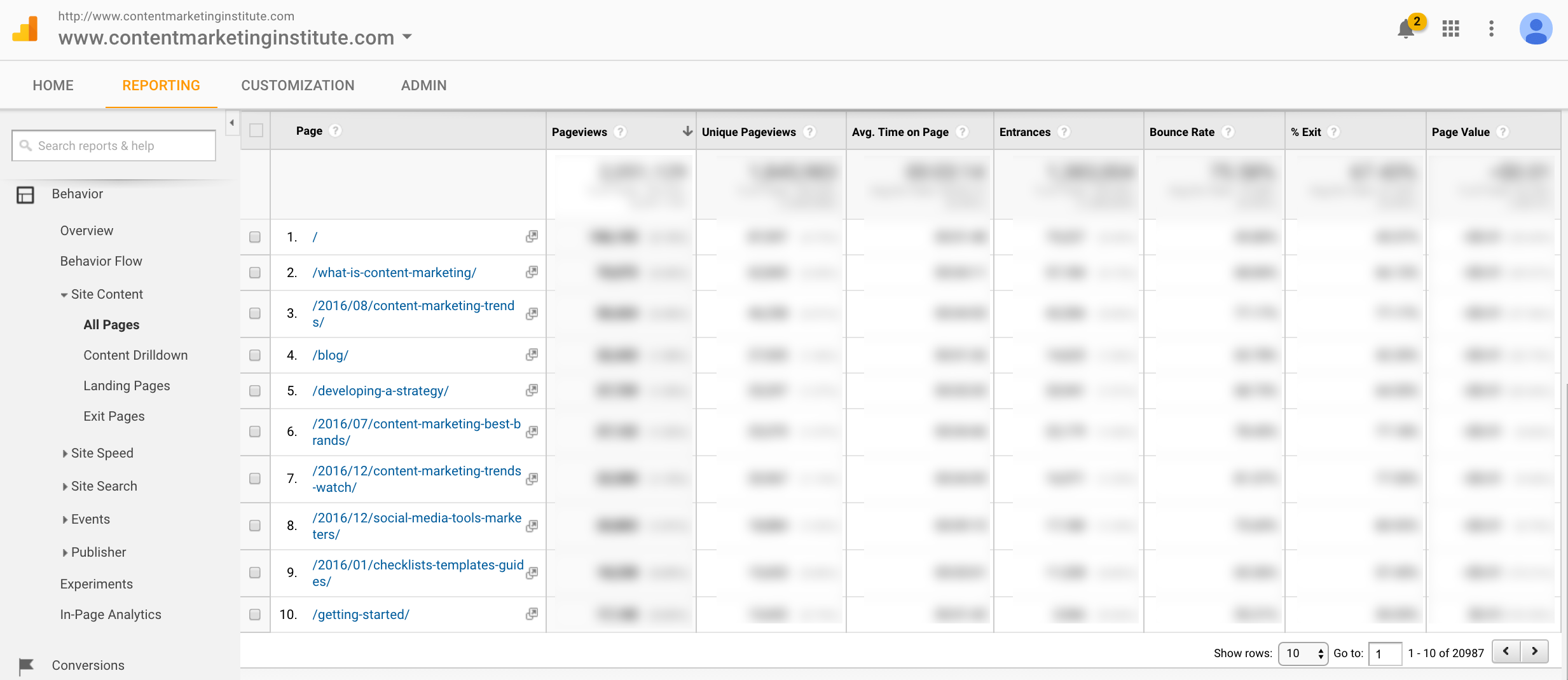
The traffic report (referred to as Pages report in Google Analytics) looks at the pages getting the most traffic on your website. By default, it also displays metrics such as time on site and bounce rate.

How to find in Google Analytics:

Go to Behavior > Site Content > All Pages.

To expand the list of pages, change the number of rows displayed by going to “Show Rows” at the bottom left of the screen.

Also, make sure the report encompasses a sufficient period. I typically look at search volume from the past quarter, six months, or year for this exercise.

Traffic-Report-Google-Analytics-blurred

Click to enlarge

How to act on this data:

This list of pages is a gold mine! Because so many people arrive on your website through these pages, keep a running list and review them on a regular basis. Remember, though, just because a page gets a lot of traffic does not mean it’s an effective page. That’s why you should review the pages that get the most traffic to:


Just because a page gets a lot of traffic does not mean it’s an effective page, says @michelelinn.
Click To Tweet


  • Ensure that the page puts your brand’s best foot forward. Is this page on message? Does it have current information and the best calls to action?
  • Include your best links. Given that high-traffic pages bring a lot of visitors, make sure to include links to relevant, high-converting pages and posts.
  • See what visitors are doing. Are visitors spending time on the page? Are they exiting or moving to other pages on the site? (See the next section on Navigation Summary for more details.)

Navigation Summary

Why this report is useful:

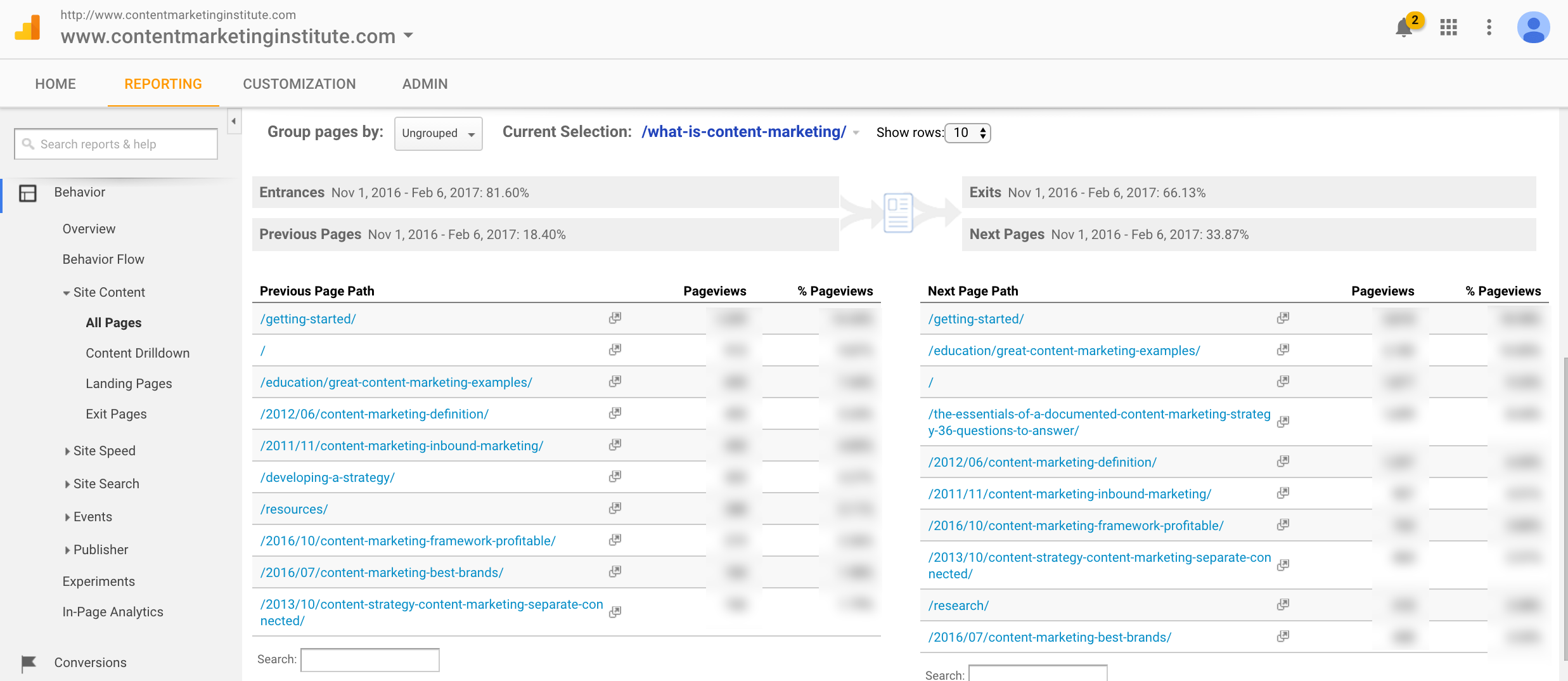
Though there are several ways to dig into pages to see how visitors are behaving, my favorite report is the Navigation Summary, where you can see 1) how visitors get to a page and 2) where they click once they are there.

How to find this data in Google Analytics:

When you are in the traffic report, click on any page. At the top of the page, you’ll see an option for Navigation Summary.

Navigation-Summary-Option-Google-Analytics-blurred

Click to enlarge

This page shows how visitors are navigating to this page from within your website – and you can see where visitors are clicking. Just as you can do with the traffic report, you can adjust the number of rows displayed.

Navigation-Summary-Detail-Google-Analytics-blurred

Click to enlarge

Alternative: You can use In-Page Analytics to view where visitors are clicking on any page on your website, but this report does not show how visitors are getting to the page. When viewing single-page data, this option is next to Navigation Summary or you can download the Google Page Analytics extension for Chrome.

How to act on this data:

There are two parts of this report to which you’ll want to pay attention:

  • The Previous Page Path is useful to know which page someone visited on your website right before they arrived on this page. It offers some context to understand how people get to this page, and it may offer clues as to what information people have – and what they still need.
  • The Next Page Path shows what people click on from that page when they are continuing on your site. This data is useful as it shows what questions people still have. Additionally, you can see whether people are clicking to pages that convert well (more on that later).

Traffic from organic search

Why this report is useful:

Not only do you want to know which pages are getting traffic in general, but it’s also useful to understand which pages are popular in organic search.

There are two reasons why search traffic matters:

  • If a page is getting a lot of traffic from search, it’s useful to be more sensitive when you make changes to that page. For instance, you would not want to rewrite it because that could significantly affect how Google ranks that page.
  • It offers the opportunity to learn more about the traffic on these pages with some additional work.

How to find this data in Google Analytics:

Go to Acquisition > All Traffic > Channels. You see a list of the channels driving traffic to your web pages.

Overview-of-Channels-blurred

Click to enlarge

Select Organic Search and then Landing Page (under Primary Dimension)

Landing-Pages-blurred

Click to enlarge

To find traffic on a specific page, such as a blog post, search by pasting everything after your primary URL into the search box. You can see the effect of organic search traffic on that page by looking at the absolute number of sessions as well as a percentage of your search traffic.

How to act on this data:

There are two things to consider with pages that get a lot of search traffic.

First, use caution when making changes. Understand that these pages likely rank well in Google. Be careful of how much you change on this page as you don’t want to negatively impact how it comes up in search. I’m not suggesting that you never change anything on the page, but tread more carefully and monitor more frequently how the pages perform after you make changes.


For web pages that get a lot of search traffic, use caution when making changes, says @michelelinn.
Click To Tweet


The good news is that there are ways to learn more about why people are visiting these pages. I use SEMrush for this purpose.

Here’s an example of how to do this using one of our search-magnet pages – Developing a Strategy.

Go to SEMrush and paste in the URL of the page.

SEMrush-URL

Scroll down on the page to the section for top organic keywords.

SEMrush-top-organic-keywords

In this example, we can see that people who arrive on this page want to learn more about content strategy, content marketing strategy, marketing plan, and content plan. As such, it’s a good idea to make sure the page addresses each of these topic areas. (Note that your high-traffic search-landing pages often are works in progress and should be continually reviewed and updated to best answer searchers’ questions.)

See how well your keyword results for the page match your intentions for the page. If you intended for this page to do something else but you see it is working for something different relevant to your business, keep this page as is. Then create a new page that better helps with the initial topic you had in mind.

Conversions

Why this report is useful:

In most content marketing programs, conversions are a critical metric – they are action(s) you want visitors to take when they arrive on your website. Do you want them to sign up for an email? Download something? Attend an event?

How to find this data in Google Analytics:

How you get this info varies and likely requires manual work. First, you need to set up your goals. Andy Crestodina, my go-to person on setting up goals, outlines the eight-step process in this video, How to Set Up Goals in Google Analytics:

Once your goals are set up, you can track them under Conversion > Goals > Overview. You can either look at all goals in aggregate or you can look at which pages are converting to specific goals.

How you can act on this data:

While the raw number of conversions is somewhat useful, what is even more useful is the number of conversions divided by the number of page views. This results in your conversion percentage.

The higher your conversion percentage, the more likely a visitor to that page will convert. These are the pages (which Andy calls conversion champions) that you should share and promote.


Share and promote your conversion champion web pages, says @michelelinn.
Click To Tweet


Once you identify your conversion champions:

  • Optimize these pages so they have a higher likelihood to show up in search.
  • Push these pages on social.
  • Link to these pages from your high-traffic pages.

These are just four ways to use Google Analytics so you can take action. Want more? Read How to Apply Analytics Data to Make Better Content Marketing Decisions.

Want more information to make your content marketing measurement easier? Subscribe to our free daily or weekly digest newsletter.

Cover image by Joseph Kalinowski/Content Marketing Institute

The post 4 Analytics Reports Every Content Marketer Should Use appeared first on Content Marketing Institute.

Thursday, March 2, 2017

Identity Matters: How Content Strategists Build Trust and Loyalty

content-strategists-build-trust-loyaltyThis post was co-written by Julie C. Lellis, Ph.D.

In 2009, whether you were a golfer or not, you likely heard about Tiger Woods. It started with a drama-filled Thanksgiving night with his wife. It ended with a public apology the following February. The superstar’s wholesome image unraveled publicly as one mistress after another came forth. Soon his marriage was lost, sponsorships gone, and fans bewildered. We were left wondering: Who was the real Tiger Woods anyway? Was everything we thought about him just a sham?

Woods didn’t need a consultant to help him with his brand. He needed a therapist. He stated this himself in a somewhat bizarre 14-minute public apology. He also could have benefited from a crisis communications expert. But most importantly, Woods needed to figure out his identity – who he was and who he wanted to be. Identity is the foundation for authentic living.

Many companies need to refocus on identity as well. When companies don’t have a clear sense of identity, they often act to some degree like Woods. We call this “going zombie.” Just like zombies, companies are often confused about their identities, haphazard in their behaviors, and sometimes downright scary. This leaves customers wondering who these companies really are. Rebranding isn’t a solid fix for this problem.

A solid foundation built on identity

Here’s how we describe identity in our recent book, The Zombie Business Cure. It differs from brand. Identity is constructed from core values. It’s the foundation that informs both an organization’s culture and its brand(s). When identity is unique – or clear and distinct– an organization will attract an audience that shares its core values.

It’s easy to confuse identity with brand, especially because the words are often used interchangeably.

The word “brand” has become somewhat tarnished – especially outside the communications industry. For example, in focus groups we led, participants often associated the word “brand” with “spin” or some kind of artificial superiority. This perception has created an additional barrier. It’s now between the group of people who comprise the company and the customers it wants to connect with. Why add an extra layer of complexity if it’s unnecessary?

Whether the word “brand” has a positive or negative connotation, it makes a company less human. This can affect customer experiences. Do we want employees thinking about “our brand voice” or just “our voice”? Should we say “Our brand stands for …” or simply “We stand for …?” We think the latter is more powerful and connotes true ownership.

People who are interacting with you and buying from you want to know who you really are. Your audiences want to know your identity – not just your brand idea.


Your audiences want to know your identity – not just your brand idea, via @julie_lellis @melissaegg.
Click To Tweet


Companies that do not have clear, responsible sets of core values applied effectively come off as inauthentic and inhuman. It doesn’t matter how creative and flashy their branding efforts are. You’ll avoid being a zombie if you refocus on your identity.

How identity intertwines with content strategy

Content strategists determine more than how to position a product or idea. They need to know how to get the right message to the right people at the right time in the right format. Part of that right message includes identity. Two identity-driven principles are most useful to content strategists: consistency and originality.

Consistency in identity is essential to build trust with customers. Audiences should easily recognize who you are. They should be able to form realistic expectations about what you offer. The specific communication messages and channels you choose may adapt and change. Your identity should not. If you craft consistent messages with your core values in mind, you show audiences that you know who you are. You show that they can trust you to stay in line with your identity. Developing a published communication plan that details your core values will help everyone on your team. Even those outside of the marketing or PR department will benefit. Everyone can stay consistent in messaging, tone, voice, and style when producing content. This will increase consistency even when explaining the company to others. Whether they’re at an internal meeting, a networking event, or even the charity golf tournament, your employees represent your company and its values.


A published communication plan that includes core values will help everyone on team. @julie_lellis @melissaegg
Click To Tweet


Your communication efforts must have some form of high-level oversight. This ensures that the same identity comes across in all channels of communication. Are all of your communication efforts supervised by different people? If so, how might you create some way to check for uniformity?

Remember lululemon’s botched communication related to its sheer yoga pants? In media interviews at the time, lululemon’s CEO seemed to blame the size of women’s thighs for the see-through fabric. His response didn’t match well with lululemon’s public manifesto about the importance of friendship, kindness, and love. The gaffe left us wondering: What kind of company was actually behind these pricey yoga pants?

Moo, the design-focused printing company in London, focuses on being human and friendly in all its communication. From order confirmations to website content, the company feels like one cohesive unit with a clear identity.

moo-website-example

Content strategist Margot Bloomstein shares an extensive case study of Moo. Check out her excellent Content Strategy at Work book.

content-strategy-at-work-margot-bloomstein

Originality in communication combines creativity with identity. Originality is about being creative within the identity you’ve already determined for yourself. You should be unique, unusual, and – most of all – you! Any content you produce – be that on your website, in digital ads, or wherever—should not be mistaken for anyone else’s.


Any #content you produce should be unique, unusual, and – most of all – you! @julie_lellis @melissaegg
Click To Tweet


It might be creative and newsworthy for an insurance company, for example, to blog about the perils of unicorns. They may share how the company protects customers from unicorn damage. But if that fun idea isn’t in line with how the traditional company normally operates, the idea may confuse customers or fall flat.

Discount broker E-Trade Financial achieved originality with its popular baby commercials. The E-Trade baby discusses investments and makes online trades.

And nobody will mistake the billboards touting spelling-challenged cows. We know the company behind them is Chick-fil-A. Both E-Trade and Chick-fil-A use distinct strategies and can be easily recognized.

chickfila-outdoor-hed-2016

Image source

Original communication is unusual – either in its style or in offering a new idea. Babies trading stocks … cows trying to convince us to eat more chicken. These are absurd ideas that don’t quite match reality, so of course we will remember them.

Being mindful of identity in content strategy

To be mindful of identity in your content strategy, consider these questions:

  1. Are our company’s core values reflected in all our content? If not, why not?
  1. Do customers know who we are and what we stand for? Do customers trust us? How do we know?
  1. Is our communication consistent? Do we look and sound the same in all our channels? Whose responsibility is this at our company?
  1. Do we have something original to say? Or do we just sound like our competitors?

Do you have something original to say or do you sound like your competitors, asks @julie_lellis @melissaegg.
Click To Tweet


  1. Do we use both qualitative and quantitative measures to see if our communication is accurately portraying who we are? Or are we just guessing?

Your answers to these questions will show how well you’ve wrapped your identity and content together. Consider your identity in all communications for lasting success and customer loyalty. As we’ve seen with Tiger Woods, after you go zombie, it can be hard to get back on track. But it’s better to step up to the challenge than live among the undead.

Mindfulness of identity pays off

Charles Schwab, the San Francisco-based financial services firm, stands out. Since the start, Schwab challenged the norms of its industry. Since he began the company more than 40 years ago, founder Charles “Chuck” Schwab and his employees have served investors big and small. They distinguish themselves by prioritizing customer needs and keeping costs low. Over the decades, the communications teams at Schwab have supported the business as it has expanded throughout the globe. The company now has more than 330 branches worldwide and more than 16,000 employees. As we interviewed Schwab CMO Jonathan Craig, he struck us as uncommonly dedicated to staying true both to Schwab’s identity and to continuous improvement. His suggestions for success include:

  • Keep everyone aligned on core values. In a small company, employees may easily be on the same page, but a firm of Schwab’s size requires more attention. With Schwab onboarding new employees every day, the company has developed special training. Recent hires are trained on Schwab’s purpose, story, and values. For example, employees take part in workshops in which they discuss how they personally define Schwab’s values. They also practice how they might explain the company to outsiders.
  • Consolidate for consistency and oversight. In 2015, the company consolidated all of its communications departments. Its marketing, public relations, employee communications, and executive communications became one large group. Previously, though they worked closely, they were spread out. Craig and others believe that being in one physical space facilitates stronger cooperation.
  • Innovate and change even in good times. Schwab’s memorable “Talk to Chuck” campaign performed well for many years. But in 2012, Craig knew it was time for a change. He explained that he “looked again to our core values to see how we could connect with our audience.”

Crispin Porter + Bogusky, an advertising agency based in Boulder, Colorado, helped Schwab develop a new marketing theme. “Own Your Tomorrow” launched in 2013. The language came straight from the mouth of Chuck in the 1970s. The new theme focuses on the power of engagement.

The Own Your Tomorrow platform emhpasizes Schwab’s values of transparency and low cost. It has raised awareness and consideration of Schwab by prospective customers to the highest levels in the history of the company. The company reported mid-year results in 2016 that indicated it was on pace to gain $100 billion in net new client assets for the fifth year in a row.

The book excerpt and Charles Schwab case are adapted and reprinted, with permission of the publisher, from THE ZOMBIE BUSINESS CURE © 2017 Julie C. Lellis, PhD, and Melissa Eggleston. Published by Career Press, Wayne, New Jersey.  800-227-3371. All rights reserved.

A version of this article originally appeared in the February issue of CCO magazine. Subscribe for your free print copy today.

Cover image by Joseph Kalinowski/Content Marketing Institute

The post Identity Matters: How Content Strategists Build Trust and Loyalty appeared first on Content Marketing Institute.

Wednesday, March 1, 2017

Things to Consider Before Crowdsourcing Design

things-consider-crowdsourcing-design

I was trying to help a friend. His association needed a new logo.

Now, creative directors, designers, and everybody else who works in the visual arts have a term that we usually dread hearing – design-by-committee. Sometimes this isn’t a bad thing. In this case, after a couple rounds – with plenty of input from the committee – I came up with a logo that seemed to encompass all of the suggestions.

Weeks passed and I didn’t hear a word. Then, I saw an email from the association using a new logo. It wasn’t the one I designed based on feedback from the stakeholders. It was an icon purchased from one of those “buy-a-logo” websites, with my type treatment applied.

That experience prompted me to look deeper into the online design offerings for marketers. Most of them use a design crowdsource model. These sites work a couple ways. Marketers can make a request for a graphic (e.g., logo, custom image for a blog post) and artists can submit their work for consideration.

Crowdsourcing sites are gaining in popularity because they’re free or inexpensive (prestige of designing the winning one or incentive-to-participate prizes are often the only compensation earned by the designers). For the artists, it’s an opportunity to showcase their capabilities and market themselves on a high-traffic site.

Crowdsourcing comes with a mixed bag. It does have its benefits, but it also isn’t the best choice for long-term content success.


Crowdsourcing design isn’t the best choice for long-term #content success, says @jkkalinowski.
Click To Tweet


Members of the American Institute of Graphic Artists warned almost seven years ago in a Forbes article that crowdsource design sites often lack a vetting process. Because people can simply fill out an online form, the site is filled with inexperienced designers looking to build a portfolio.

Twist your crowdsourcing

If you’re using the same stock images as everybody else, crowdsourcing is a good first-step alternative to improve your visual content strategy, according to author and friend Roger C. Parker.


Crowdsourcing is a good first-step alternative to improve your visual content strategy, says @RogerCParker.
Click To Tweet


Mozilla found another benefit in design crowdsourcing when it tapped into its community for help with its new logo. Wired writes about how the software company teamed with a London-based agency to create logo concepts. Then they asked the online community for feedback on those logos. Over 3,000 comments and five months later, Mozilla had its new identity.

Mozilla Logo

Image source

Josh Miles, principal of branding agency Miles Herndon, expounds on the benefits: “Crowdsourcing is also a reasonable option for campaigns seeking contributing points of view, such as voting for a new flavor, or submitting to a customer-driven storyline.”


Crowdsourcing is a reasonable option for campaigns seeking contributing points of view, says @JoshMiles.
Click To Tweet


Velocity Partners’ creative director Doug Kessler isn’t an advocate of crowdsourcing but he recognizes that budget constraints force some companies to use these design sites. If that’s your situation, Doug offers this counsel: “Skew the brief towards super-simple solutions. Don’t be too ambitious. Just go for simple clarity (which in itself is harder than it looks).”


If you have to crowdsource due to budget constraints, skew brief towards super-simple solutions. @dougkessler
Click To Tweet


Buddy Scalera, author of multiple books on creativity and visual storytelling, says a prerequisite to working successfully with crowdsource sites is having a strong design background. His advice may seem contradictory, but it’s not. “If you have a strong design sense but no time to do the designs, these crowdsourced solutions could help you get things done on a tight schedule with a modest budget,” Buddy says.


A prereq to working successfully w/ crowdsource sites is having a strong design background, says @buddyscalera.
Click To Tweet


Go for quality design

Crowdsourcing design reminds Doug of the line – “Fast, cheap, good: Pick any two.”  As he says, “Crowdsourced sites offer fast and cheap. Do the math.”

If you don’t have the experience to guide a quality crowdsourced design, you should work directly with an experienced artist. “Great designers do more than follow your directions. They use their abilities as visual storytellers to help you tell your story,” Buddy says. “You need to invest in the right places. If you’re looking to get designs made for less than you pay for shoes, you should reevaluate what your customers want from you.”


Great designers do more than follow directions. They use their abilities to help tell your story. @buddyscalera
Click To Tweet


Even with a smaller budget, you may be able to afford a customized experience. Find a talented freelancer or small design-focused firm to help. Then, track the results of the content using their creative to build the business case for quality graphic work. Buddy says it well, “Cheap, non-specific designs may not evoke the emotion you need to drive your business. I wouldn’t hunt for the cheapest solution for my design needs, especially now when it’s getting more difficult to capture attention and engagement.”

Conclusion

Crowdsourcing your design work can be an option to consider if you seek active community feedback, can provide detailed design briefings, and have a good sense of design and structure. In the long run, though, consider the value of working one-on-one with a design expert who can help deliver your content goals. As Doug says, “A good relationship with a talented design resource is a long-term asset for your business. It pays to invest in that.”


Find a talented freelancer who can help deliver your #content goals, says @jkkalinowski.
Click To Tweet


Want to hear from these experts on visual storytelling and many more? Register for Content Marketing World by Friday, March 3, for super early bird rate – a $500 saving. Plus, save an additional $100 using the code BLOG100.

Cover image by Joseph Kalinowski/Content Marketing Institute

The post Things to Consider Before Crowdsourcing Design appeared first on Content Marketing Institute.