Thursday, October 12, 2017

What to Consider When It’s Time for New Marketing Technology

what-to-consider-new-marketing-tecnology

Marketing automation tools. Social media tools. Collaboration tools. As a marketing leader, you’re faced with a crushing number of marketing technologies to consider: almost 5,000 of them, falling into some 75 categories. When it’s time to consider new technology, how on earth do you know what all to consider?

B2B Marketing Academy co-founder Peg Miller has some guidance. Peg talked at the Intelligent Content Conference about Your Next Marketing Technology Implementation: How to Survive, Thrive, and Keep Your Job. In this post, I sum up what she had to say on three points:

  • Prioritize people and process over technology.
  • Seek as simple a solution as possible.
  • Ask questions from multiple perspectives.

Prioritize people and process over technology

The people-process-tech model, which puts technology at the end of the decision-making process, has been around for decades. Still, companies often rush into marketing-technology decisions before they understand their current processes or lack of processes.

I like the way Peg made this point in a CMI article earlier this year:

To prepare for any technology implementation, document the holes or weaknesses in your processes. This knowledge will help you eradicate poor processes before you replicate them inside of a new technology.

Monitor and document your processes until you fully uncover the way your teams do things today, Peg says. Find out where you lack processes and where you need to do things differently. Improve your processes as much as possible before you buy.

In many cases, the changes companies need to make don’t even require new technology.

When you need technology as part of the solution, address process issues and pain points before you move over to new tools. “Companies often adopt new technology and keep bad processes,” Peg says.


Fix process issues before moving to new martech tools, says @PegMiller.
Click To Tweet


For example, one company she worked for bought a tool, staffed up, hired an integrator, and did all the things the way you should do it. After a year, “we realized, wow, we’re still churning out all these email newsletters, batch-and-blasting. We had ported our email service provider into a marketing automation system. We fell into that trap of using old process in a new tool rather than using the new tool the way it should be used.”

In a nutshell, “plan long and execute short.” Don’t be in a hurry to get a new tool in place. Whenever possible, avoid pulling out what you have – the rip-and-replace approach. Migrations, Peg warns, are usually painful.

Get agreement from your executive level – whoever is signing off on this decision – as to how you will measure success of any tool you choose.

Finally, work with your IT team. “Marketers love to bring in new technologies and break things. We know how to market, not how to buy and implement technology,” Peg says.

For any technology you’re considering, evaluate – and promote – the user payoff. Successful implementations are fueled by payoffs.

For example, even if you bring a technology to improve reporting from an executive’s standpoint, keep in mind the people who must use the system to create that great reporting. How will you convince them to use this technology? Will it save them time? Are they going to have better reporting for themselves? Are they going to have easier access to content they created? Can they reuse their content in new ways? The people using the tools must see what’s in it for them.

Seek as simple a solution as possible

When you’re considering new technology, look for ways to keep things simple. As Peg suggests:

  • Plan no more than one year ahead. No one knows what martech tools will be capable of three years from now. Get comfortable with planning quarterly and annually, and choose your tools accordingly.
  • Look for tools that require minimal central administration. The beauty of these technologies is that they simplify complex processes. Don’t get yourself tangled up with a tool that makes it seem you’re going to need an administrator and you’re going to have to do all this work to make the tool perfect. That’s a big red flag, especially if you are trying to be a nimble organization.
  • Find tools that work for the biggest naysayers on your team. You might have designers, copywriters, content creators, and people working with social media and analytics. Some may shy away from tools that strike them as overly complex. They may say, “I am not working in this or that tool because it keeps me from doing my job.” Look for tools that the biggest naysayers on your team find helpful in some way. Your early adopters will fall in line.

Find marketing tech tools that work for the biggest naysayers, advises @PegMiller.
Click To Tweet


  • Avoid overanalysis. Analyze whatever information you have; don’t wait around for the perfect decision. You’re not making a lifetime commitment. Stay focused on looking for tools that enable your team to do more or to do their jobs better. Be wary of tools that add steps to your process, require burdensome training, or take extra ramp time.

Ask questions from multiple perspectives

When you’re creating RFPs or otherwise researching martech vendors, ask questions like the ones listed below. Dig for answers until you find a vendor that fits what you need. You’re not necessarily looking for set answers. “You want to know what you’re getting into,” Peg says.


When researching martech vendors, dig for answers until you find the right vendor, says @PegMiller. Read more…
Click To Tweet


History

  • How long have you or your product been in the market?
  • Have you worked successfully with companies like ours (of a similar size, using similar processes, in a similar industry)?
  • How have you solved problems like ours?

Customers

  • How many customers do you have?
  • What references can you give us from customers similar to us?
  • What’s your retention rate? (Peg notes that the retention rate may predict future success. For example, a SaaS company that’s retaining only 40% of its customers may disappear within a year or two. This information may feel confidential to them, and they may avoid answering, especially if the number is low. As Peg says, “You’ve got your answer at that point.”)

Support and service

  • Is support free? If not, what are the fees? What levels of support do you offer?
  • Are services free? Do you provide a basic level of free service for all customers? Do you offer an extra service package?
  • What is our access to support teams, service teams, and other resources?
  • How is the transition from sales to post-sales?
  • How experienced are the support and service people assigned to our account?

Analytics and reporting

  • What out-of-the-box analytics and reporting features are available?
  • Can we easily customize reports and dashboards?
  • Does your company help with customizations (either creating them or providing training)? Or are we on our own?
  • What kind of snapshots (monthly, quarterly, etc.) and comparison reports are available?
  • Can this tool measure success in the way we require?

Feedback channels

  • How do you receive feedback from customers (bugs, feature requests, etc.)?
  • Do you have an active community, a user summit, or other ways for users to share ideas?

Resources

  • Does the tool require a central administrator? Can our team use the tool without external support?
  • How will the tool help us do our jobs better? (Users must be motivated to use the tool.)
  • What technical or human resources do we need for planning, budgeting, migrating, integrating? (Don’t buy a tool as a cost savings if you’re going to spend more money on it and all the trappings around it to achieve success.)
  • What kinds of content do you provide?

Qualitative

  • What do people on social media and on review sites say about this vendor?
  • What clues can we get from the way reps behave during the RFP process? (Are they organized? Are they on time? Are they kind? Are they rude? All those are clues about the culture of the company.)
  • What can we learn from a test, pilot, or trial?

Conclusion

When it’s time to consider a new marketing technology, the first thing to do has nothing to do with technology: Assess your processes and address any issues you can. When you’re ready to research your martech options, seek the simplest solution possible. And invest time in asking questions — those listed above and others.

Don’t automatically go with the top vendor in the industry or the most expensive, Peg advises, or you could end up buying things that your teams don’t use. “Find the fit for you.”

Here’s an excerpt from Peg’s talk: 

Sign up for our weekly Content Strategy for Marketers e-newsletter, which features exclusive stories and insights from CMI Chief Content Adviser Robert Rose. If you’re like many other marketers we meet, you’ll come to look forward to reading his thoughts every Saturday.

Cover image by Joseph Kalinowski/Content Marketing Institute

The post What to Consider When It’s Time for New Marketing Technology appeared first on Content Marketing Institute.

Wednesday, October 11, 2017

The Future of Content and SEO: 5 Trends Every Marketer Needs to Know

30646022701_ddfe968476_o

Content marketing is at a critical inflection point. For it to serve as the fuel and infrastructure for modern marketing departments, some things need to change. Brands are not getting much of a return on that investment. We know this thanks to a survey of 252 marketing leaders at Fortune 500 conducted by BrightEdge (one of my clients).

Some key findings:

  • 71% of marketers say that less than half of their content is being consumed.

71% of marketers say that less than half of their #content is being consumed via @brightedge.
Click To Tweet


  • Fewer than 9% of marketers report three-quarters or more of the content they produce is engaged with.

Fewer than 9% of marketers report 3/4 or more of the #content they produce is engaged with. @brightedge
Click To Tweet


  • The B2C content consumption rate was slightly better than B2B.

#B2C #content consumption rate was slightly better than #B2B via @brightedge.
Click To Tweet


Note: All research in this post comes from the BrightEdge study of Fortune 500 marketers unless otherwise noted.

Content marketing isn’t just about production, but also about performance. Wouldn’t it be great if you could turn your brand into a content powerhouse of the future – today?

You can.

Become a leading content marketer (and boost your content consumption rate) by adapting to and adopting these five trends now – before your brand or business is left behind.

HANDPICKED RELATED CONTENT: Strengthen Your SEO Strategy for 2017

1. Convergance of SEO and content

Combining your SEO best practices and content marketing process is easily the most important initiative today if you want to win tomorrow. In fact, only 3% of marketers surveyed view SEO and content as separate disciplines.

convergence-content-seo

Image source

Search reveals powerful insights about consumer intent, which can lead to smarter content strategies. Content optimization ensures that consumers are able to discover and consume your content via organic search, which drives 51% of all website traffic, according to BrightEdge proprietary research.


Search reveals powerful insights about consumer intent, which leads to smarter #content strategies. @AndyBetts1
Click To Tweet


Conversions, engagement, and traffic are the three most important metrics to track content performance, according to the survey of marketing leaders.

The convergence of content marketing and SEO initiatives is what will help brands of the future achieve those critical goals and objectives. It will grow conversions and increase engagement while driving more traffic.

Three tips to adapt to this trend:

  • Invest in SEO before (not after) launching content: Better integration from the beginning will lead to better results.
  • Consider creating micro content: Small, custom content elements are more highly optimized for specific consumer searches and questions than long-form, investment-heavy content (e.g., webinars, research reports, case studies).
  • Let the data guide you: Quit creating content types that don’t work. If you spend 80% of your time on content that generates just 20% of your results, flip that around and invest more time on efforts that have produced results.

Integrate #SEO before launching #content for better results, says @AndyBetts1.
Click To Tweet


2. Content success and engagement

Content that isn’t engaging – in terms of traffic, conversion, and revenue – won’t convert or position well in search engines. It’s that simple. Case in point, only one in five B2C brands produces content that their target audience engages with. For B2B brands, the average content engagement rate was 50%. In the latest research, 71% of marketers stated that half of their content is consumed.

marketers-content-that-performs

For Google, engagement metrics like click-through rate and time on site can positively impact your organic search rankings (albeit, indirectly). On Facebook, it’s a similar story. Content that attracts the most engagement (shares, comments, and reactions) gets more visibility in more people’s news feeds.

Three tips to adapt to this trend: 

  • Understand what consumers want: The time is now to create intelligent content. That is, create content on topics and trends relevant to your audience, align it with user intent, and optimize for discovery and device.
  • Write headlines that attract engagement: BuzzSumo’s Steve Rayson has done some essential research into headline formulas. Headlines can’t be an afterthought. Headline writing is both art and science.

Headlines can’t be afterthoughts, says @AndyBetts1. #SEO
Click To Tweet


  • Deliver on your headline’s promise: After winning the click, your content must be the best answer to a question, be the most useful resource, or help consumers successfully learn something new or solve a problem.

The key to content success is all about aligning the content you create to match the user experience. As CMI founder Joe Pulizzi says, “creating content that has the primary purpose of improving the life of my user and a secondary purpose of driving the sales pipeline.”

3. Hyperconnected mobile and local

The hyperlocal revolution is here. In fact, 51% of the marketing leaders say optimizing content for local was either a top priority or very important. Still, that means almost half aren’t prioritizing the creation of content effective for local and mobile audiences.

Nearly one-third of all mobile searches are related to location, according to ThinkwithGoogle. If your content doesn’t match that local intent, your content will be harder to find through search, which means your audience won’t consume it.


Nearly 1/3 of all #mobile searches are related to location, according to @ThinkwithGoogle. #SEO
Click To Tweet


Two tips to adapt to this trend:

  • Optimize for location, device, and speed. Always. Consumers want and expect content that is localized and optimized, and they expect it to load quickly.
  • Meet demand for hot topics and format types (such as video or images) or lose potential

4. Voice search

Voice search is the next “next big thing.”

Well, maybe. Even though voice search accounts for at least 20% of all Google mobile searches and 31% of marketers believe voice search is the next big thing, roughly 62% of marketing leaders say they have no plans to prepare for voice search.


31% of marketers believe voice search is the next big thing via @brightedge. #SEO
Click To Tweet


preparing-for-voice-search

What’s going on here?

Obviously, marketers are falling well short of consumer expectations in this area right now. This lack of marketer interest in voice search has the potential to be a serious problem.


Marketers fall far short of consumer expectations in the area of voice search, says @AndyBetts1. #SEO
Click To Tweet


After all, by 2020, 50% of consumers will be interacting with voice-activated technology, according to ComScore.


By 2020, 50% of consumers will be interacting w/ voice-activated technology via @comScore‏.
Click To Tweet


That’s less than three years away.

Two tips to adapt to this trend:

  • Align your content with the intent and interests of customers at the right moment of the decision journey. For example, the majorty of voice search queries are conversational in nature, so understanding the reason (intent) behind a search question is important to tailor your content for voice responses.
  • Keep your brand visible by creating content that answers questions around high-value keywords and topics that matter to your brand. Providing quick, relevant, and fast answers are essential to voice search success. Structure your content so as to provide traditional SEO value and ensure that a voice engine recognizes and understands the content’s context and meaning.

5. AI and machine learning

We’re now moving toward a post-mobile world. Intelligent agents (chatbots and personal assistants) are changing the very nature of search as we’ve known it. Google used to be a mobile-first company. Now it is moving to be an AI-first company. But Google  isn’t the only tech giant betting on AI – so are Facebook, Microsoft, Amazon, Apple, and others.

Why AI-first? It’s all about understanding consumers – their intent, interests, and interactions – and providing the best possible experience for them along their content journey.

Your audience has so much data available to them right now. Perhaps too much. If leveraged appropriately, AI and machine learning can help you use that data and turn it into actionable insights and content that performs better.

Thanks to machine learning, your brand will earn more visibility and you’ll be ready to make better content marketing decisions to help drive your business forward.

Summary

The future of content is all about building a better customer experience. Your massive opportunity comes from connecting the dots on all these elements – combining SEO and content marketing, engagement, hyperlocal, voice search, and machine learning.

By adapting to the evolving way people search and consume content, you are better prepared to get ahead of the curve and provide the content your audience needs in the way they need it before your content competitors.

Spend 61 minutes to go deeper into SEO and content, and hear from Andy Betts in CMI’s webinar: Connecting Content Marketing and SEO for Better Results.

Cover image by StockSnap

The post The Future of Content and SEO: 5 Trends Every Marketer Needs to Know appeared first on Content Marketing Institute.

Tuesday, October 10, 2017

How 3 Serious Brands Engage Humanly on Social Media

brands-engage-human-social-media

Leaf through a portfolio of social media award winners, and you’re likely to see entrants from the tourism, cooking, and fashion industries. Putting together an Instagram or Snapchat plan for these companies may not be easy, but then again, emerald beaches and platefuls of poké make for great social sharing. 

What about those less-than-obvious brands? I chose three Content Marketing Awards finalists that prove even serious brands can be human and entertaining.

Cisco uses Snapchat to woo new employees

Finding great talent is a perennial problem for technology companies, and hiring young technophiles is particularly important to ensure a strong talent pipeline. Cisco highlights the everyday lives and challenges of young employees – a smart way to entice young professionals to apply to work at the IT and networking giant. Cisco’s Talent Brand Team’s mission is to make personal connections with future talent, and they do that by showcasing Cisco employee voices and their work with technology across the @WeAreCisco social media channels. The challenge is: how to stand out?


#Cisco’s @WeAreCisco uses #Snapchat & #Instagram to recruit new talent on #social. @soloportfolio Read how
Click To Tweet


To connect with university students, new graduates, and Generation Z, Cisco recruited 20 super-ambassador employees (whom they found through social media listening) from several geographies and invited them into a meeting using Cisco’s Webex platform for a launch brainstorming session. That group was soon dubbed the Kitten Rainbow Unicorns (everything that is awesome about the web), and the social media team launched a pilot Snapchat program that effectively handed over the keys to the #WeAreCisco Snapchat account to these young unicorns.

JM_Cisco_TS_SnapChat

Each day, one of the employees  (the program has now grown to 70+ Snapchatters around the globe) was responsible for creating a Snapchat Story about what it’s like to work inside Cisco. (To ensure that the project didn’t run off the rails, each member had to sign the Cisco Social Media Policy, promise not to share the password, and go be themselves.) After three weeks, the pilot was transitioned to an ongoing effort. The Kitten Rainbow Unicorns get together to share ideas for future takeovers, and compare notes about what works well and what doesn’t.

cisco_snapchat

Image source

“In just over a year since our pilot program, we’ve doubled our unique views each day, and we average 60-70% completion rate (how many people watch from start to finish on each Snap). Our research indicates that is 20-30% more than the industry standard,” says Carmen Collins, social media lead for  Cisco’s Talent Brand,

The idea of employee-generated content is found throughout the WeAreCisco social media channels, including  Instagram. In the same way the team found ambassadors for Snapchat, they’ve identified employees posting photos of life at Cisco on Instagram, and through listening on the #WeAreCisco hashtag, they request permission to amplify the photos and stories on the @WeAreCisco Instagram account. You’ll find a similar strategy on all of their social channels.

“Through employee-generated content, we’ve got authenticity which builds trust. Our Instagram account, for example, has grown organically (no paid followers) from 0-20K followers and double industry engagement rates,” Collins says. ”While it’s not like our takeovers on Snapchat, it’s the same idea, customized for each social media platform.”

CalSTRS reaches millennials with quirky financial content

CalSTRS is well known as the largest educator public pension; it provides benefits for more than 914,000 California educators and their families and has an investment portfolio worth over $213 billion. The pension fund conducts annual surveys to ensure that it’s reaching its members and positively influencing their behavior relative to saving and investing – and a more recent survey showed it could improve its outreach to early-career members who might not be as savvy (or motivated) about retirement planning.

The fund decided to put a greater effort into its Facebook page — specifically, ensuring that its educational content has a human face. As CalSTRS explains in its CMA submission, “Our voice is youthful and positive, but never inaccurate or silly.” CalSTRS publishes original videos, humor, and teacher-interest stories, and news about the CalSTRS portfolio. It publishes more than 25 posts per week, many of which are repeating themes such as Pie Day Friday, Investments 101, and Teacher Talk (profiles of California educators). The posts share educational information, but do so with fun and quirky humor. It’s proof that money management need not be such serious business.


.@CalSTRS publishes on #Facebook to ensure that its educational #content has a human face. @soloportfolio
Click To Tweet


Merrill Lynch wants to stand out on Twitter

Speaking of serious money management … financial advisers Merrill Lynch wanted to ensure that its online content didn’t suffer from serious-subject syndrome. The company’s Twitter handle, @MerrillLynch, is its key content distribution channel to share information about smart money management as well as cast the brand as a sage adviser to customers and prospects. But getting attention for financial news on Twitter is a bit like trying to keep your umbrella right-side out in a hurricane. The social team at Merrill decided to take a different, less staid approach.

Rather than only publishing the serious stuff, Merrill experimented with newer and more-playful formats. For Father’s Day, it published a “GIFographic” that shows the current state of paternity leave around the world.

PaternityLeave_FINAL_02_new

View full GIFographic

And it published a Twitter Gallery Card that highlighted the benefits to cities “When the Political Convention Comes to Town” (#RNCinCLE; #DemsinPhilly). “It’s all about giving followers experiences that are memorable, timely, and useful,” according to Merrill Lynch in its CMA submission. The company is also becoming more adept at using hashtags and leveraging influencers to get greater visibility for its content online.


Give #Twitter followers memorable, timely, & useful experiences, says @MerrillLynch via @soloportfolio.
Click To Tweet


Finally, Merrill uses its internal thought leaders to deliver just-in-time content to media outlets during big news events in the financial industry. (For example, after the Brexit vote.) And it uses interactive polls and questions during these breaking news events to keep the Merrill-made available videos of experts sharing the latest thinking from its BofA Merrill Lynch Global Research conversation open and engaging. The result: With nearly a half-million followers, the @MerrillLynch handle has the second largest following of all wealth management firms – and more than Money magazine’s handle.

What can you learn from these unexpectedly fun examples?

1. Develop a clear plan.

Earlier this year, Melissa Eggleston wrote a great article about finding your brand’s identity – and why that matters. She explains, “Identity is constructed from core values. It’s the foundation that informs both an organization’s culture and its brand(s). When identity is unique – or clear and distinct – an organization will attract an audience that shares its core values … Companies that do not have clear, responsible sets of core values applied effectively come off as inauthentic and inhuman.”


Companies that don’t have clear, responsible sets of core values come off as inhuman. @melissa_egg
Click To Tweet


If you’re not sure whether quirky content or a playful voice would work … it’s possible you don’t know what your company stands for or at least haven’t spelled it out clearly. In other words, uncertainty may be a sign you need to work on brand identity, personality, and voice BEFORE you embark on a new content initiative.

2. Don’t force it.

Want to know the perils of straying too far from your company’s identity or consistent voice? Who better than to warn us than Jonathan Crossfield? Jonathan chronicles the mishaps of well-meaning but overly artificial brands on social media. (And what happens when brand banter just isn’t funny.)

3. Talent-facing content is a great place to begin.

If you’re shy about using humor across your social channels, you may feel less constrained with employer branding – particularly if you’re trying to attract a younger crowd. Consider starting with employees or future talent prospects to try out a more playful tone and voice. Tim Washer, an SNL writer and creative director at Cisco, has great tips about how to exercise your funny bone.

4. Consult your younger professionals.

Cisco understood that to use Snapchat it needed to consult its younger workers (who else would come up with Kitten Rainbow Unicorns). Always ensure that if you’re trying to reach a certain demographic, you have a planning and strategy team that includes that demographic. That will save you from the perils of trying too hard.


You need to have a planning & strategy team that includes the demographic you want to reach. @soloportfolio
Click To Tweet


5. Think in terms of repeating themes.

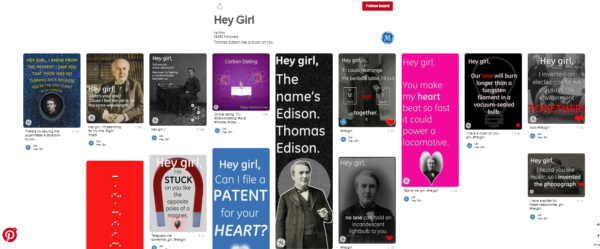
Rather than attempting a wholesale personality change, why not try it in small doses? Weekly themes give you permission to break from the serious stuff. For example, CalSTRS’ Teacher Talk repeats each week and is expected by its audience. (My all-time favorite version of this is GE’s takeover of the Hey Girl meme — though in that case swapping out Ryan Gosling for Thomas Edison.)

ge-hey-girl-valentines-day (1)

Click to enlarge

Get insightful, human perspectives and fresh trends in content marketing through CCO magazine edited by Clare McDermott. Subscribe to the free print version today.

Cover image by Joseph Kalinowski/Content Marketing Institute

The post How 3 Serious Brands Engage Humanly on Social Media appeared first on Content Marketing Institute.

Monday, October 9, 2017

How to Deliver Emails That Will Increase Reach, Impact, and Subscriber Satisfaction

email-increaste-reach-impact-subscriber

Editor’s note: Because email marketing continues to be one of the most used and most effective cornerstones of content marketing, Jodi Harris updated her 2015 article.

Think of a well-executed email strategy as the backbone of a successful content marketing program. It’s an essential structure that supports your various content efforts and is the best technique for building a subscriber base – which is critical for achieving value from your content marketing program.

Just how important is the email channel? Consider this: 93% of B2B marketers report using email to distribute their content, according to CMI/MarketingProf’s B2B Content Marketing: 2018 Benchmarks, Budgets and Trends—North America research. And, perhaps even more importantly, 74% of marketers who use email consider it to be the most effective distribution channel for their content.

But, just like most things in the world of content marketing, email is not a set-it-and-forget-it tactic. Media trends, informational needs, and consumption preferences evolve; and people change careers, upgrade their devices, develop new interests, and discover new obsessions. If you aren’t prepared to maintain the effectiveness of your email content to ensure that your experience is always viewed as fresh, useful, and personally relevant, your once essential resource can transform into a fly-like nuisance that won’t stop buzzing in your reader’s inbox – keeping it from performing to its full potential.


Email is not a set-it-and-forget-it tactic, says @joderama. #emailmarketing
Click To Tweet


If you are looking to evaluate the fitness of your email content, CMI’s original 7-Minute Email Workout infographic is a great quick-start guide on how to test the strength of your e-newsletters and fine-tune your delivery strategies at all levels of experience – beginner, intermediate, and advanced.

Print

Of course, it never hurts to go the extra mile when it comes to enhancing the impact and performance of your email efforts. Here, I revisit my original article on the topic and add some fresh tips and takeaways from a few of CMI’s most trusted email experts. I also share some new examples to inspire you to branch out and get creative in how you use this channel to build and maintain your vital audience relationships.

Build a strong list

Your email content won’t do your business any good if you aren’t reaching the right people – or reaching enough of them to drive your content marketing strategy forward. Fortunately, there are plenty of techniques at content marketers’ disposal when it comes to attracting consumers who will be delighted by your email offerings.


Your email content won’t do your business any good if you aren’t reaching the right people, says @joderama.
Click To Tweet


As Aaron Orendorff explains, email list-building techniques typically fall into one of three main categories:

  1. Options – exclusive content offers, forms, and various types of button ads to tempt readers to opt in to hear from you regularly
  1. On-site techniques – landing pages, pop-ups, and other types of sign-up notifications to alert your site visitors to your subscriber-only assets
  1. Off-site techniques – Social media fans and followers can join your subscriber list without having to interrupt their social experience on sites like Twitter, Facebook, or Medium.

The most profitable online click is subscribe, says @iconicontent. #contentmarketing
Click To Tweet


For more details on each of these techniques, check out Aaron’s visual checklist:

Example: Salesforce’s sign-up forms

Salesforce takes a multistage approach to build its email lists. For instance, it initially attracts blog subscribers with a simple two-field form that clearly outlines what they are opting to receive:

salesforce-sign-up-form

The company also uses more detailed forms that require additional audience information in exchange for higher-value assets, such as its industry reports. The longer forms provide additional marketing benefits for Salesforce. They are used as a preliminary step toward customer qualification (i.e., identifying high-quality leads) and help the company to better tailor its outreach to the needs of individual consumers.

salesforce-signup-form-2

Craft meaningful, compelling messages

Once your subscriber list is filled with consumers eager to hear from your business, you need to take steps to ensure that they like what they receive. Sujan Patel reminds us that this boils down to creating email content that your recipients will want to read. Of course, this means your content needs to be well-written and focused on their interests (rather than your company’s); it also means you must deliver on the promises made to your email subscribers – including publishing on a consistent, reliable basis, and avoiding unwanted surprises and not bombarding them with content they opted out of receiving.

To make sure all your bases are covered, follow Sujan’s top recommendations summarized below:

  • Only send emails when you have something of value to say.
  • Keep your messages simple, focused, and concise.
  • Write great copy – or hire a professional writer to do it.
  • Go easy on sales-y messages.
  • Allow subscribers to customize the types and frequency of the messages they receive.
  • Invest in creating a well-thought-out design that will grab your readers’ attention from the get-go.

#Emailmarketing tip: Allow subscribers to customize type & frequency of message, says @SujanPatel.
Click To Tweet


Example: The 21-Day Self-Care Challenge

Nonprofit organization Move to End Violence issued a challenge to its audience members to become more impactful and strategic change agents by incorporating sustainable, mindful practices – like exercising self-care – into their everyday lives. According to the website, what started out as a short-term email campaign that invited social change-minded activists to receive one self-care tip a day for 21 days became a wildly popular ongoing content initiative – helping to grow Move to End’s email database from 400 to 11,000 subscribers in just over a year.

21-day-self-care-sign-up

Segment your list for increased relevance and impact

As a smart marketer, you surely recognize how important it is to create content that targets a particular persona – the audience member who will benefit most from the insights you plan to share. This is particularly true for email content, given how discerning today’s consumers are when it comes to allowing marketers to penetrate the inner sanctum of their inboxes. Remember, as CMI founder Joe Pulizzi always says, if your content is meant for everybody, it won’t end up benefiting anybody.


If your #content is meant for everybody, it won’t end up benefiting anybody, says @joepulizzi.
Click To Tweet


By segmenting your subscribed audience by known interests and communication preferences, you can deliver an email experience that’s more personally resonant as well as relevant – something that, according to Andrea Fryrear, will increase the likelihood that the recipient will do something with that content, such as sharing it.


Delivering #email content that's resonant will increase likelihood the recipient will share it. @andreafryrear
Click To Tweet


How do you gather the insights you’ll need to accurately characterize and categorize your email subscribers? Andrea recommends asking a few targeted questions at the start of your subscriber sign-up process to gauge their top priorities and engagement preferences:

  • How often would you like to receive emails from us? Daily? Weekly? Monthly?
  • What particular topics are you interested in?
  • What kinds of content interest you the most? Text? Video? Infographics?

Example: Eventbrite

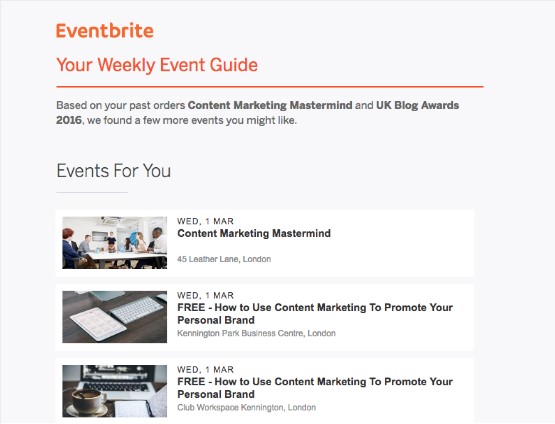
According to Eventbrite’s Mark Walker, the company recently updated its newsletter to personalize event picks based on the recipient’s stated preferences and order history. Not only does this technique increase the likelihood that recipients will find Eventbrite’s content to be relevant, the emails are algorithmically generated – so they can easily scale to target all subscribers regardless of how they are segmented.

Eventbrite-newsletter

Surprise and delight your recipients

Once you incorporate segmenting capabilities into your email program, you can adjust your email content in all sorts of ways – including how you get your messages to stand out from all the other emails your subscribers receive on a given day.

For instance, as Mathew Sweezey points out in his presentation at Content Marketing World 2016, your subject line and sender details (prime email real estate) are the only pieces of information readers have to quickly determine if an email is worthy of their attention. As such, he recommends customizing this valuable bit of real estate to speak to the recipient’s current stage in the buying process. Here are his guidelines for achieving this:

  • Stage 1: This audience is asking generic questions. They may not even know the keywords in that space. If they see a vendor’s name in the prime email real estate, they know the email is from a marketer. In the prime email real estate, don’t include keywords or brand names.
  • Stage 2: This audience is looking for social proof to support their research. Use the subject line to give them ammunition to get support from others. In the prime email real estate, use a keyword or brand name, but not both.
  • Stage 3: This audience wants to be assured that they have researched all the viable options before they make a decision. In the prime real estate, use a keyword and brand name.

Subject line and sender details are prime #email real estate – make them count, advises @msweezey.
Click To Tweet


Example: Xerox’s Get Optimistic

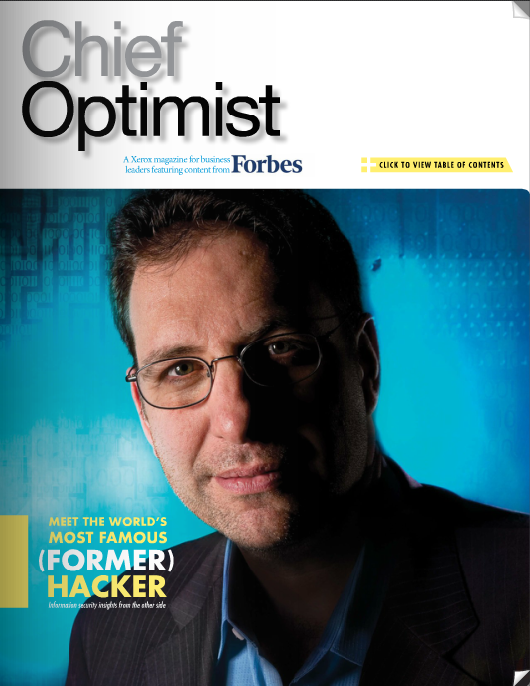
When the marketing team at Xerox was looking for a way to differentiate its messaging from its numerous competitors, the big, audacious idea it came up with was optimism. It started a biweekly email campaign targeted to CIOs called Get Optimistic, which provided a look at the future of technology, business, and the world through an optimistic lens. This e-newsletter quickly grew in popularity, leading the marketing team to expand it into a full-fledged print and digital content initiative – Chief Optimist Magazine – which has reportedly helped the company generate over 1,000 new sales appointments and more than $1 billion in pipeline revenue.

xerox-chief-optimist-magazine

Nurture your subscribers on an ongoing basis

Email newsletters may be one of the best ways to build and communicate with your target audience, but, as Gini Dietrich pointed out during CMI’s ContentTECH virtual event, there’s a potential flaw to consider: “New subscribers only see your new emails. They don’t see anything that came before it.”

To quickly help your subscribers – new and old, alike – get better acquainted with the value your business provides, consider creating an email drip campaign. As Stephanie Stahl explains, a drip campaign is a progression of pre-written marketing emails sent automatically on a set schedule or directly triggered when a reader takes an action – like signing up for an e-book on a particular topic, or registering to attend a conference or webinar your business is hosting. Below are some of the forms this useful technique can take:

email-drip-campaign-types-consider-600x282

By crafting a series of messages customized to address a topic or purpose, marketers can nurture their subscriber relationships and increasingly earn their trust. However, Gini cautions, unless you are certain the subscriber data is accurate, you need to be careful about using it to personalize an email. “Good personalization can help you convert. Bad personalization will actually kill your efforts,” she warns.


Good personalization can help you convert. Bad personalization will kill your efforts, says @ginidietrich.
Click To Tweet


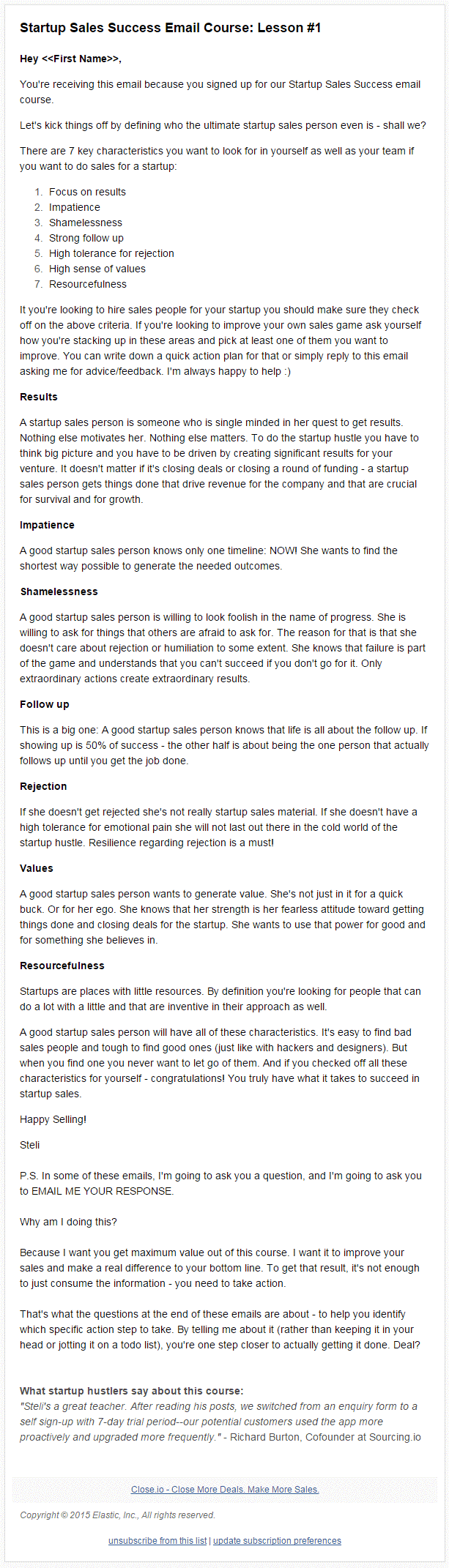
Example: The Start-up Sales Success Email Course

CRM provider Close.io created a drip campaign to deliver a free course designed to help start-ups get better at sales. At the bottom of the first email, a testimonial from someone already enrolled in that same course is included. What Sujan Patel points out is that testimonial doesn’t push (or even mention) Close.io’s products. Instead, the testimonial reinforces the value of the course, consequently addressing a key question (potential objection) that subscribers are most likely to have – is the course worth continuing with?

drip-campaign-example-293x1024

Click to enlarge

Measure and optimize

The above tips and guidelines will take your email content efforts far. But, as Jessica Best contends, you aren’t truly ready to unlock your “email rock star” badge until you are prepared to do two things:

  • Accurately measure the returns on your marketing investment – not just opens and clicks
  • Understand how to maximize your content assets and email framework

#Email rock stars measure returns on marketing investment, not just opens and clicks, says @bestofjess.
Click To Tweet


Jessica recommends calculating email return on marketing investment (ROMI) by taking the amount of revenue a campaign generated, subtracting your expenses for creating and delivering that campaign, and dividing the result by your expenses. (She also suggests visiting the email marketing ROI website for a simple calculation tool that comes in handy for this task.)


email-marketing-romi-600x300

Once you understand your baseline email ROMI, Jessica offers the following high-impact ideas for optimizing, enhancing, and amplifying your email content:

  • Look for ways to automate and extend the email experience, such as delivering your welcome message as a series of customer-nurturing (i.e., drip campaign) emails.
  • Ask for the referral: While sometimes this amounts to no more than a new subscriber or lead, it can also mean a purchase under the right circumstances.
  • Use motion to move your audience: Not only can including animation and relevant motion effects in emails add emotional appeal to your messages, it can drive up response rates up to threefold, according to Jessica.
  • Take advantage of video: While embedding a video in your email messages simply doesn’t work well in the inbox setting, there are ways to get around that. For example, you can offer text about why readers might be interested in watching and link to the full video.
  • Make email a two-way conversation: Use your email content to convey how receptive your company is to hearing from its audience by encouraging subscribers to ask questions and offer their feedback or even inviting them to take a detailed user survey.
  • Tell a great story: Even some of the most seemingly mundane of businesses can harness the creative muse and deliver an emotionally resonant experience through this marketing channel.

Example: Noodles & Company

Fast-casual restaurant Noodles & Company created a full-blown campaign to support email sign-up referrals, offering a chance to earn entries for its Travel the World sweepstakes. According to Jessica, the restaurant received almost three times the number of new email address sign-ups in one month as a result of the campaign, which also led to a 200% increase in monthly sales.

Noodles-and-company

Conclusion

Don’t overlook the value that email offers for strengthening your brand’s relationship with customers and prospects. Email may no longer be a shiny new tactic on the content marketing scene, but with the right strategy and a little upkeep, it still packs a powerful punch.

Got a great email content example to share? Let us know what we’re missing out on by posting in the comments.

Join us in a conversation about improving your email marketing with Sujan Patel on Tuesday, Oct. 10 in the #CMWorld Twitter Chat – 12 p.m. US Eastern time.

Want help in improving your content marketing program every day? Sign up today for the CMI newsletter (or weekly digest.) (And feel free to give feedback on our email marketing format about what works or doesn’t work for you.)

Cover image by Joseph Kalinowski/Content Marketing Institute

The post How to Deliver Emails That Will Increase Reach, Impact, and Subscriber Satisfaction appeared first on Content Marketing Institute.

Sunday, October 8, 2017

Why Content Creators Are Using This Simple Article Format to Draw a Bigger Audience

content-creators-article-format

You know this article format.

A glance through Content Marketing Institute’s recently published posts, Growthhackers Must Read articles, or BuzzSumo’s most-shared marketing content from the past six months makes it clear – one blog post framework seems to be winning:

How (Company You Know) Is Doing (Something) to Achieve (Positive Result)

CMI posts included Smackdown Content Marketing Secrets From the WWE, How GE Gives Recruiting Content a Personality Lift, and How Health Catalyst Gets Results with Ungated Content.

GrowthHackers had How GrowandConvert Got 10k Hyper-Targeted Visitors in 3 Weeks, How Slack Generates 100,000,000 Website Visitors, and How Grammarly Quietly Grew its Way to 6.9 Million Daily Users in 9 Years.

What’s happening? I thought “being different” was crucial in driving content marketing success. Why are some of the best content creators publishing the same type of article over and over? And why are these articles so damn popular?


Being different with your content isn’t always the best model, advises @JDScherer.
Click To Tweet


Why this content model works

Let’s examine this article model from beginning to end.

Brand name recognition

Back in 2015, Nielsen wanted to determine why people purchased specific products. What did it find? Was it urgency, testimonials, color?

Nope. It was brand name.

nielsen-2015-purchase-study

SurveyMonkey found something similar in 2013, uncovering the fact that 70% of consumers first click on search results from “known retailers.”

When MarketingExperiments tested this hypothesis, it found that a branded page outperformed a non-branded one by 40%.

When I see headlines such as How Moz Used Adwords to Drive 1,000,000 Visitors or How Shopify is Building a $389 Million Brand With Content, I’m attracted by the inclusion of a brand which I believe knows what it’s doing and I already trust.

Rob Wengel, senior vice president and managing director of Nielsen innovation in the United States, has said that “recognizable brand names signify quality,” which is separate from that brand delivering quality. For a reader, recognizable brand names signify a greater understanding, a source of information they can learn from and trust.

Influencer involvement

This type of article also succeeds because of the relationship between author and subject. If I can get a recognizable brand name to champion my article, I’m halfway to viral.

And what have they got to lose? These articles are, by definition, exploring how awesome these companies are. They’re literally saying, “If (brand) does it, it must be worth trying.” The brand gets external links, a huge trust boost, and an increased brand awareness it probably doesn’t need (but never hurts).

Inherent trust

I can write about the need to A/B test your landing pages all I want. You’ll read the article and say, “Just another best-practice article,” and move on with your day.

But if I write, “We A/B tested click pop-ups over landing pages for our gated content and saw a 44.3% average increase across nine campaigns,” you’re far more likely to pause and say “Maybe I should give this A/B testing thing a go.”

This article model does just that.

cmi-inherent-trust-example

On some level, every modern content absorber is fighting for reasons to move on to the next piece. An article headline that details a real-life example and impact, though? At the very least, the reader knows that the strategies being discussed worked.


An article headline with an example of a brand readers trust goes a long way to getting clicks. @JDScherer
Click To Tweet


Proven format

Many of you have seen this graph from SerpIQ from a couple years ago, which breaks down the “best” article length.

serpiq-graph

Rand Fishkin, as he’s wont to do, debunked any “ideal” article length in a Whiteboard Friday in August, but the facts show longer articles tend to:

  • Get more social shares
  • Rank better in search results
  • Receive more comments
  • Receive more backlinks (and that stat’s from Moz, Rand)

No, long doesn’t mean better. Some topics need only 500 words. But in this article model, long form is necessary to take readers on a step-by-step walk-through. This type of article doesn’t have a headline like The Complete, 20,000-Word Guide to Facebook Ads. Its headline reflects its function – the strategy a trustworthy company is using to find success, with actionable takeaways you can implement today.

The best authors using this article model aren’t just presenting readers with the walk-through of another company’s strategy, they’re presenting those strategies with ways the readers can implement.

5 steps to use this article model

The best part of writing these articles is that they write themselves more often than not. I wrote one focused on Shopify’s inbound funnel and simply followed it down. My headings were the strategies I was exposed to (from SEO to content upgrade and a webinar campaign). My images were screenshots from that funnel, and my actionable takeaways were based on what I was seeing them do.

To create your own content using this article model, follow these five steps.

1. Identify an innovative company or thought leader

The most challenging part is determining what business to target. Once you get that down, the rest of the article follows a path set by them, not you.

Here are a few guidelines:

  • Identify a business that doesn’t feel too out of reach. Avoid mega brands such as Apple, Coca-Cola, or Salesforce, as it’ll be tough for your reader to relate to the strategies they’re implementing.
  • Identify a business implementing innovative or interesting strategies. It should be doing something worth writing about. Your article will be harder to write (and less interesting) if you pick a big brand name that isn’t doing something exciting.
  • Target a business doing something interesting related to your business. There’s no point in getting people excited about a strategy that doesn’t relate to your business.

Here a few suggestions of companies doing interesting things you may want to consider in the B2B and SaaS space:

And here are some ideas for the B2C industry:

2. Start your research

Explore the company’s sales funnel. Start with the first possible touchpoint. Try a search or display advertisement, a blog article, a press release, etc.

As you proceed through the funnel – from ad or article to lead generation to email marketing to sales prompt, take screenshots. Your article will be framed by that funnel.


If your content is about a process, take screenshots at each step, advises @JDScherer.
Click To Tweet


TIP: If you look into a single facet of the business like the type of content being published or a particular tactic’s role in the sale funnel, be sure go sufficiently in depth for your reader to understand the details.

3. Reach out to a representative

You want the company on your side before you publish your insight and observations about what it does. And, if possible, you want information from the company. Try something like this:

Hey [first name of contact],

Hope this finds you well. I am (your name) and was talking to your colleague, (name), and she mentioned you were the one behind (specific strategy you’re writing about). I’d like to congratulate you on putting together one of the most innovative marketing campaigns I’ve ever seen.

Your (specific strategy) would be an awesome topic for an article I would like to write. I would appreciate it if you would have the time for an interview to walk through what you’ve done and inspire other marketers to do something similar. Would you have 15 minutes this week to jump on a call so I can ask you a few questions about the thinking behind the strategy and if it’s performing for you guys?

I look forward to hearing from you! 

If they don’t have time for a call, send over a few questions and ask if they have time to respond that way. And if they don’t have time for that, write the article without their involvement, but share the link once it’s done. You’ll still get the bump from a recognizable brand name in your title and the brand will have been made aware your article is being published.

TIP: You also could use the word “interview” in the headline to indicate the brand’s direct input in the post – How (Recognizable Company) is Doing (Specific Strategy) to Achieve (Positive Result): An Interview with (Company Representative). Just be sure to still include actionable takeaways, don’t publish a transcript of your call.

4. Go a step above with design

Your article ideally will be at least 2,000 words and broken into several sections. As a result, a table of contents will help readers navigate.

You can format an automated table of contents within your article. The easiest way is to add a bit of html in the back end (don’t worry, it’s super simple).

Copy this HTML into the top of your article beneath your intro:

<h2 style=“text-align: center;”>Table of Contents:</h2>
<hr>

<ul>
  <li><a href=“#a”>Strategy #1</a></li>
  <li><a href=“#b”>Strategy #2</a></li>
  <li><a href=“#c”>Strategy #3r</a></li>
  <li><a href=“#d”>Strategy #4</a></li>
</ul>

And then, before each of your section headers, add “<a name=“a”></a>“ or <a name=“b”></a>, etc. At the bottom of your article, include this JavaScript:

<script>
  setTimeout(function () {
    var anchorlinks = document.querySelectorAll('a[href*=“#”]');
    for(var i = 0; i < anchorlinks.length; i++) {
      anchorlinks[i].setAttribute('target', '_self');
    }
  }, 1000);
</script>..

5. Promote to specific influencers

BuzzSumo research of 100 million articles uncovered some interesting stats about influencer outreach:

  • One influential share equaled 31.8% more total social shares.
  • Three influential shares equaled about 50% more total social shares.
  • Five (the magic number) influential shares equaled about 400% more total social shares.

5 influencer shares = 400% more total social shares according to @BuzzSumo #research via @JDScherer.
Click To Tweet


Note: BuzzSumo defines “influencer” as someone whose tweets are retweeted two times on average.

buzzsumo-influencer-shares

If you need assistance creating an influencer list, you can use a tool like BuzzSumo. After you create an account, click on the “most shared” tab and search for articles on your topic. Within those results, click “view sharers” to see and then add to a new influencer list.

Research the influencers before you reach out to them to better learn whether they might be interested in content similar to what you’re doing. Follow them on social media.

Then reach out to the influencer. Don’t go in cold. Nobody (and I’ve been “cold emailed” enough to know) likes being approached by someone who has just filled in the blanks of an obvious template sharing a recent article and a request to promote it. Personalize the outreach.

If the influencer follows you on Twitter, send a direct message mentioning that you just wrapped up an article that you think they’d be interested in, and that you’d appreciate their thoughts on a specific element of it.

If you can’t direct-message the influencers, send a tweet tagging them. Try to find an email address. Reach out through LinkedIn InMail. If you reach out to 20 or so influencers with personalized requests, you should yield the magical five social shares to amplify your shares 400%.

Final thoughts

This article model — in which the author identifies a recognizable brand doing innovative stuff and then analyzes that stuff, breaks it into bite-sized pieces, and presents it as doable with proof in hand — is a model predicated on that number of rule of content: Better content does better.

Who knew?

Any questions, or just want to chat about creating good content? Start the conversation in the comments.

Please note: All tools included in our blog posts are suggested by authors, not the CMI editorial team. No one post can provide all relevant tools in the space. Feel free to include additional tools in the comments (from your company or ones that you have used).

Want to learn more about how the companies you trust are doing content marketing for big success? Subscribe to CMI’s daily newsletter.

 Cover image by Joseph Kalinowski/Content Marketing Institute

The post Why Content Creators Are Using This Simple Article Format to Draw a Bigger Audience appeared first on Content Marketing Institute.