Friday, May 4, 2018

Content Marketing and Sales Alignment: Bridging the Gap [New Research]

CMI_LinkedIn_Research_CoverStop me if you’ve heard this one. Two psychiatrists walk by each other in the hallway. Each says, “Good morning.”  After they pass, each one thinks, “I wonder what he really meant by that.”

Have a look at the picture. What do you see?

abstract-image-example

If you are in marketing, you probably see a visual of something you work to optimize every day. It’s the representation of marketing process and efficiency. You work to put aggregate customer segments – audiences – into this funnel. It controls flow. Marketing people would say “I see a filter.”

But if you’re in sales, you likely see something different. You see layers of waypoints where target prospects sit. They are potential customers waiting for gates to open and move them to the next waypoint. You see the potential to choose specific relationships to foster, for trust to be established, and doors to be unlocked. Sales people would say “I see a gateway.”

And if you put the salesperson and the marketing person together, each might say, “What do you really mean by that?”

Classic battle between sales and marketing

The tension created between sales and marketing is one of the most well-documented relationships in the B2B environment. When that tension is healthy, it creates an innovative atmosphere where adaptation is encouraged, and customer value is created. Marketing ensures that sales teams provide consistency and context to the evolution of the customer’s long-term needs. Sales teams push back on content development to ensure that individual customers are treated as partners rather than demographic targets.


Sales pushes back on content development to ensure that customers are treated as partners. @Robert_Rose
Click To Tweet


When it’s unhealthy, the relationship festers. Fingers point. Blame is held. Marketing claims, “We are generating more leads than sales can handle.” Sales responds, “Marketing’s leads aren’t worth our valuable time.”

Over the last few years, maintaining alignment between sales and marketing teams has become one of the most complex challenges for B2B enterprises. Today, B2B sales professionals face an environment where the relationship between them and their prospective customer has fundamentally changed.

It would be easy to chalk up these changes to the internet and the ease with which buyers can gather information. But it’s not that simple. The digital and social world has changed the buying process too. B2B buyers have new challenges and are under more pressure to make the right decisions in an ever more complex marketplace.


B2B buyers are under more pressure to make right decisions in complex marketplace. @Robert_Rose
Click To Tweet


B2B marketers understand this, and B2B sales professionals realize that prospects are usually highly educated by the time they connect with sales. Shouldn’t sales trust the content that marketing produces to do more of the initial relationship building? Why are B2B enterprises reluctant to invest in a strategic approach to content?

Three words: lack of alignment.

But what happens when there is alignment – in particular, between content marketing and sales? That’s the question the CMI research team pondered prior to conducting a new study on the topic with LinkedIn this year. Specifically, we wondered:

Can better alignment between content marketing and sales serve as the key for a broader, more strategic alignment between sales and marketing – and drive more success?   


What happens when there is alignment between #contentmarketing and sales, asks @Robert_Rose. Read more>>
Click To Tweet


In other words, if sales had a better understanding of content marketing — and the role content plays along each phase of the buyer’s journey — could the alignment between marketing and sales improve with frequent collaboration and shared incentives?

Conversely, if marketers understood that the funnel they see as a filter is also a gate — and that prospects have personal and unique needs that sales must address — could they deliver more valuable content?

CMI’s new research with LinkedIn indicates the answer to those questions is yes.

Highly aligned content marketing and sales teams do things differently than those with low alignment

CMI and LinkedIn surveyed 1,246 marketers around the globe representing a range of industries. Narrowing to the 208 B2B marketers in North America, we found:

  • 46% report their content marketing and sales teams are highly aligned.

46% B2B marketers say their #contentmarketing & sales teams are highly aligned. @cmicontent @linkedin
Click To Tweet


  • 75% of those reporting high alignment have a documented content marketing strategy.

75% B2B orgs whose content marketing/sales are highly aligned have documented strategy. @cmicontent @linkedin
Click To Tweet


  • The difference in how often highly aligned and less well aligned content marketing and sales teams collaborate on content-related activities was significant.

cmi-linkedin-research-frequency

  • When asked which one factor would most strengthen content marketing and sales alignment within their organization, the less well aligned marketers’ top response, by far, was “a company culture that encourages alignment/collaboration.”
  • Alignment empowers marketers to build a better business case for content marketing. Consider:
  • 61% of those with high alignment expected their content marketing budget to increase in 2018 (versus only 35% of those with low alignment). There was much higher uncertainty about content marketing budget among those that are less well aligned. This suggests that highly aligned marketing and sales teams are proving the value of their efforts, either through revenue and/or pipeline growth (which they indicated are their top two success metrics), or other ROI metrics.

Alignment empowers marketers to build a better case for #contentmarketing, says @robertrose.
Click To Tweet


cmi-linkedin-research-expected-change

We not only found ways content marketing can help align sales and marketing, but also uncovered best practices for how misaligned teams can increase their ability to work in concert. You can find the complete results in this white paper.

Interestingly, the results showed that content marketing may be the bridge to bring together the sales and marketing teams in a meaningful way. Content marketing might be the key to sales and marketing understanding, “What did they really mean?”

Today’s B2B buying process makes content more critical than ever

For deeper insight into the challenges today’s B2B buyers face, consider the following:

  • B2B buyers are self-directed. Because of the asymmetry of information, B2B buyers are under pressure to self-educate. Their colleagues and bosses demand it. Today’s buyers feel they can no longer trust sales representatives to educate them on available solutions to their challenges. They have a responsibility to understand the solution set more than any salesperson they speak with. It shouldn’t be any surprise only 12% want to meet in person with a sales representative and 71% start their process with an unbranded search, talking with a sales representative via phone or online chat only when needed.
  • B2B buyers are teams. Today’s B2B buyers are more frequently part of cross-functional buying committees. Almost 70% of companies with more than 5,000 employees have four or more people involved in buying decisions.

Almost 70% companies w/ 5K+ employees have 4 or more people involved in buying decisions. @MarketingProfs
Click To Tweet


  • B2B buyers seek trusted advice among their peers. Today’s B2B buyer uses social media, search, and all manner of digital tools to connect with colleagues, other customers, and industry experts to acquire the information they need. And they are loath to encounter any pushy sales messaging or overt persuasion in the content they consume.

Thus, content that provides value to these buyers and avoids overt selling has become one of the most important keys to building customer trust. As one recent Forrester Research study puts it:

The empowered B2B buyer is neither concerned with how your organization is structured and who’s responsible for the content on your website, nor are they interested in talking with a sales rep simply because they downloaded a white paper. Your buyers want contextual interactions with both human and digital assets across a holistic, but non-linear journey.

But that brings us back to the inkblot, and the joke about what do you really mean? Marketing and sales professionals in many B2B organizations have fundamentally different views of the customer journey process. Marketing and sales struggle in developing a common vision for the inkblot of the funnel at a broader level. That leaves the strategic content marketing inkblot – still seen as an experiment even within marketing – as an abstract unicorn or butterfly in most B2B enterprises.


#Marketing & sales in B2B orgs have different views of the customer journey process. @Robert_Rose
Click To Tweet


Content marketing – challenge of a common vision

Over the last decade, CMI has seen content marketing as a practice that provides an innovative approach for B2B companies. However, in many ways, a consistent, strategic, and scalable approach to content marketing has remained separate, elusive, and mostly ad hoc in many organizations.

CMI’s 2018 annual research found that only 20% of B2B marketers say their organizations are extremely committed to the approach of content marketing. And, only 24% say their organizations are “extremely” or “very” successful with the practice.

Further, more than half of those B2B marketers say their content marketing consists of a “small (or one-person) team” that serves the entire organization.

What are the reasons for such a minimal commitment of investment to content marketing?

For starters, when CMI asked B2B marketers if they measure content marketing ROI, 65% said “no” or “unsure.” Without metrics, marketers can’t build a business case for content marketing, which is key to expanding resources needed.


W/ out metrics, marketers can’t build case for #contentmarketing which is key to more resources. @cmicontent
Click To Tweet


From the sales perspective, far too much marketing content goes unused by sales. One reason is because many sales professionals don’t understand their company’s content marketing strategy.

And yet the fact remains that most B2B buyers are conducting research on their own, which means they need content – informative, quality content. If a strategic approach to content marketing is taken, it’s more likely that content marketing and sales will collaborate to make sure that type of content is accessible. That collaboration creates better opportunities to create alignment between content marketing and sales, which may also be the key to a broader sales and marketing alignment within the enterprise.

We marketing folks may never see the inkblot the same way as sales does. But as long as we are aligned with sales, we can avoid having any, you know, Freudian slips along the way.

We hope you find the research valuable.

To download the results from the LinkedIn and CMI research – and get started on better alignment between sales and marketing in your organization – click here. 

Content Marketing World offers an opportunity for sales and marketing to build bridges. Register today using code BLOG100 to save $100. 

Cover image by Joseph Kalinowski/Content Marketing Institute

The post Content Marketing and Sales Alignment: Bridging the Gap [New Research] appeared first on Content Marketing Institute.

Thursday, May 3, 2018

How to Use Social Media to Get More Speaking Gigs

How to Use Social Media to Get More Speaking Gigs

When you’re just starting out as a public speaker, it can be a challenge to find actual speaking gigs. In the past, speakers had to rely on sending out cold emails or reaching out to former colleagues to get invites to industry events and conferences.

But social media has made finding speaking gigs far simpler.

Here are some ways you can begin leveraging social media to land speaking gigs:

LinkedIn for landing speaking gigs

Not only is LinkedIn great for networking with other professionals in your industry, but your LinkedIn profile has a better chance of ranking in the search results than your own personal website pages. This is beneficial and allows event organizers to find you easily. That is, as long as you:

Optimize your keywords to reflect your expertise

What are public speakers, really, if not subject matter experts? When event organizers search for speakers, they are searching for people who have knowledge on a certain topic.

For this reason, it’s important that you use specific keywords related to your expertise throughout your profile, particularly in sections like your summary and job descriptions.

Not sure what keywords to use?

Think from the perspective of an event organizer. If you were looking for a speaker like yourself, how would you search for you? What words would you use? You may use broader keywords and phrases in your headline (social media), and more specific keywords in your summary and job descriptions (Twitter, LinkedIn).

Call yourself a public speaker

This tip may seem obvious, but many burgeoning public speakers completely overlook it. You will have noticed that LinkedIn automatically populates a job title for you when you create a profile. But you are allowed to remove this title and replace it with your own wording.

By simply adding the title “public speaker” to your title, you will not only optimize your profile to turn up in LinkedIn’s results for “public speaker”, you will also optimize it for Google’s search results. As I mentioned earlier, your LinkedIn profile will more than likely rank higher in the search results and therefore be found more easily. Should someone be searching for public speakers in your local area, your profile will turn up.

Create a separate job description for “Public Speaker”

You’ve already sprinkled your other job descriptions with keywords related to your topic of expertise, and that’s a great start. But let’s take it one step further by creating an entirely separate job description for “public speaker.” This will allow you to speak directly about your public speaking experience.

You will want to include how many keynotes you’ve delivered, the average size of your audience, and any positive feedback you’ve earned. Don’t forget to get those keywords in there, and be sure to mention your topic of expertise.

Make the case for your expertise

And speaking of your expertise, it’s time for you to show it off! Your summary section is where you’ll want to make the case that you are an expert in your field.

But before you begin writing, it’s important to mention that how you write this section is as important as what you say. The event organizers that are searching for speakers are first and foremost searching for actual people. Write your summary in the first person and be sure to keep the tone conversational.

And finally, as public speakers are ultimately storytellers, it’s important that you tell your personal story in this section. How did you get where you are today? What challenges have you overcome? What insights are you ready to share? If you can tell a compelling story in your summary, you make a very good case that you are a public speaker worth reaching out to!

To get you started thinking about what personal story you can tell, try and think of challenges you have overcome. What goals you have reached, and what some of the hard-earned lessons along the way have been.

Spend an afternoon brainstorming. On a piece of paper jot down some of the main events in your life and what you learned from those events. It’s important that your story and overall message be positive. Avoid focusing on negative emotions like loss or failure. Though the events you share may have been challenging, ultimately you want to end on a high note that inspires the reader, just as you inspire audiences through your speeches.

Share your speaking videos

If you have one, it’s a great idea to share your speaking reel. This can go right under your summary, so people immediately see you in action. If you don’t have a produced reel, consider embedding two or three full-length videos in this section to entice event organizers to contact you.

Blog on LinkedIn

Take advantage of LinkedIn Publisher and blog about your speaking experience. When you blog about the very topics your speeches cover, you further establish yourself as an expert in your field.

When it comes to what content you are allowed to publish, you have two options: original (always recommended) or republished guest posts that are living on other blogs. If you go with this second option, just be sure to get permission from the blog owner first. If you aren’t able to get permission, you will simply need to feature these posts you’ve written for other sites through the “Add Media” option.

Ask for recommendations

After each speaking engagement, ask the organizer of the event if you may send them a recommendation request through LinkedIn. When sending these requests, be sure to specify the position the recommendation should fall under – in this case the “public speaker” position you’ve created. Now when visitors look at your profile, one of the first things they’ll see are your recommendations.

Twitter for landing speaking gigs

You may think that LinkedIn is the best, or only, social media platform for landing speaking gigs because it is a social hub for professionals. But many speaker bureaus and meeting planners use Twitter as well, and what better way to know what they’re looking for than to follow and interact with them. When you reply to their posts, there is a very good chance they will take a look at your optimized profile, see a link to your website, and click on it to find out more about you.

Now, it’s important to mention that you must already be active on Twitter before you start following people you hope to connect with. How will it look if an event planner clicks on your profile and sees only three old posts? Not very good.

You don’t have to Tweet 20 times a day, but you should be sharing content daily and consistently. Also, be sure to use hashtags that are relevant to your topic and industry. This will help you be discovered by the right people. Not sure which hashtags to use? Take a look at some of the thought leaders in your industry to see which hashtags they’re using.

And finally, a great way to establish yourself as an expert on your chosen topic and “meet” people who may want to hire you is through Twitter chats. Are you scratching your head right now at the mere mention of Twitter chats? No problem, check out this comprehensive guide that will get you started.

Facebook for landing speaking gigs

If you thought Facebook was only good for rubbing your friends’ noses in how great your last vacation was, you’re wrong. Although it is admittedly excellent for showing off scuba diving and camel-riding pictures.

Beyond optimizing your profile page to highlight your speaking credentials, Facebook allows you to advertise directly to the people who are most likely to want to hire you. That’s right, with Facebook’s ads, you can target meeting planners specifically, so only they see your ad.

So how would that look? Well, after you do a bit of research and find some local events you would love to be invited to, you create a promotional ad through your Facebook account and send it to only the handful of event organizers you select. In fact, Facebook even lets you upload a specific list of people to reach out to. When it comes to advertising, it really doesn’t get any better than that.

But here’s the really important part: you MUST have an awesome website to send people to. Once they click on your ad, your prospects will be sent to your website, so make sure they land on a page that best represents you.

Wrap up

Will getting your LinkedIn and other social media profiles optimized take a little time? Absolutely. But it will pay off exponentially when you start receiving more and more invitations to speak at events within your industry.

Guest author: Ashish Arora is the Co-Founder of SketchBubble.com, a leading provider of result-driven, professionally built presentation templates. Travelling the world to gather new creative ideas, he has been working in the digital marketing space since 2007 and has a passion for designing presentations. You can also find him on Twitter or LinkedIn

The post How to Use Social Media to Get More Speaking Gigs appeared first on Jeffbullas’s Blog.


Read Full Article: http://bathseoexpert.tumblr.com/post/173546637796

Content Tech Overload? 3 Questions to Ask Before You Buy

content-tech-overload-questions-ask

“Ever want to throw your computer across the room?”

When Cathy McKnight asks hundreds of tech-savvy marketers this question at the Intelligent Content Conference, many heads nod. And there’s a good reason.

“We’re expected to be content superstars,” Cathy explains. “We’re caught between automation and the human touch. How do we use AI? Where do we draw the line in automation? How do we keep our hands in the mix and not let technology take us over?”

As a one-time SAP coder who co-founded and now helps lead the enterprise consulting practice Digital Clarity Group, Cathy understands the content-technology overload marketers face. She knows large organizations’ content-tech stacks have many parts: marketing automation, analytics, content management systems, digital asset management, and so on.

And yet many organizations often lack a clear strategy for building those stacks. “A good strategy helps you get more use out of your technology and helps the tech last longer,” she says. “You don’t want to replace technology when you don’t need to.”


A good strategy helps you get more use of your technology & helps the tech last longer. @CathyMcKnight
Click To Tweet


Yet, when she asks the ICC audience, “How many of you have a martech-stack strategy that talks about integration and team and training?” only one hand raises.

Would you have raised your hand? If your hand is still at your side (or even if it isn’t), stop asking for or accepting new content tools or technology until you answer these questions, derived from Cathy’s ICC talk, Content Tech Overload: Four Pillars and Five Tenets of a Successful Content Technology Strategy.

1. Do I understand what’s available in the content part of our martech stack?

You may have seen this image, which shows the ever-growing landscape of marketing technology.

growth-marketing-technology-landscape

Image source

Here’s a close-up of the 2017 Martech 5000 chart, which shows over 5,000 logos grouped into categories. Cathy highlights in orange all the categories that affect content professionals – nearly the whole chart.

martech-5000-chart

“You may look at those 5,000 logos (3,500 of which are unique) and say, ‘I work with content. Most of that doesn’t apply to me.’ You might think that only the section labeled Content & Experience Management applies to us,” Cathy says. “In fact, most of these areas do apply to us as people responsible for content that delivers the experiences that our customers and our contacts want to have.”

Even marketers who “never want to get any closer to a piece of technology than the keyboard in front of them to enter content” need to understand which pieces of technology affect the content. If you don’t understand how content experiences are getting delivered to customers, you can’t make strategic decisions.

You probably have much more technology in your organization that impacts content than you’re aware of. Most importantly, Cathy says, “Find out which parts of the content stack your company most relies on and take care of those pieces.”

TIP: Form partnerships with other teams

Reaching across department lines and working regularly with people on other teams that relate to content technology can help make sure you’re getting the most value from existing and new technology investments.

Cathy says, “Get on a first-name basis with people on your IT team. Set up a time – maybe every other week or every month – to talk about things that are coming up, things you’re thinking about, things you wish you could do with your technology.”


Marketers, get on a first-name basis with people on your IT team, says @CathyMcKnight.
Click To Tweet


2. Does the team have the skills to use the tools?

To make your content sing, Cathy says, you may not need new or top-of-the-line technology. You need top-of-the-line teams, including marketing, editorial, IT, and maybe business intelligence, administrative, and others. Those teams need the skills to use, support, and integrate your content technologies with other parts of the business.

“Skills aren’t just about learning the user interface. They’re not just about understanding how to send a campaign or how to post a blog post. They’re also about understanding how the content works within the technologies: where it’s transferred, where it sits,” Cathy says.

Some team members, for example, may need training to gather and use data to make their lives as content providers easier and to enable your content to reach more prospective customers.

The point is, companies can’t just drop technology in people’s laps. Though that happens all the time, Cathy says. Somebody buys a tool, points everyone to an hour-long training video, and says, “Now go! Make a return on that investment! We just spent a half-million dollars on this technology; make it work!”

TIP: Audit team skills

Do a skill-set audit to find out what people know how to do and their comfort level in using each technology. What training is missing? What would they like to learn to do?

“You may discover that someone in an analytics role or other technical role is super creative and would like to help generate some of the social content,” Cathy says.

In addition to helping with planning for tools and technology, a skill-set audit provides a strategic benefit when it’s time to hire someone. “Wouldn’t it be great to understand the gaps on your team so that you could bring in people who can fill those gaps?” Cathy says.

HANDPICKED RELATED CONTENT: New Tech Friends on the Marketing Block

3. What’s our content-tech strategy?

“Oooh, we want that. We need that!” New technology – whether it’s right for you or not – can be tantalizing. Vendors may want you to believe that without some shiny new thing you will fail.

But is that shiny new thing for you? Without a road map, it’s hard to say. To take stock and create a strategic road map, Cathy suggests asking these questions:

  • If we bought that functionality or tool, could we adopt it?
  • Are we in a position to use it the way it’s intended?
  • Do we have the processes?
  • Do we have the skill sets?
  • What are our capabilities?
  • What direction are we heading in?
  • Is now the right time to acquire it?
  • Can our technology already do those things?
  • Will it help us meet our corporate goals?

After you answer these questions and others like them, plot a technology road map. Maybe you’ll map your way to buying a shiny object or maybe you won’t. You may find you can achieve what you want to achieve by adopting new features, functions, and innovations within your existing stack.


Plot a content-tech road map to be strategic about your tech use and purchases, says @CathyMcKnight.
Click To Tweet


TIP: Make friends with content technology

To create the most useful road map, get over your fears or insecurity around technology. “Be the one who can go to your IT department and say, ‘I heard that our CMS in the next release is going to have x functionality. I think we could use that. Are we in a position to adopt that?’” Cathy advises.

When you can envision the impact the content technology will have on the company and how it will help the organization succeed, you’ll have what you need to get buy-in from senior leadership

Take control of content-tech decisions

Frazzled. Frustrated. Confused. Those are the words Cathy uses to describe today’s marketer in relationship to technology. Tools hamper us even as they enable us.

Stepping back and thinking strategically about all those tools can make all the difference.

Cathy offers some ways to do just that:

  • Get to know the parts of your martech stack that relate to content.
  • Audit your teams’ skills – and address the gaps.
  • Form partnerships with other teams.
  • Help create a content-tech road map.
  • Measure before you act (and think before you measure).

As you do these things, you’ll be well on your way to developing a content-technology strategy that could inform your company’s technology purchases for years to come.

Here’s an excerpt from Cathy’s talk: 

Create your road map and then learn about the shiny new objects (and a lot more about content marketing) at Content Marketing World Sept. 4-7 in Cleveland, Ohio. Register today using code BLOG100 to save $100.

Cover image by Joseph Kalinowski/Content Marketing Institute

The post Content Tech Overload? 3 Questions to Ask Before You Buy appeared first on Content Marketing Institute.

Wednesday, May 2, 2018

6 Easy Ways To Boost The Efficiency Of Your Sales Pipeline

6 Easy Ways To Boost The Efficiency Of Your Sales Pipeline

No matter how simple and common the job of a sales rep sounds, it still requires a lot of patience and steady positivity to drive leads from the initial contact stage to the final deal closure stage.

Every business thrives on customers and with a good sales team, more leads mean more customers.

So what exactly is a sales pipeline you may ask? Sales reps acquire leads, connect and capture their interest, market products and services to solve pain points and ultimately close the deal; all these steps constitute a process that’s called a sales pipeline.

Building a successful sales pipeline mainly means that sales reps are able to lead more contacts from the initial stage to the deal closure stage to become customers.

The possibility of a high win rate at sales may seem like a distant dream for every salesperson, but it isn’t impossible. The key step in this process- Prospect, Prospect and keep Prospecting!

Brian Tracy of Brian Tracy International has rendered some sound advice in this perspective – “Keep your sales pipeline full by prospecting continuously. Always have more people to see than you have time to see them.”

Setting up a process to increase your customer base not only helps in fetching greater profits but also helps build long-term relationships that enrich and sustain brand loyalty.

Still wondering what a sales pipeline is and how it differs from a sales funnel?

While a sales pipeline is the sequence of actions that a sales rep executes to convert a lead into a customer, a sales funnel is the visual representation of the success rate at each step of the sales pipeline.

Although the main concept of a sales pipeline and sales funnel are the same, there is a vast difference in the insights or results that can be inferred from them. It is important to know the critical difference between the two in order to learn how to boost the efficiency of your sales pipeline.

Image Source

In order to understand the progress of each step of the sales pipeline, it is vital to take insights from your sales funnel. The coordinated analysis and tracking of the sales pipeline and funnel can help you accelerate the conversion rate achieved from your sales strategy.

How exactly can you perk up your sales pipeline efficiency?

Every time as an entrepreneur, when one sees the sales figures rise there is an inexplicable sense of elation!

How is this achieved? What are the points or processes where streamlining can result in better sales?

Here are 6 easy ways to boost the efficiency of your sales pipeline:

1. Track progress at each stage of your sales pipeline

Basically, a sales pipeline constitutes 5 stages and the vigilance of the sales team at each of these stages can prove to be critical to evaluate the success of the sales pipeline.

The 5 main stages of the sales pipeline include:

  • Prospecting
  • Qualification
  • Proposal
  • Closing The Deal
  • Repeat Business

It is important to assign reps in sales teams the job of evaluating the efficiency at each stage in order to surmise the overall success of the sales pipeline. Sometimes the clogging of leads at a particular stage can slow down the progress of the pipeline and can ultimately lead to loss of potential prospects and ultimately a lower conversion rate.

Thus tracking each stage of the sales pipeline can not only boost its efficiency but can also guarantee long-term business relationships with the chance of repeat buyers.

2. Understand the potential of your sales pipeline

Image Source

Every sales team needs to have a plan in place before starting to execute at each stage of the sales pipeline. It becomes vital for sales personnel to identify the potential opportunities at each stage of their sales pipeline and make the most of them.

For this, the first and foremost requisite is to understand whether the prospect or lead is at the ‘ready to buy’ stage or still requires ‘convincing and nurturing’ to be able to proceed to the buying stage.

Once this vital understanding is obtained then the process is fairly simple, sales reps need to adopt different approaches and strategies to make the maximum conversions happen.

Getting an idea of the number of possible conversions that can happen not only helps in boosting the success of your pipeline but also helps to predict when to slow down the lead generation efforts and when to fuel them up so that your sales pipeline management is smooth.

3. Push forth the velocity of each stage of the pipeline

I am sure as a sales rep your main aim would be to present a sales report at the end of the month that shows the highest conversion rate ever!

But for that, you would have to ensure optimal momentum and flow of leads into conversions out of the sales pipeline.

How can you possibly ensure something that seems like a huge challenge? It’s easy! All you have to do is track the speed of each stage of the sales pipeline and try to circumvent all possible obstructions.

Tracking the velocity of the pipeline includes ensuring constant prospecting and the setting up of metrics to measure the success rate at each stage of the pipeline.

It is estimated that if you are not connecting with all those on your database at least 1.8 to 2 times a year you are losing out on a huge chunk of potential sales profit. Hence it is important to prospect by contacting prospective customers on a regular basis.

As a kid I wondered why we had different parameters to measure our success at school, isn’t being good at studies enough? Why do I have to be evaluated at sports, moral conduct, artistic talent and a million other things when I am getting good marks in my exams?

Now I realize that there was a need to explore the potential of each child to help them grow into multi-talented individuals. Similarly, there is a huge potential in your sales pipeline and thus, at each stage we need to track its progress with the help of certain metrics.

Some of the important metrics that can measure your sales pipeline success include:

  1. Number of qualified opportunities
  2. Win rate
  3. Size of deals
  4. Sales cycle length

Each of these metrics will help not only estimate the success of your sales strategy but also help to map out the buyer’s journey in a systematic manner thus, aiding optimal changes in product design, marketing, and sales strategies.

4. Identify points of lead leakage and control lead loss

With continuous prospecting and an inflow of leads, sometimes tracking each lead’s progress across the pipeline becomes difficult.

This often results in unforeseen leakage of leads due to clogging at a particular stage or not enough nurturing.

Lead scoring can be extremely helpful in categorizing leads into sales-ready and those that still require nurturing. Lead scoring prevents clogging of leads at different stages of the pipeline and also helps in effective lead management.

Image Source

Controlling lead leakage and lead loss is an important step to ensure the efficiency of the sales pipeline. For this, the marketing and sales teams need to work together to make sure that leads who enter the sales pipeline are prospected, qualified, presented attractive proposals and ultimately converted to satisfied customers.

Even minor glitches in the proposal or qualification process can prove to be detrimental to the sales profit figures if not tracked regularly.

5. Increase the prospect influx with better acquisition techniques

There are several tactics and techniques that can boost your lead and prospect influx. Acquiring better leads and guiding them along the sales pipeline carefully to ensure maximum conversion is what every businessman aims for.

There are several techniques that can aid in better lead generation, these include:

  • Build an impactful blog. A blog can be a powerful tool to increase your outreach, capture your target audience’s interest and acquire qualified leads.
  • Create lead magnets. Video demos, free perks, discounts, reports and guides etc. are lead magnets that can ensure a steady influx of leads for your brand. These lead magnets need to be created carefully and promoted optimally for the acquisition of good leads.
  • Employ an efficient sales team. A sales team that works together coordinating different touch points of the sales pipeline can prove to be a valuable asset to your company. Moreover, tightly aligned sales and marketing teams can boost your pipeline efficiency exponentially.
  • Be active on social media. In today’s world, social media is where the world is! So if you want to have a big audience and an even bigger client base then you need to perk up your social media marketing tactics.

6. Use a pipeline management tool to boost productivity

Pipeline management is an important step to sales success. Pipeline management tools such as CRM Software, Marketing Automation etc. can accelerate your sales pipeline success significantly.

Managing the individual steps of the sales pipeline and providing vital information of the prospect’s purchase behavior accumulated from previous transactions are some of the most important benefits that can be obtained with the use of a pipeline management tool.

A few conclusive words

Building a sales pipeline is critical to a business set up and must be done well so as to ensure guaranteed results and profit. With the mentioned 6 ways to boost the efficiency of your sales pipeline, I hope I have given you tips that can help your business grow and succeed.

Guest author: Blogger, Content Developer & Editor. Amberlynn is a Content Marketing Professional and an integral part of DataCaptive since its inception. She holds a passion of tracking new changes in the ever-evolving business world and putting them down in the form of blogs to encourage intelligent discussions & thought exchange. Apart from writing, reading fiction and thriller novels are her major interests.

The post 6 Easy Ways To Boost The Efficiency Of Your Sales Pipeline appeared first on Jeffbullas’s Blog.


Read Full Article: http://bathseoexpert.tumblr.com/post/173515236086

Reddit for Marketing? Hell No, Except in This One Case

reddit-for-marketing

A couple of years ago, I wrote a blog post about Reddit for this very site. Before it published, I was sure it was going to be my Best Post Ever. I cleared my morning to handle the massive influx of comments.

Crickets.

Netting just over 400 shares, it was – by CMI’s standards – a dud.

I’ve since learned that confessing my undying love of Reddit to non-redditors creeps people out. Reddit has a strange and even repellant interface, though its engineers are working on a friendlier site redesign now. And when Reddit makes the news, it’s usually a story about the site’s trolls or less attractive underbelly (such as when redditors harassed innocent bystanders after the Boston Marathon bombing, implying they might be the bomber based on appearance alone).

If you’re not currently using Reddit, I’m going to try to convince you to change your ways. But before I do, here’s a Reddit 101 for those of you not familiar with the site.

What is Reddit?

Reddit is a collection of thousands of subreddits, communities built around a particular topic or idea. Some subreddits (called “subs”) are massive in size and scope (r/technology), while others can be pretty arcane (r/overlanding).

If you have a hobby, there’s a subreddit for that. If you have a problem, there’s a subreddit to help you cope. And there are thousands of subreddits devoted to things you didn’t know you wanted to know about (but do!), such as r/accidentalrenaissance or r/AnimalsBeingJerks. Each subreddit has its own rules, moderators, and vibe based on the people who subscribe to it.


Each subreddit has its own rules, moderators, and vibe based on the people who subscribe. @clare_mcd #Reddit
Click To Tweet


If you visit the site when you’re not signed in to a Reddit account, your “front page” will be a collection of popular posts from across the site – and that’s what usually turns new visitors off. As a little experiment, I took a peek at the top few posts on “popular” to see what a non-user would encounter when visiting Reddit for the first time (timestamp: 3:20 pm on 4/24/18). Let’s just say the editors of this blog would not allow me to post what I saw.

To understand why Reddit is awesome, you need to open an account. Without one, your view will default to what is interesting to the average user (my guess: a 20-year-old guy, living at home, eating Hot Pockets). Once you have an account, you can choose subs to join and customize what you see on your front page. That means fewer pictures from r/aww and r/BikiniBottomTwitter, and more posts from the communities you enjoy. Whenever I hear people say, “I don’t get it,” it’s because they haven’t joined subs that interest them.


To understand why @reddit is awesome, you need to open an account. @clare_mcd Read more>>
Click To Tweet


Reddit for Marketing? Tempting …

We’ve gathered here, however, not to talk about Reddit in general but to explain Reddit for marketing. I find it fascinating that most content marketers don’t understand just how popular Reddit really is. 

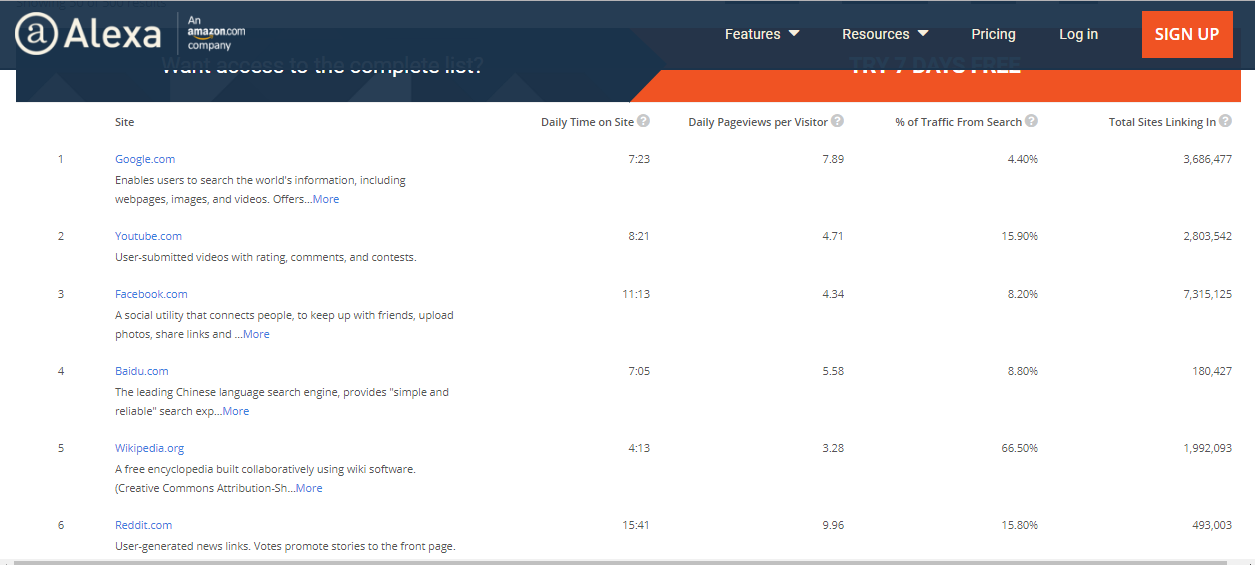
The numbers speak for themselves. A list of the top websites in the world, compiled by Alexa, shows Reddit comes in sixth, just behind Wikipedia. (Alexa’s rank is calculated using a combination of average daily visitors and pageviews over the trailing 3 months.) Even more amazing? Reddit’s average for daily time on site is more than 15 minutes, crushing the sites above it in the rankings, including Facebook and YouTube.


Of the top websites in the world, @reddit comes in 6th behind @Wikipedia via @AlexaInternet. Read more>>
Click To Tweet


alexa-top-website

In the last 30 days, Reddit had nearly 60 million unique visitors from the U.S. alone, more than 1 billion visits, and over 8 billion pageviews. Holy cr@p; that’s a lot.

reddit-unique-visitors

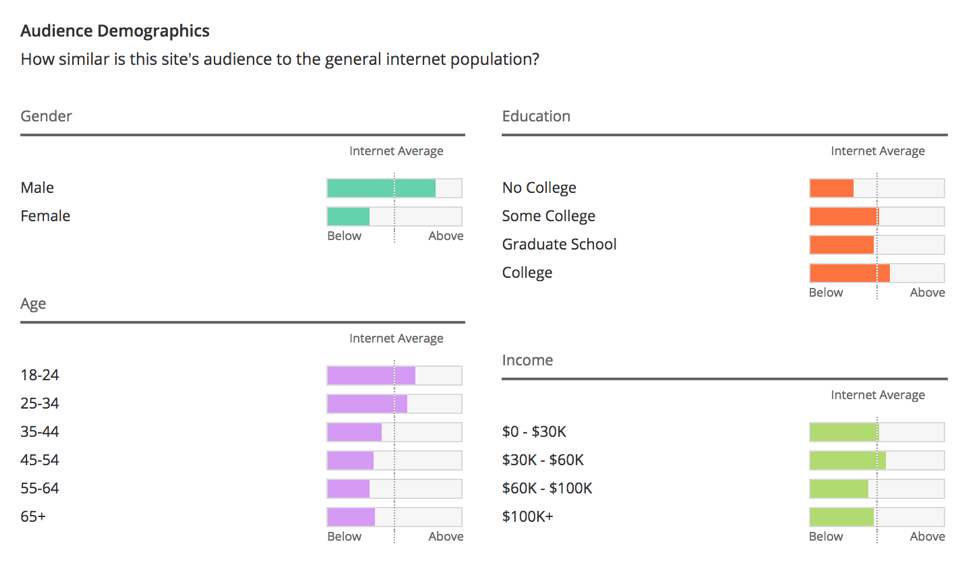
And Alexa confirms what I knew already from hanging around on Reddit: The audience skews young, male, and more educated than the average Internet user. (Individual subreddits differ significantly, of course.)

reddit-audience-profile

If Reddit’s audience is so massive and engaged, why don’t we hear marketers talking about it?


The #Reddit audience is massive, but it's hard for marketers to make inroads, says @clare_mcd. @AlexaInternet
Click To Tweet


But it’s fraught with peril

So far, it’s been exceedingly hard for marketers to make any inroads on Reddit – and that’s good.

Reddit (warning: massive generalization incoming) thinks of itself as different and better than more brazenly commercial sites like Facebook. There’s a knee-jerk suspicion of anything promotional or covertly self-interested in large part because the culture values the community over the commodity. That means marketers who go on Reddit to plug a product or idea are verbally disemboweled. There are legendary cases of famous people doing Reddit for AMAs (“Ask Me Anything” interviews) and bombing terrifically because they just didn’t understand the community’s unwritten rules. (You can read about some of these bombs in my earlier post.)


Marketers who go on @reddit to plug a product or idea are verbally disemboweled. @clare_mcd #socialmedia
Click To Tweet


Reddit has tried recently to push marketers into sponsored content, though I’m not convinced that’s working out well either.

A few weeks ago, QuickBooks organized a sponsored AMA with Julie Gordon White, an author and speaker who specializes in women entrepreneurs. There wasn’t anything wrong with the attempt; Julie seems like a likeable and interesting woman, and the microsite created by QuickBooks was decent. But with a measly three upvotes after three days, it’s clear something wasn’t clicking. (The conversation thread on the AMA was also fairly anemic, through no fault of Julie’s.)

quickbooks-ama-example

The right way to use Reddit for marketing

Therein lies the big problem: On a site where all users are anonymized (which tends to embolden snarky behavior) and where there’s a general disdain for marketing, what’s the role for marketers?


What’s our role on a site like #reddit, where there’s general disdain for #marketing, asks @clare_mcd.
Click To Tweet


The answer: Research, young grasshopper.

Reddit is a veritable gold mine of information relevant to your area of expertise, your audience, and your business. The number of subreddits on Reddit is so vast, it’s impossible NOT to find a community that matches your audience and its interests. Are your buyers statisticians? Hang out on r/AskStatistics, r/badstats, r/dataisbeautiful, and r/samplesize. Do you need to attract young programmers to your company? Why not join r/learnprogramming, r/programming and r/machinelearning? Interested in launching a new recipe microsite (poor timing .. but OK!)? Check out the most popular content on r/GifRecipes.

No matter what community you join, you can sort posts in a dozen ways to find the information you need. The best way to check and see if a sub is right for you is to sort by “Top – All Time.” You’ll quickly see what the community is all about.

And outside of the subs that match up with your business audience, you’ll find other cool subs to satisfy your learning needs:

The most important rule to observe

If you’re visiting a sub because it’s interesting from a marketing perspective rather than from a personal perspective, it’s best to keep your mouth shut. Listen without speaking (or typing).

If you really can’t help yourself and need to share something (whether a post or a comment), I advise you to:

  • Hang out as a subscriber for a while before you share
  • Read the sub’s guidelines in the righthand sidebar to ensure that you’re not running afoul of the rules

Keep your mouth shut in #reddit subs until you read the guidelines, says @clare_mcd.
Click To Tweet


Surprising rewards

If I still haven’t convinced you to road-test Reddit, consider this: When you join a community, there’s often a subtext or inside joke that you only understand after logging some time there. And much of my insider knowledge bleeds out into the real world ­– whether it’s understanding the subtext of my kids’ conversations or getting the joke in Twitter conversations. It’s as if Reddit is a middle-aged mom code-breaking tool to help me understand my older kids.

Just the other day I told my 18-year-old son to be careful driving that night because … you know… 420. His eyes widened into white orbs of surprise. My response?

“Reddit, honey.”

clare-mcdermott-reddit-subs

Here’s a code you won’t have to break: Use BLOG100 to save $100 when you register for Content Marketing World, which takes place Sept. 4-7 in Cleveland, Ohio. But hurry: Early Bird rates expire May 31.

Cover image by Joseph Kalinowski/Content Marketing Institute

The post Reddit for Marketing? Hell No, Except in This One Case appeared first on Content Marketing Institute.

Tuesday, May 1, 2018

How To Transform Your Blog Titles From Meh To Irresistible

How To Transform Your Blog Titles From Meh To Irresistible

Your blog post titles are just as important, if not more, than your content. Readers will look at your blog post title and decide whether they want to invest their time into reading the rest of the article or not.

As a writer myself, there’s nothing more frustrating than crafting a well-researched, thought-provoking article only to find it goes unappreciated, un-tweeted, and un-shared in the deepest and darkest pit of the Internet.

Before we deep dive into writing blog post titles that lure and engage visitors, let’s not confuse click-worthy headlines with clickbait. Sure, they are creative, but clickbait headlines are overly sensationalized and only meant to get clicks – not engagement or trust.

In this article, we will be focusing on how to write blog post titles that are creative, appealing, and attention-grabbing while not promising anything that your blog content can’t deliver. You want to keep your readers happy and satisfied – from the title to the content and down to the last point.

Here are 5 things to remember when writing a click-worthy blog post title that your readers will find irresistible.

1. Focus on one central idea and stick with it

A great blog post title must contain one (or two) fundamental pieces of information your article seeks to answer. Going back to Journalism 101, your headline should answer the 5Ws and H – what, where, when, why, who, and how.

The article Why Jon Snow Needs To Die focuses on two important questions, namely the who (Jon Snow) and the why (why he needs to die). I don’t know about you, but I am a die-hard Game of Thrones fanatic, and I’d gladly click on this link should I happen to stumble upon it on Facebook.

2. Keep it short and simple

Another way of writing a headline is to ask yourself, “How would I explain this blog post to a friend in just six words?”

Using the same example above, notice how the blog post title is limited to six words. In my journalism class back in college, we had this acronym – as a joke, though not entirely – KISS, which stands for Keep It Simple Stupid.

Make it a habit to limit your blog post titles to a number of words. Try five, or seven, or eight words. It doesn’t matter. Strict boundaries and limits often allow us to get more creative and force us to think outside the box.

3. Help readers solve their problems

Google has allowed us the venue to find fast answers to urgent questions. According to Moz, here’s how users interact with search engines like Google:

  1. A user experiences a need for a solution, answer, or piece of information;
  2. The user types in a string of words that describe what they’re looking for known as “the query”;
  3. The user enters the query into the Google search box;
  4. The user browses and scrolls through the results;
  5. The user clicks on a result;
  6. The user scans for an answer or a link to the solution;
  7. If unsatisfied, the user returns to the search results and clicks on another result;
  8. If still unsatisfied, the user performs a new search with a more refined query.

With these things in mind, you can then craft your headline as straightforward as possible if your blog post talks about a solution to a problem – no need for flowery adjectives and unnecessary details.

As a reader, I’d always ask myself, “What’s in it for me?” If a headline is more likely to offer something and show how it’s relevant to me, I’d be more inclined to click it and read the rest of the article.

4. Inject some attitude into your blog post title

Your readers will ignore your article if your blog title sounds and looks like something they’ve read before. Be different and make your title stand out from the rest of the pile by adding some attitude and personality.

Your blog post title doesn’t have to come off as patronizing, preachy, or plain arrogant. Notice how the word ‘actually’ in the example above added some color and perkiness to the headline. It arouses readers’ curiosity while still offering the answer to the question “what’s in it for me?”

5. Arouse curiosity without sensationalizing it

It’s easy to create controversial and sensationalized blog post titles – if you’re running a tabloid, that is, but let’s not dismiss the fact that we can still learn a thing or two from them.

Tabloid headlines often have the tendency to overpromise and underdeliver. Because their content doesn’t support and give justice to their overly sensationalized headlines, readers feel like they’ve been tricked into reading the whole article.

This is something you don’t want to do to your readers. Respect their time by writing headlines that promise nothing your content cannot fulfill.

With the example above, you’d be surprised to know that, as you read through the article, the guy the headline was referring to was actually a security expert speaking at a financial security conference in Las Vegas.

See? The blog post title underpromised yet over-delivered in the content. Headlines like this one from Gawker will leave readers happy and satisfied because I am happy and satisfied, and I feel like the time it took me to read the whole article didn’t go to waste.

These are just five of the many ways you can craft an irresistibly appealing blog post title to give your content the time and attention it truly deserves.

Over to you

Have you recently seen a blog post title so irresistible you can’t help yourself but click it? Share it with us in the comments section. We’d love to hear from you!

Guest author: Kristoffer Canimo has developed the love for writing headlines while he was the editor-in-chief of their newspaper back in high school. Now, he is a freelance writer and content manager currently based in the Philippines, and writes for Sydney-based businesses like JMAC Wealth. See more from Kristoffer by following him on LinkedIn, Twitter, and Facebook.

The post How To Transform Your Blog Titles From Meh To Irresistible appeared first on Jeffbullas’s Blog.


Read Full Article: http://bathseoexpert.tumblr.com/post/173483375096

The Secrets of High-Performing Online Content

secrets-high-performing-online-content

Good content is one thing, but great online content is another.

How do you define great content? Yes, it should be well-written, addictively readable, and hit home for its intended audience.
But it should also convert like crazy. After all, that’s the point of content creation for us, the marketers.

The good news is that content that is high-performing for us is useful for them, our readers. To reach this win-win, let’s look at what you can do to take your content from good to great, from “just OK” to high-powered, high-performing, and massively successful.

1. Use keywords based on target audience’s search intent

If you want your content to perform better to hit your goals, you need to scoop up the right traffic. Huge traffic numbers mean zilch if not one of those people takes action after clicking your link and consuming your content.


If you want your #content to perform better to hit goals, you need to scoop up the right traffic. @JuliaEMcCoy
Click To Tweet


To funnel traffic that will translate into high performance and conversions, understand how your targets are searching and which keywords they’re using.

According to Practical Ecommerce, there are four types of search intent – navigational, informational, investigational, and transactional. CoSchedule defines three of them in this graphic:

coschedule=saerch-intent

Here are deeper explanations of the search-intent types:

  • Informational intent – Searchers seek information. They want to find an answer to a question or a solution to a problem

Example: The bathroom sink is clogged. I perform a search to learn how to unclog a sink.

  • Navigational intent – Searchers seek a specific company or website. They don’t necessarily want to buy any of their products. They want help navigating to the site.

Example: Uncertain of my local bookstore URL, I search the name of the store and visit the site to find out the store hours.

  • Investigational intent – Searches with investigational intent hover between being informational and transactional in nature. People seek information to research future purchases and services they may want to buy, or companies they may want to buy from some day.

Example: I need a new pair of running shoes and want the best deal. I search types and brands to comparison shop and find the highest quality pair for the lowest price.

  • Transactional intent – Searchers are ready to buy. They search with keywords that are long-tail, specific, and intentional.

Example: I know the brand, color, and size of running shoes I need. I want to buy them and have them arrive by next week. I search for “Nike women’s Free RN Flyknit running shoes blue size 8” and find the best price and delivery time – and purchase the shoes.

transactional-intent-search-example

Target the keywords that hone in on the users’ search intent based on the action you want them to take. For example, if your goal is email list conversions, you might focus on informational intent searchers because they may discover you as a trusted source in your topic area. You might target keywords that begin with “how to” and ones that ask questions.


Target keywords based on intent: informational, navigational, investigational or transactional. @JuliaEMcCoy
Click To Tweet


Look at how This Old House targets users with informational search intent and encourages them to connect with home improvement professionals in their area:

informational-search-intent-example

Bottom line: Help your content perform better and make sure you target the right keywords and search intent to achieve your goals.

2. Make your headlines irresistible AND helpful

High-performing content starts with a high-powered, irresistible headline that makes people want to read more.

You may have read about formulas and tools to help you craft headlines proven to perform better. But what about your headline’s usefulness factor?

Does your headline accurately describe the content piece and let readers know what they’re in for if they keep reading? Or does your headline use sneaky hyperbole and clickbait tactics to mislead readers?

Does your headline set up realistic expectations for the content? Or does it ultimately let your audience down?

Your content should build trust with the reader, but you can’t do that if you start with a headline that stretches the truth or neglects important information.


You can’t build trust with readers if you use a misleading headline, says @JuliaEMcCoy. Read more>>
Click To Tweet


Here’s an example of a clickbait headline that’s misleading:

clickbait-headline-example

Is this jaw-dropping? No. Is the headline extremely misleading? Yes. The article reveals the kids are jumping into a swimming pool.

Here’s the interesting thing. Clickbait headlines don’t perform well. (Maybe this means people are catching on to the sneaky ways.) In a 2015 study, ReturnPath analyzed over 9 million headlines and subject lines and found that ones with common clickbait words performed below average as opposed to headlines focused on wording that emphasized benefits or urgency.


Headlines w/ common clickbait words performed below average via @returnpath.
Click To Tweet


clickbait-headlines-top-keywords

Compare the average read rate for headlines with clickbait keywords (the highest is nearly 13%) with the average read rate for headlines with words that connote benefits:

average-read-rate-keywords-benefits

The average read rate is much higher, spanning from 11% up to almost 33%.

Bottom line: Use powerful wording to create irresistible headlines. Use formulas and tools to help you craft them, but don’t oversell your content or mislead people about the value it provides. Aim to be helpful and enticing for best results.


Use powerful wording to create irresistible headlines, says @JuliaEMcCoy. Read more>>
Click To Tweet


3. Improve your writing flow

After you hook ’em with your headline, what keeps readers moving through your content piece?

It’s a few things, but a big one is how well your writing flows. How well do you carry your readers along your content river? How easy is it to follow you from point to point, line to line, and paragraph to paragraph?

Plenty of content creators make their readers lose interest (or just plain get lost) along the way because they create unnecessary hurdles such as:

  • Paragraphs that are too long
  • Awkward paragraph breaks and split-up thoughts
  • Tone that is too formal or stilted
  • Content that loses sight of the audience (i.e., you get too technical or too simplistic)
  • Rambling without providing any value

Avoid these mistakes and aim to improve your flow.

For a primer on good writing flow, study blogs that consistently make you want to read to the end of every piece of content. Jon Morrow’s posts on Smartblogger flow expertly, taking readers through his content without even realizing they’re continuing to read:

jon-morrow-smartblogger-example

Bottom line: Naturally guide your readers through your thought process, points, and information in a logical way – making them much more likely to complete a desirable action after they finish.

4. Include relevant, interesting images to illustrate your points

The power of images in your content should be blatantly obvious, given that we’re a visually oriented society.

BuzzSumo analyzed over 1 million articles to see how many with images were shared. Then it looked at the top shared ones to find telling trends.

Turns out, articles with images peppered in every 75 to 100 words got twice as many shares as articles with fewer images.


Articles w/ images peppered in every 75 to 100 words got 2x the shares as articles w/ fewer images. @buzzsumo
Click To Tweet


images-articles-shared

Include images throughout the body of your content that relate to and expand on the text. If you need inspiration, look at Neil Patel. He consistently creates content with examples, images, screenshots, and graphics to illustrate his points.

neil-patel-images-example

Bottom line: Provide relevant images that add context and illustrate your points. This not only makes your content more interesting, but also increases the chances that your readers will remember it.


Using images to add context makes #content more interesting and memorable, says @JuliaEMcCoy.
Click To Tweet


5. Show the value immediately

If your readers can’t figure out why they should care within the first paragraph or two, they won’t. They’ll bounce from the page. If you waste time with an introduction full of fluff, your reader will click away to find another piece of content that gets to the point.

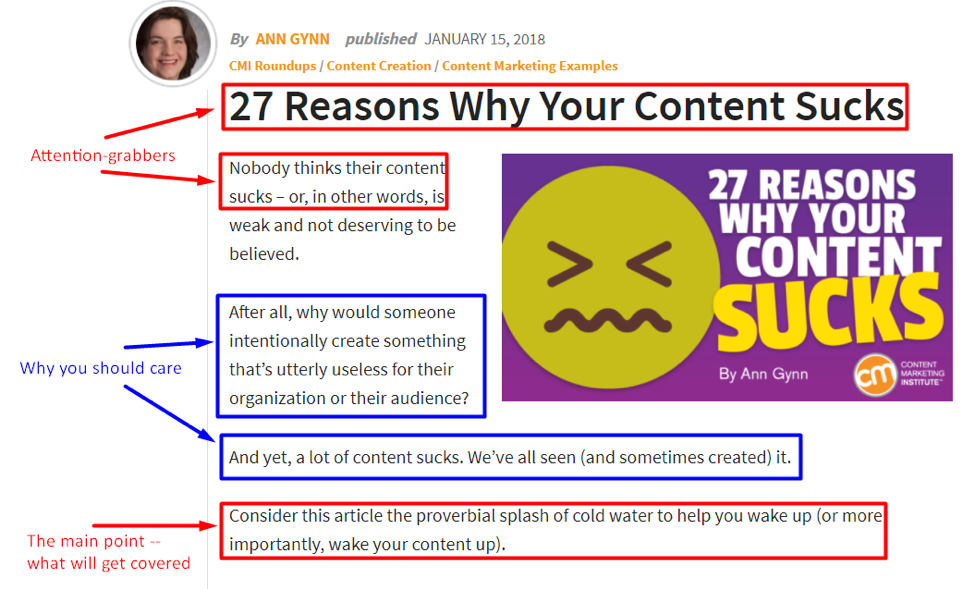
After you get their attention, tell them the topic, why they should care, and the main point you’re proving or explaining in the content. Remember, this isn’t high school composition. Throw the rules you learned there out the window and focus on writing to capture the attention of the average internet user.

Bottom line: Here’s a great example of an intro that works. It effectively grabs your attention and shows the value of the post immediately. Follow its lead and you’ll improve your content’s read rate as well as the length of time your reader stays on the page. Both add up to a better chance of converting.

article-showing-value-example

6. Create an utterly clickable CTA

High-performing online content ultimately inspires action. Of course, you can’t get readers to act unless you give them an opportunity. It should come in the form of a call to action – a link in your content that directs readers on what to do after they’re done reading.

CTAs come in many forms, but the best ones, the ones found in high-performing content, are utterly clickable:

  • They are tied into the content. Clicking the CTA should feel like a natural progression.
  • They use strong, persuasive wording (think powerful action verbs) that make readers want to click.
  • They are enticing –a graphic, a button, or linked action words in the CTA sentence.

This example from HubSpot accomplishes all of the above:

hubspot-cta-example

This CTA is related to the content, uses strong verbs (e.g., “download,” “learn”) and is enticing to click because it’s larger than the surrounding text, bolded, and in a color.

According to a HubSpot study, this anchor text CTA (a single line of text linked in the content) rakes in 47 to 93% of leads from posts where it appears. And, it works better when it shows up at various points in the content, not just at the end.

Bottom line: As you can see, a compelling, clickable CTA does a lot of work for a high-performing content piece. It’s the final push to get your readers to take that desirable action, so you need to make sure it counts.


A compelling, clickable CTA is the final push to get readers to take desirable action, says @JuliaEMcCoy.
Click To Tweet


HANDPICKED RELATED CONTENT: Words That Convert: Test, Learn, Repeat

Put all the puzzle pieces together

High-performing content doesn’t have one or two standout factors. Instead, it has many pieces that each contribute to its success – shares, conversions, sign-ups, or some other desirable reader action.

Think of it this way: A piece with a fantastic headline is nothing without a solid intro and value-added content. The first part grabs readers, the second keeps them on the page, and the third nurtures them, warming them up for the irresistible CTA.

You need each piece to inspire action and get results. Once you have all of them in place, your content should perform better than you ever dreamed.

Crafting content is both an art and a science. Learn more about each side of the practice at Content Marketing World Sept. 4-7. Register today using code BLOG100 to save $100.

Cover image by Joseph Kalinowski/Content Marketing Institute

The post The Secrets of High-Performing Online Content appeared first on Content Marketing Institute.