Friday, August 3, 2018

A Comprehensive Guide On Social Media Marketing For SaaS Products

A Comprehensive Guide On Social Media Marketing For SaaS Products

One of the many challenges that you will face when trying to raise awareness, generate leads and promote your product, is the fact that you have a rather limited resource pool to work with.

SaaS products are not exactly easy to advertise on all mediums and chances are you won’t be able to do it properly on a lot of them. Because of their digital nature, displaying them in action, using their strengths, and generally making them appealing is something that does not really work on more traditional mediums like TV adverts, radio promos, or even newspaper sections.

So, as the nature of the beast intended, you will have to turn to the digital advertising mediums, the most popular of which is social media.

But in today’s world, the average user is far too jaded and far too weary in order to blindly try anything and everything he or she sees. In order to win the attention of users and attract visitors, you need to make sure that your social media marketing campaign is done correctly and ingeniously.

But how? How can you make an outstanding social media marketing campaign for your SaaS product?

1. Prepare

Before you hit the market, you will need to know what the actual users are looking for as well as what needs they have, and how your product can satisfy them.

That being said, you will want to start off by scoping your target audience and deciding what demographic the campaign will be addressing. It is very important to decide properly on a strict core demographic, with a few auxiliary demographics that are in various ways related to the core.

If you already have dedicated visitors on your website, you can use tools like Google Analytics to get a better understanding of your audience’s interests and how to target people who might also be interested in your product.

preparation for social media marketing for saas

Image Source: Megalytic

Once you’ve settled on a demographic, it is time to see where that demographic usually hangs out online, what social media platforms they use the most, and where you can plan your campaign.

This way, you will know which platform you will be rolling your campaign out to and gain access to community influencers as well as the platform’s services.

2. Groom the product

This is a more aesthetically important task that needs to be taken care of before the campaign starts.

Simply put, it is all about making the product look as good as possible and as appealing as possible, without misleading the readers or making absurd and over-rated promises.

The best way to go about this is to break it down into different layers, depending on what will be used in the campaign.

For texts, like press releases, posts, blogs, you will want a writer. They are not difficult to come by, and a freelance writer will generally be rather inexpensive.

For photos and general graphics, you will want a graphic designer. These are a bit more pricey, but a good freelance graphics designer will generally be more affordable than ones contracted through services and companies.

For videos or animations, you will want to turn to a specialized service. This is because it is a lot more affordable, and a lot less time consuming than sourcing out the individuals by yourself.

Have your writer start writing drafts for promotional texts, and the graphic designer come up with visuals, that will be used throughout the campaign. Remember to highlight the positives, drown out the negatives, but refrain from sounding too commercial.

A great example here is Airbnb’s ‘Live There’ campaign where they motivated their users to not visit a place like a regular tourist would do but actually live there like a local, even if it’s just for a night.

The video received 11 million views and 56,000 likes on Facebook which means that it was a great hit for their target audience.

On Instagram, the ‘Live There’ campaign received over 50 million impressions and nearly 5 million video views.

grooming the product for social media marketing for saas

3. Launch the campaign

When the time is right, and you have everything that you need, you’ll need to pull the trigger and get the campaign rolling.

Start by contacting the chosen social media platform, and opting for their advertising services. Be sure to pay close attention to the options that are given to you, and that you think long and hard about which ones are the best ones for you.

launch the campaign for social media marketing for saas

This is also the time when you set the demographic and select who will be targeted by the ads themselves as well as on what devices it will be shown. A good rule of thumb is to go for both mobile and desktop platforms, increasing the number of people reached exponentially.

Whatever you do here, don’t roll out everything at once. Start using some of the texts that the writer has provided for you, and 1 maybe 2 of the graphics that your designer created for you. Keep the rest in reserve for later, so that you can mix things up and vary certain elements, thus extending the lifetime of the marketing campaign.

4. Choose a rhythm and stick with it

Something very important to note about marketing campaigns is the fact that they are always in motion. They never stick to one form for long, and there is always new posts, new concepts, new ideas and new elements thrown in every so often in order to vary things up and keep it interesting.

You will have to do the same for your campaign.

You will need to change posts, change graphics, maybe even insert a new element, like a short animation, a voice over, or a sponsorship, every now and again. This is to remind users that your product is still out there, still alive, and still great, plus you might raise more interest this way.

The main thing to remember here is the fact that you need a rhythm. Not too often, but not too rare either. As a rule of thumb, you might want to vary things up every 1-3 months, depending on the severity of the variation.

Once you’ve chosen a rhythm, stick with it. This will help you plan out your campaign further as it goes along, and give you actual time frames to work with, thus leading to better results and better advertising material used.

5. Attract external interest and influencers

Something that will prove vital to the success of your marketing campaign is the help of external interest and influencers.

Simply put, interest from outside the company and fan base that can promote your product, as well as influencers that have a large following in the field that you are advertising on.

The best thing that you can do is go through the community, see who are the most influential members, and reach out to them. More often than not you will be able to strike a deal with them which will result in more exposure and promotion for your product.

This can be done through blogs, videos, streams, as well as other forms of social media.

When we launched Setapp, the first subscription service for Mac apps, we did the same thing.

We opted to use Product Hunt because you can launch your product on the platform each time you add a major upgrade to it. Which helped us gain a bit more coverage and push our marketing campaign further.

However, in order to market our new Mac App Advisor system, we turned to our office cat, Hoover, for inspiration. We created a series of banners with pictures of Hoover giving app recommendations and ideas.

Coincidentally, our office cat shares the same name with Product Hunt’s founder, Ryan Hoover, who noticed the banners, liked them, left a nice comment and even sent a tweet about them.

Attract external interest and influencers for social media marketing for saas

This gave our product a lot of exposure and the much needed new interest that we were looking for. Soon enough more and more people were trying out our product and actively subscribing to it.

6. Keep the campaign rolling throughout the lifetime of the product

This is fairly self-explanatory, but the product itself needs to be promoted constantly throughout its lifetime. This is so that you can attract the maximum amount of interest in it, at all times.

The only times when you can consider stopping the marketing campaign is when you decide on releasing a new version or coming up with a new but related product. Even then you’re not exactly stopping the campaign itself but rather shifting it from one product to the other.

Remember to check up on it regularly, interact with the people that show interest in the product, as well as gather feedback and figure out more ways to improve.

Wrapping up

A social media marketing campaign might sound easy, but it’s not.

You will be constantly looking for ways to improve it, looking for ways to reach even more people, ways to generate more interest and ways to attract more and more sales.

As long as you plan ahead properly, prepare every single detail, go over your strategy, find the right people and keep putting in the effort, your campaign will undoubtedly succeed.

There are a lot of online marketing campaign success stories out there, and with enough work and a bit of luck, yours can be among them.

Guest author: Eugene Kalnyk is a Marketing Specialist at Setapp, the first Mac app subscription service which gives access to hand-picked apps for every job on your Mac. He loves writing about Marketing, PR, SEM, and Productivity, and help readers solve their problems. Meet him on Twitter.

The post A Comprehensive Guide On Social Media Marketing For SaaS Products appeared first on Jeffbullas’s Blog.


Read Full Article: http://bathseoexpert.tumblr.com/post/176590666181

Aon Shares Why Its Content Scorecard Is a Must

aon-content-scorecard-a-must

Editor’s note: Venetta Linas Paris is a finalist for 2018 Content Marketer of the Year. We’ll share insight from CMY finalists in the blog before the winner is announced at Content Marketing World in September.

We talk a lot in content marketing about how stories can engage, educate, and win over audiences. Yet many of us struggle to measure the impact of the stories we tell.

At a data-driven company like global professional services firm Aon, one-dimensional views of a story’s effectiveness (such as traffic or social sharing) won’t cut it. Marketing-qualified leads (MQL) and conversion rates aren’t part of the mission of the company’s brand journalism platform, The One Brief, so they’re not even part of the discussion.


One-dimensional view of a story’s effectiveness doesn’t cut it at @Aon_plc , says @Venetta_Beretta. #CMWorld
Click To Tweet


Instead, its Senior Manager for Content, Global Marketing, Venetta Linas Paris, and team worked with key business stakeholders to develop a scorecard customized to Aon’s needs and objectives for the platform. The work on The One Brief, which earned Venetta a 2018 Content Marketer of the Year nomination, holds many lessons for enterprise content marketers.

First, understand the goals

Serving as an advisor, Aon’s role is to help clients manage volatity and improve performance by making  smarter decisions about risk, retirement, and health solutions.

“Aon’s path with content marketing started with a desire to look at the problems our clients are trying to solve,” Venetta says.

The One Brief is designed to further demonstrate the business goal and reflect the role of a team of expert advisors. With analysis and guidance from expert sources across Aon’s global team, the digital publication covers three key topics:

  • Capital and economics – a wide, macroeconomic view of the world, focusing on the interconnectivity of the global commercial system
  • People and organizations – issues relating to demographic shifts and the impact they will have on people’s lives, particularly focused on health, retirement, and investment needs
  • Risk and innovation – emerging trends, new technologies, and potential threats that could impact your business, the global economy, and society at large, with an emphasis on preparing for possible changes

the-one-brief

“We designed The One Brief as a champion of brand journalism that helps the company better articulate a storyline across varying points of view to give our audiences insightful perspectives on important topics,” Venetta explains.

Aon has a strong brand, yet awareness of the global company’s range of capabilities varies among regions and even among clients. The One Brief aims to bridge these gaps.

“By investing in content that tackles broad issues and connects to our specific perspective, we are able to shift from general awareness – who Aon is – to understanding the breadth of what Aon does and the impact we make for our clients and society.”

Match measurement to objectives

To measure the effectiveness of this approach, Venetta and team developed a unique-to-Aon scorecard that helps determine success across each piece of published content. The scorecard is tied to these specific objectives for The One Brief:

  • Increase the understanding of Aon: Use journalistic content to showcase the expertise of colleagues and partners rather than selling specific products or solutions.
  • Decrease costs by centralizing content creation: As a global content platform, The One Brief acts as a center of excellence and a reusable content asset so solution line marketers can repurpose in campaigns and local marketers can translate instead of produce new.
  • Unite the firm: By pairing cross-functional points of view, the platform aims to unite the 50,000-plus employee base around a shared understanding of Aon’s capabilities.
one-brief-scorecard-example

Example for illustrative purposes only

As not all content is produced for the same reason, the scorecard helps Venetta measure success across a set of criteria. The team assigns a score based on factors such as:

  • Cross-firm point of view
    • Are we representing a firmwide point of view on critical issues?
    • Are we considering various geographies to ensure global relevance?
  • Audience engagement
    • How are our executive leaders leveraging this content?
    • How are our client teams leveraging this content?
    • How are our audiences across email and/or social media engaging with this content?
  • Marketing reuse and efficiencies
    • Is the content being translated into additional languages?
    • How are teams reusing this content in local campaigns?
    • How are we delivering this content to internal and external audiences?
  • Media interest
    • Which pieces have garnered the most interviews?
    • Are publications interested in reusing the content – as bylined articles or just picking up quotes?
    • If so, what backlink options exist?

The scores help Venetta make decisions about what kind of new content to create and what opportunities exist to further promote the content that has been produced. She’s found, for example, that articles with multidimensional points of view generally yield greater reuse, resulting in fewer one-off content pieces.


Articles with multidimensional points of view generally yield greater reuse, says @Venetta_Beretta. #CMWorld
Click To Tweet


Look beyond the content team

Venetta oversees The One Brief (and was the first employee dedicated to it) from the firm’s Chicago office. Aon’s managing editor of global publications works from the London headquarters. This arrangement helps create a balanced geographic perspective.

Beyond the two full-time employees on the core content team, the weekly content effort also involves:

  • Freelancers and an agency for interactive content production and writing support
  • Subject matter experts from business teams across all regions
  • Global marketing and communication leaders representing different capabilities and regions and geographies
  • Cross-functional teams that help lead and maintain channel distribution across email and social media, including media relations teams that help ensure consistent messaging across owned and earned channels, and pitch repurposed content to media outlets

Build on your results

Though she can’t share specific measurements, Venetta says The One Brief continues to exceed her and the team’s expectations.

By optimizing all of Aon’s owned channels and using no paid promotion, the site has achieved over 250,000 unique visitors between its launch in the third quarter of 2015 and first quarter 2018. Recent investments in paid promotion in the second quarter of 2018 have allowed the team to learn even more about how audiences respond to the content. Based on these pilots, Venetta, working closely with Aon’s global digital team, can continue to learn from data and adjust the content to better serve its audience across channels.

Based on the audience growth and engagement The One Brief has seen, the firm is beginning to use the platform as a proxy for overall brand impact. Audience engagement with the publication’s content serves as a bellwether for the audience’s understanding of Aon’s full suite of business offerings.


.@Aon_plc is beginning to use The One Brief platform as a proxy for overall brand impact. @Venetta_Beretta
Click To Tweet


While The One Brief has been instrumental in helping to unify Aon’s story, Venetta sees more opportunities to centralize content efforts across other channels, including events. 

And there’s more opportunity, she says, to promote collaboration and achieve cost efficiencies. Centralizing content creation already has increased content reuse and repurposing, so less content languishes in silos.

And, as more teams add their points of view to the site rather than creating their own content, Venetta expects cohesion of voice to become even stronger and more effective.

Never underestimate the power of story

“For as long as I can remember, I’ve loved telling stories,” Venetta says. It’s no surprise that her advice to content marketers focuses on seeing the story behind your brand’s work.

“Embrace the bigger picture,” she says. “Think like a journalist and find the story. Pursuing broad storylines can help create new perspectives in the marketplace while building credibility by focusing on a specific area of expertise.”

To find out live who is named the 2018 Content Marketer of the Year (and lots of things to help your content marketing program), register today for Content Marketing World Sept. 4-7 in Cleveland, Ohio. Use code BLOG100 to save $100.

Cover image by Joseph Kalinowski/Content Marketing Institute

The post Aon Shares Why Its Content Scorecard Is a Must appeared first on Content Marketing Institute.

Thursday, August 2, 2018

Why Interactive Email Is The Future Of Inbox Communication

Why Interactive Email Is The Future Of Inbox Communication

Email: the marketing bedrock. When everything else feels like a passing trend, email has stood the test of time and shows no signs of slowing down.

Every business can reap huge benefits from email, but what happens when your audience stops engaging? What if your open rates and clicks are suffering?

With so many businesses doing email and improving their email strategies, the competition for attention is fierce. But don’t worry, there’s an easy way to reignite your customers and prospects! It’s called interactive email. If you jump on the bandwagon now you will stand out as one of the most forward thinking, customer experience focused brands out there.

What is interactive email?

Interactive content is anything that requires a viewer to actively engage and participate with the content to access the full experience, usually by tapping, swiping, or otherwise physically interacting with the piece of content. Interactive email just incorporates that premise into an email campaign.

And while email is still playing catch-up when it comes to adding interactivity. There are a few ways to give your emails an interactive edge right now. Soon though, we expect emails to be on par with other web properties. Gmail for instance, seems to already be laying the groundwork for this to happen.

Interactivity in email

GIFS have been pretty prevalent in email lately. They’ve been around for a while but are swiftly gaining popularity as more and more social media services are allowing them to be used within their platforms (Twitter, Facebook, etc).

The best way to use these in an email campaign is to design your own, as Fundbox has done here. Just inserting a random GIF probably won’t make your audience sit up and take notice, and may even confuse them. Better to make sure it’s on brand and communicates your message effectively.

Video is tricky because most ESP’s (email service providers) won’t let you directly embed playable video into an email (although Gmail might soon be an exception to that). Clicking out to a video on a landing page, though, is easy and – bonus points – you can capture a bit of the action in a GIF for your email.

People are starting to get really creative in emails these days, including creating unique experiences that your audience can interact with. Creating a clickable experience that links to an interactive overlay or landing page is a great way to interject some personality into your routine emails. This also has the added bonus of feeling much more personal to your audience, which leads to people being 66% more likely to buy from you!

How and why should I use interactive email?

Interactive email has much higher open rates and click-through-rates than static email. According to Martech Advisor, “interactive email content increases the click-to-open rate by 73% and adding videos to your email content can boost click rates up to 300%.”

Additionally, in a recent survey of 1,000 consumers, they overwhelmingly chose to receive interactive emails over regular, static emails (82% to 18%!)

interactive vs. static for interactive email

The easiest way to incorporate interactivity into an email is with a GIF. Even just a funny GIF, inserted appropriately for your brand, takes almost no time but has a quick and easy impact on your audience.

However, if you really want the full benefit of interactivity, interactive experiences are really the way to go! Something that is customized for your brand feels very personal and will allow your audience to really connect with your message. Interactive experiences in email aid in brand recall, which in turn aids to customer loyalty. People will always remember brands that do something new, different, and fun!

Is it really worth it?

Your audience WANTS this! They’ve actually said that they would rather get an interactive email than an old-fashioned static email campaign.

Entertaining consumers with your unique brand voice through interactivity also helps them remember you, and if you have a particularly strong campaign, can even make customers want to share your campaign.

Interactive content also generates 4-5x the page views as static content!  Truly, if your emails aren’t making your audience smile, you’re probably doing it wrong (and getting a lot less traffic)! Interactivity helps with this by injecting some whimsy and delight into your email campaigns. Plus, the millennial cohort – the largest group of buyers – would rather buy from a brand that is fun, inspirational, and true to their own brand. What’s more authentic than an interactive experience that feels personal?

Not only do people buy, but they buy a lot more often. Interactive content converts nearly 3x over static content.

Real consumers had plenty to say about their email preferences, but these quotes really stuck out to us.

love emails for interactive email

tom of emails for interactive email

Not only is interactivity in email proven to work, but your customers are literally begging you for it.  If you haven’t tried incorporating a GIF or an interactive experience into an email campaign, start small. Yearly birthday emails are a great place to test the waters; everyone likes getting something fun on their birthday!

Get creative and incorporate various forms of interactivity into your email marketing. Your customers will thank you!

Guest author: Cheyenne Miner is a marketing specialist at Zembula where she gets to collaborate and coordinate with a team of marketing masterminds. On the weekends, you can find her in the backcountry of the Pacific Northwest, or not, because they don’t have cell towers out there.

The post Why Interactive Email Is The Future Of Inbox Communication appeared first on Jeffbullas’s Blog.


Read Full Article: http://bathseoexpert.tumblr.com/post/176555516051

How to Unite Brand Storytelling and Marketing Tech

unite-brand-storytelling-and-marketing

Henry Ford didn’t invent the car. He made cars accessible and affordable to the masses through an innovative process.

Marketers didn’t invent the technology to build bots, mobile apps, games, and productivity tools, but they can make them entertaining, delightful, and helpful to entice their audiences to use them.

And marketing tech tools once available to enterprise-level brands with big budgets are now viable for small and medium-sized businesses too.

Welcome to the new sweet spot of content and tech, a hybrid that forward-thinking marketers are smart to embrace.

“My media relations team built our first bot,” says Heather Whaling, CEO and founder of Geben Communication, who presented Acting Like Technologists to Improve Content Strategy at the 2018 Intelligent Content Conference. “If my media relations team can figure out how to build a bot, I bet any number of you can also figure out how to build a bot.”

When Wolf’s Ridge Brewing needed help directing guests’ attention to their talented chef’s cuisine, Whaling’s team spurned conventional ideas such as social media posts, email marketing, media outreach, etc.

“That didn’t feel really engaging,” Heather says. “So we created a bot that was much more of an interactive tool to help guests get interested in the food and educate them more about the food.”


Forget #socialmedia posts. Build a bot to educate guests about the opportunities, says @PRTini.
Click To Tweet


wolfs-ridge-interactive-tool

The team didn’t use tech because it could, it used tech to show or tell the audience something. That’s the sweet spot for marketers who see technology advances as methods for evoking emotional engagement and serving specific business goals.


Use #tech to show audience something that evokes emotional engagement & serves goals. @thanybethanybe
Click To Tweet


To create that, Heather recommends four tactics:

  • Encourage observation and reflection: Ask your team to monitor (and share) new tools as they emerge, including use cases, potential applications, and foreseeable risks or pitfalls.
  • Create a technology sandbox: Give your team a space for hands-on experimentation to build skills and experience in-house before offering the innovative solutions to clients.
  • Require ideation: Ask for and collect imaginative ideas from your team to encourage brainstorming. You likely won’t implement every zany one, but you’ll develop a culture of gutsy, clever, prolific proposal-making.
  • Nourish curiosity: Hire naturally innovative people and give them the space to do just that.

Once your team is empowered and equipped to think differently about technological tools, it’s time to build your case for clients and stakeholders.

Target the ready audience

Heather’s team worked with Nationwide Children’s Hospital Columbus Marathon, which draws about 20,000 athletes and 100,000 spectators. They wanted to differentiate the marathon using technology.

Before mulling all the bells and whistles, the strategists examined the event’s best performing content and found that the top piece was the countdown clock on the website. What if this anticipation-engaging content could be used in more ways, infusing the brand story with the audience’s daily narrative?

Heather’s team created an Alexa Skill that let users ask how many days they had left to train until the big day. Having the countdown available verbally at any moment was a gift to an already engaged audience who relished the anticipation.

columbus-marathon-alexa-skill

TIP: Keep the message before the medium. It’s tempting to implement a tool because it’s new or neat. “But at the end of the day, content marketing is storytelling,” Heather says. “We all are in the business of storytelling and using stories to evoke some sort of behavior change, or action, or next step.”

Organize and analyze data to convey the story’s value

Nifty technological content marketing tactics can do more than wow your end user. When done well, the marriage of tech and brand storytelling can increase revenue, profit, growth, and retention. The final step to obtaining ongoing approval is the ability to prove the story’s business benefits. Heather offers up her method of data analysis for this purpose:


Combine today's #tech & brand #storytelling to increase revenue, profit, growth, & retention. @prtini
Click To Tweet


  • Clarify what you want to prove. If you had only one thesis, one claim, or one data point to share, what would it be? Forcing yourself to distill your points to the minimum lets you work backward to fill in only the necessary details. You won’t overload decision-makers with less relevant factoids.
  • Create an appendix or searchable addendum in your documented business case. Organize secondary points here for impromptu inquiries and to equip your superiors or clients with the data to dig into on their time. Make yourself available to answer questions that may arise from the appendix.
  • Recall your original objective. In the brewery’s case, it was getting guests to embark on a great culinary experience. To the marathon organizers, it was better, more delightful touchpoints to build anticipation for marathoners and their supportive friends and family. Identify insights related to the original goal and call them out when building your data-driven case.
  • Look for success in unlikely places. If the coveted upward trend line doesn’t pop out immediately, look for another positive outcome to highlight.
  • Point out curiosities. Reveal a data blip or trend no one predicted. Invite stakeholders to participate in the analysis by speculating on consumer behavior. Vocalize the ramifications if these curiosities go on unaddressed.
  • Suggest your team as the solution. You’ve shown your value, taught decision-makers how to approach problems with more confidence, and uncovered more opportunities to deliver similar results.

“When you have the data the right way, and you’re able to present it in a way they can easily understand and see the value you’re creating, they become all of a sudden that much more open to the next idea,” Heather says. “They’ll be open to taking the next risk a little bit more.”

Conclusion

As Heather illustrates, you don’t have to invent a new technology to be an innovator, you need to create a culture where innovation is embraced to take advantage of new technologies. You must operate in an environment where you and the team can think about unique ways to tell your brand’s story that will engage and delight your audience. What cool new solution would you suggest if your team, stakeholders, and clients were all on board?

Here’s an excerpt from Heather’s talk:

Meet where the storytellers and technologists will gather Sept. 4-7 in Cleveland, Ohio. Register today to attend Content Marketing World. Use code BLOG100 to save $100.

Cover image by Joseph Kalinowski/Content Marketing Institute

The post How to Unite Brand Storytelling and Marketing Tech appeared first on Content Marketing Institute.

Wednesday, August 1, 2018

How to Set Up Multiple Blogs and Why It’s Worth It

how-to-set-up-multiple-blogs-and-why-its-worth-it

Blogging has seen a rollercoaster ride in the past few decades.

From its rise in the 90’s to its legendary fall in the early 2000’s, we have seen it come and go as a trend and source of income.

In this day and age, the digital world is taking over, and blogging has returned as a viable occupation. There are now millions of blogs out there, tackling every niche and topic, no matter how obscure or odd it might be.

The beautiful thing about running a blog is that you can turn your passion and hobby into income. You can genuinely generate a decent salary by writing about what you love, as long as you’re good and pay attention to some technical details.

But in this dire competition, it’s tough to see how you can distinguish yourself as a content creator with just one blog.

Have you thought about starting a second blog?

Perhaps your first blog is doing great, but if you want to branch out on your writing, you need to understand that you will have to change your voice.

A new niche requires a different way of approaching your audience. Think well and hard if you are ready to develop another voice for your writing and if you can keep up with it. It will only be exhausting should you fail.

Before heading into a new venture, you need to establish why people should read your content. Unless you come up with an innovative topic that few people discuss, you will have fierce competition.

Before setting up multiple blogs, remember that you will have to make something new and become someone’s favorite source of inspiration.

If you’re thinking about starting another blog, don’t forget that you are human and that there are only so many hours in the day.

You’ll have to post regularly, write in all categories, take care of social media promotion, along with emails and newsletters. That is challenging enough with just one blog, so consider the time and energy you will have to invest into two.

We bloggers love multitasking, but sometimes have a difficult time understanding when we have reached our limit. Passion drives it, and it refuses to let those flames burn down before we burn ourselves out. So know when you have too many, and never sacrifice quality for quantity.

If you can hack it, you will find there are numerous benefits to setting up and managing multiple blogs. It’s not an easy road to take, but the destination will be well worth it.

You will be on your way to building an “empire” as they say, where you will have a vast online presence. Many say they simply don’t have the time to manage more than one blog. However, it may just be because they don’t understand the benefits.

Bonus: Learn how to set up a WordPress blog in 5 minutes here.

Multiple blogs are easier to manage

Perhaps you have heard the pancake rule. It implies that the first pancake almost always ends up burnt, weirdly-shaped, and a failure.

The same goes with blogging. Your first blog might not be a failure, but it likely has numerous mistakes littered across it after a long time of trial and error. In fact, you may head to your old articles and realize how many blunders you’ve committed.

At the same time, though, you also understand how much you’ve learned.

Whether it’s the actual building process or growing your new blog’s influence, you will notice a different pace that will be faster and more efficient.

Your second blog will incorporate all the wisdom and knowledge the years have offered you. It will not be your first draft, but a high-quality source that shows that someone with experience is behind the wheel.

Viewers will feel that confidence in your writing. It will create more credibility for your new blog, and in turn, your visibility will skyrocket.

They help you avoid compromise

It may be a part of life, but sometimes it can be satisfying to avoid it when it comes to your writing. There are numerous niches and categories to sort your content, but one topic might not fall into the right one. It’s interesting, trending, and may genuinely increase your traffic, but it barely has a place on your site. They say that the Miscellaneous/Others category is the true weak link of any website, so you don’t want any of your articles to fall there.

Instead, you can create multiple blogs that will have an appropriate place for them. One site cannot cover everything without compromising credibility. Thus, you may avoid it by managing multiple blogs that tackle different niches.

Major publications like The New York Times have supplements like The New York Times Magazine where they delve more into fashion, lifestyle, and design. It takes away the serious edge of writing about worldwide events and truly impacting stories. It’s a clever tactic of maintaining their reputation without doing something such as adding a style section on their already-existent publication.

newyorktimes

You can apply the same to your blog. It will allow you time to develop your skills and expand your horizons. More importantly, you will be able to write without the dreaded necessity of the business world that is compromise.

You can keep one for work, one for play

Multiple blogs will take off the pressure. It sounds as if they will require a lot of work, and they will. However, they will allow you to perhaps create a medium for your passions that are more lighthearted.

If you are a writer at heart, sometimes you don’t want to live by a schedule. Managing multiple blogs means that you can have one for yourself, write what you please and whenever you want without keeping an eye on the numbers.

It may be the perfect outlet. It could improve the quality of your other blogs and prevent you from burning out. Sticking to scheduled posting and perfect keyword research can be exhausting. By creating a separate blog that is solely for yourself, with no expectations or pressure, your other sites will benefit.

This is a common practice among writers, even famous ones. Agatha Christie, for example, was an exceptional author, with an impressive collection of 66 mystery novels that have thrilled the world. However, fewer people know that she also wrote six romance novels under the pseudonym, Mary Westmacott.

They posed as her outlet, a change of pace, and a release from the pressure that her name had created due to people’s expectation of quality, style, and theme. This can translate beautifully into your own writing experience, namely blogging. Maintain a second site where you can relax and write about whatever it is you please, no matter how relevant or popular it is.

You could have your own brand

Multiple blogs open up new doors for you, such as making your own brand. That implies creating a common name for all, but with a slight twist that is entirely appropriate for their niche.

It’s an excellent way of using your already-existent online presence to boost your new content. Thus, you can create a brand for yourself or a chain of websites that are related in name but not in topic. It will allow you to expand on your content while keeping your online influence and adding more to it.

Managing multiple blogs means that you can interlink them. It’s a good way to reassure your viewers that they can expect the same high-quality content you have delivered before. It will increase traffic and successfully help you in creating a brand for yourself. However, never lose sight that it implies the responsibility of meeting the usual standards regarding content quality and frequency of posting.

A good example would be National Geographic. While their publication is known worldwide for its exquisite writing and thirst for adventure, the same could be directed toward children.

newyorktimes

Thus, they created National Geographic Kids, with the goal to educate children and inspire them to explore the world. The topics are quite different, as some may be inappropriate for kids, and the approach is easier for younger minds to grasp. However, the famous brand name persists.

national-geographic-kids

They’re a great way to do cross promotion

Multiple blogs are an excellent way of stepping into the terrain that is “cross promotion”.

As long as it’s applicable, it’s entirely acceptable that you help promote one site with the other and vice versa. It will create several backlinks that will increase your traffic and influence.

It’s important to keep in mind that you don’t become spam. While Google is a fan of blogs that actively use links toward other content, too many promotional links could get you penalized.

The best part about it is that it’s free, you know the policies and styles of both websites, and you can certainly trust the information. Take into account the matter of Domain Strength and your site’s authority in the eyes of Google. The more links you have, the better the reputation. Your blog’s credibility will increase.

Just make sure you don’t abuse this function as it is frowned upon by search engines. Continuous promotion of one site will draw the bad kind of attention and you may end up with one of your site’s penalized.

Keep it balanced and practical. Don’t just do it for the sake of promotion. It has to make sense.

You can get more advertising deals

A blog that earns traffic will undoubtedly attract advertisers. However, most don’t know the real value of multiple websites to advertisers. They have a limited amount of ads for each site, which means that you, in turn, have only a certain number of deals you can cut with them.

By having multiple blogs, the potential is increased tenfold because you can strike partnerships with the same advertiser but for more sites. That means you can double the benefits of one forged connection, which will ultimately increase your income.

You have already made the contact, so half the job will be done. Not to mention that multiple blogs will increase your online presence on search engines, and more advertisers will find your website. That, in turn, will increase your credibility in Google’s eyes and draw in more visitors.

So, if you’re writing for the purpose of monetizing your work, it’s certainly more practical to manage more than just one blog.

WordPress has a useful plugin that can help you manage multiple ads.

wordpress-advanced-ads

All of these are beyond the usual benefits of managing multiple blogs and dealing with the challenges that may appear:

  • Increased revenue
  • Diversified content
  • Wider social media reach
  • Exploring multiple niches
  • More traffic
  • Easier to rank

How to set up multiple blogs

wordpress

If you’re convinced that you are ready to set up and manage multiple blogs, you will need proper understanding of how to do it.

The most popular tool for setting up multiple WordPress blogs is WordPress MU, now made easier to continue your experience with something you are likely already familiar with. However, you will also need to make a decision on how you wish to manage them.

The process of installing WordPress should already be familiar after the first blog is already set up. However, the wp-config.php file will have to be slightly different for each different type of database.

There is an easier way, by creating separate blogs on a single WordPress install. However, it’s arguably a little flawed in the sense that you will not truly have a separation between them. In the end, it’s up to your preference and SEO management capabilities.

Bonus: Learn how to set up a WordPress blog in 5 minutes here.

Wrap

Managing multiple blogs is not an easy task, and some frequently undertake it without knowing the resulting burdens. However, understanding the benefits will lessen the strain.

It may be a challenge that will double your workload, but it can also have excellent results in a matter of months. Once you have gotten a taste of the potential success, you may even be tempted to build more and more.

Just remember to keep yourself in check and know when to stop and when it’s spinning out of control. As it is with everything in life, moderation is key.

Guest Author: Dustin Ford is a well-known writer. He is published on many websites and his opinion is valued. One of his most important projects is Top Web Host.

The post How to Set Up Multiple Blogs and Why It’s Worth It appeared first on Jeffbullas’s Blog.


Read Full Article: http://bathseoexpert.tumblr.com/post/176528494276

How To 10x Your YouTube Channel Growth In 9 Simple Steps

How To 10x Your YouTube Channel Growth In 9 Simple Steps

Video is a marketing strategy must-have. This year it has been predicted that video content will take 79% of consumer’s internet traffic. This statistic alone should be enough to convince you to include video in your promotional plans!

The first thing you have to do is choose the best platform to host your videos. With over one billion users, it’s obvious that YouTube is the best video platform to go for. But the downside of this is that it is hard to stand out. You will have to be smart and differentiate your content in order to rule out the competition.

How will you stand out? How will you make a difference? How will you make people notice you and your business on YouTube? It may seem difficult at the beginning but there are steps that can help you grow your channel and gain a strong following.

Before you get started, think about why people watch YouTube videos in the first place. People watch YouTube primarily for entertainment. Education follows suit.Choose the area that is most suitable for your business and you are ready to begin.

As always, before you dive into any new endeavors you have to do the following steps:

Do your research

Whatever your business is, you will have to research what your competitors are doing on YouTube. How have they positioned themselves and how will you be able to differentiate from them? What are they good at? What are they lacking? What are their key interests? Learn from them but be original. It is important to remain current and to research Google Trends for any trending topics that might be suitable for discussion.

Find your niche and have a vision

Make sure that you have a clear vision of what your channel will be about and find your niche market. Have a specific brand identity in mind and build your profile around it.

Add value

Whatever type of video you choose to create, it should add value to your viewers. They have to feel that they were entertained or gained knowledge after watching your videos. Keep your brand and audience in mind when you shoot your videos if you want to get noticed and grow your following.

How to get your first subscriptions on YouTube

You have created your first video having followed the tips mentioned above and now you want people to watch it and start subscribing to your channel. Follow the below tips to help get your first subscribers.

1. Share your content

The first thing you do is to let everyone know that you have created a YouTube channel and explain to them what you will be talking about.

  • Invite your friends and family to subscribe and watch your video. Start with the people you know well first, and ask them to spread the word with their friends and family.
  • Create an email campaign with all of your contacts inviting them to watch your video and subscribe to your YouTube channel.
  • Share your content across all of your social media channels and ask people to subscribe.
  • Share your content on all relevant Facebook groups, and forums and let people know how they will benefit from watching your videos.

2. Engage and interact

Start engaging with other YouTube channels that have similar content to yours.  A useful method is to interact in the comments section introducing yourself and your channel.

3. Don’t spam

When you share your content, don’t spam! Always be mindful of the information you are sharing and clearly explain how your video will be beneficial.

4. Structure your videos

The most important part when building your video platform is to find the best structure for your content. Whatever the nature of your videos make sure to follow a script, include an introduction, analyze your main topic and always have a call to action. At the end of your videos always ask people to subscribe to your channel.

5. Collaborate

What better way to grow along with your competition than to collaborate with them. Foster valuable collaborations with other YouTube channels and create videos that you can use for both channels. This opportunity can bring a new set of viewers and increase your subscriptions.

6. Optimize

Straight after you upload your video on YouTube you have to optimize it so it can be easily found on Google and YouTube search. Find the best keywords for your video using Google’s Adwords keyword planner and create a title that includes strong keywords.

optimize for youtube channel growth

After identifying the most suitable keywords, add them in the tag and description section of your video. Make sure that the name of the file and the name of the video describe the content in an effective manner.

7. Be consistent

Another important aspect when growing your YouTube channel is to remain consistent. It is advisable to upload at least one video a week to keep your channel active, so pick a day of the week, and let your followers know that there will be a new video published every week on that specific day. Try to create a habit for your followers, so they will continue to come back for more.

8. Build a YouTube art

Treat your YouTube Channel as your own creative space. Be creative with your YouTube channel art, choose your colors and a theme that best represents your business and again remain consistent. People will be more likely to subscribe to a channel that is consistent throughout as it shows your viewers that you care about the content you share and reflects your professionalism.

See examples of YouTube channels with consistent YouTube channel art:

Build a YouTube art for youtube channel growth

yoga andriene for youtube channel growth

simply sissy for youtube channel growth

venetia for youtube channel growth

You don’t need to be a graphic designer to get creative with your YouTube channel art. All you need is to be able to build a YouTube banner and thumbnail that you can use for all your videos. Design Wizard is an online graphic design tool that allows users to create YouTube channel art without the need for design expertise. Simply log in and select the most suitable template available for your YouTube Banner and YouTube thumbnail. Each template is easy to edit to suit any industry.

youtube channel art for youtube channel growth

9. Increase watch time

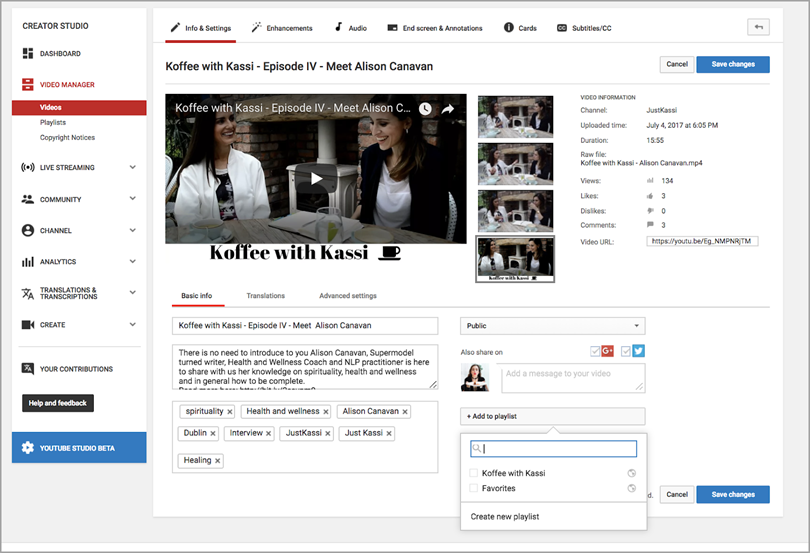
YouTube suggests other videos suitable to the viewer according to its algorithm. YouTube can only determine if a video is important by its watch time. Watch time is not the number of views of a particular video but instead how many hours this video has been watched. To encourage people to continue watching your videos you can create YouTube playlists. Such playlists will allow your viewers to watch your content back to back. This is very easy to do and you can do it after uploading your video in the edit video section. Lastly, make sure to keep your videos under categories, eg: healthy tips, makeup tips, food recipes so the videos in your playlists are relevant to your audience.

increase watch time for youtube channel growth

add video to a playlist for youtube channel growth

If you follow the above tips, and you love video creation and editing then you will see your channel grow. For more information on YouTube check YouTube Creators Academy.

Guest author: Kassiani Cheirogergou is a Social Media Specialist and Content Writer working with Design Wizard. She has over 8 years experience in Marketing Communications and Project Management working on online and offline marketing projects and is passionate about helping business to grow online. Design Wizard is an online graphic design tool that enables users to create and share brilliant visual content within minutes in a fun and easy way. 

The post How To 10x Your YouTube Channel Growth In 9 Simple Steps appeared first on Jeffbullas’s Blog.


Read Full Article: http://bathseoexpert.tumblr.com/post/176519705826

How to Plan a Year’s Worth of Content With One Original Research Survey

years-worth-content-original-research-survey

When you look at the library of content you publish, is it a string of somewhat-related blog posts, videos and more — or do all the pieces work together to tell a better, broader story?

Of course (to poorly paraphrase Robert Rose), you want your editorial to tell one story instead of each piece being disconnected from the rest.


Your editorial should tell 1 story instead of many disconnected pieces, says @MicheleLinn.
Click To Tweet


While there are many ways to do this, one approach that works well is to use a survey-based research project to bring focus to all of your editorial. That research can serve as your keystone from which spring many assets and related stories.

This article walks you through the steps of designing and publishing survey-based original research to make it the cornerstone for your editorial plan.

But, before I begin, an important note: The goal of your research is to be able to tell a compelling story validated with data. The quality of your data is, of course, important, but it needs to relate to a broader story. Constantly ask yourself: Why will someone care?

Step 1: Choose a topic

Spending time deciding on the area of focus is even more important when you plan to use your survey as your editorial glue.

The best research topics check three boxes. They need to:

  • Interest your audience (Note: This, of course, requires you to define your audience. Customer? Prospects? Media or influencers?)
  • Align with your brand story
  • Focus on an area not yet covered with research

If you are in a new space or trying to create a new category, an original research project on the state of the industry could be ideal. YOU become the source of authority and you are what people link to because you have the stats — especially if you repeat this study annually to show trends.

If you are in a crowded industry, such as, ahem, content marketing, focus on a niche. What is that thing you want to be known for?

This is a challenge Brody Dorland and team faced when embarking on their research project in 2017. Their tool, Divvy HQ, helps content marketers, but as Brody explains:

We did not want to do a state of content marketing report because others had already done so. Instead, we decided to focus specifically on content planning, which is something that had not been covered – and it’s something our business directly helps marketers with. This research was a way for us to better understand the challenges our customers face, validate the direction of our product roadmap, and provide insights that marketers can use to benchmark their own content planning process.

TIP: Answer this question: How do you want your audience to think or act differently as a result of reading this research?

Do you want to validate current thinking? Challenge a belief or assumption? Reveal an opportunity? Keep your reasoning top of mind.

Example: Let’s say you work for a workflow software company, and you want more content marketing teams using your platform. Studying team productivity is too broad, so you focus your research on how content marketing teams operate and whether their processes are working.

Step 2: Pinpoint the survey ‘dimensions’

Once you know your general topic, identify the specific topics you want your research to cover. I call these areas of focus “dimensions” — the key categories you want the research to study. Think of these dimensions as a table of contents. You can see how CMI’s annual content marketing research easily falls into a table-of-contents format.


Think about a table of contents when you structure your #research dimensions, says @MicheleLinn.
Click To Tweet


table-of-contents-content-marketing-research

Dimensions serve as a way to organize your thinking, prioritize the questions you want to ask, and provide structure for your data analysis. (I’ll explain all of these steps in more detail as we go through the process.)

Example: Continuing the workflow platform solution company example, to study content marketing teams, you choose these dimensions:

  • Team composition: Which people and skills do people have on their teams? Are people in-house or outsourced?
  • Communication: How are teams communicating with each other — and what’s working? 

TIP: The example only looks at a subset of topics. As a rule of thumb, identify three to five dimensions.

Step 3: Hypothesize your story for each dimension

Once you know the key dimensions, hypothesize what the results will tell you.

Now, this is important: You aren’t designing the research to end up with a specific angle. You are using your research to test your hypothesis.  

If the results differ from what you expect, that’s OK. In fact, that may be a story.


It’s OK if your #research findings differ from your hypotheses. That could even be a story, says @MicheleLinn.
Click To Tweet


CoSchedule embraced this hypothesis vs. results idea in its State of Marketing Strategy in 2018. I love how the team details what it expected the data to show and the actual findings.

coschedule-state-of-marketing-strategy

Example: The chart illustrates the hypotheses for each dimension established for the workflow software company.

mantis-research-hypothesis-workflow

Step 4: Draft questions to test your hypotheses

Next, draft the questions for each dimension to test your hypotheses.

How the questions are asked is incredibly important. (If you are unfamiliar with survey design, consider getting help with this step of the process, including these pointers.)

Example: Add a column to the table for “possible questions.” As you see, the questions you ask will help you determine whether your hypothesis is correct.

mantis-research-draft-questions-test-hypotheses

TIP:  Ask only questions that will provide insight. Continually ask, “How will I use the data from this question?” If you are uncertain, chances are you don’t need to ask the question.

Step 5: Identify key segments for comparison

If you want to do comparisons, looking at the data through that lens will offer more opportunities to tell the story in a nuanced and useful way. Salesforce does a great job comparing segments in its research, as you can see in State of Service.

salesforce-state-of-service

TIP: Any segment you report on needs to have an adequate sample size. While there is no hard and fast rule as to what constitutes an adequate sample, aim for at least 100 participants.

Example: With the workflow software company research, the segmenting goal is to understand the differences between marketers who consider themselves productive versus those who do not. You also could compare the habits between those who use a workflow management tool versus those who rely on email.

Step 6: Analyze the findings by dimension and segment

Once you have the data, your goal is to identify the story. As Rachel Haberman, content marketing manager at Skyword, told me:

Don’t fall into the trap of simply presenting your data as is. Find the story behind your data – that’s what’s meaningful. Numbers alone are forgettable, but when you use them to tell a story, they reinforce an emotional appeal with data-driven evidence. It’s the best of both worlds.


Find the story behind your data – that’s what’s meaningful, says Rachel Haberman @Skyword.
Click To Tweet


Because you have gone through these steps, it will be easier to identify what your story is. Go back to your dimensions and organize the results in these categories. Does the data support your hypothesis or were you surprised?

Keep a list of the insights and ideas you uncover, looking at the dimensions as a whole and through individual questions. You can use these later.

Step 7: Create a home base for your findings

When it’s time to publish your findings, decide on one spot on your website where you will consistently point all traffic from your research. Not only does this keep things simple, but it is key to help get backlinks, which is a huge benefit of using your research in multiple ways.  (In fact, as Aleh Barysevich uncovered in the study SEO PowerSuite’s Link Building in 2017, SEO professionals consider research to be the most efficient type of content for getting backlinks.)


Publish findings in a dedicated spot on your website & consistently point all traffic to it. @MicheleLinn
Click To Tweet


If you aren’t familiar with backlinks, understand this: the more backlinks to a page, the more authority it will have and the more likely it is to rank in search engines. Yet, our research with BuzzSumo found only 49% of marketers earn backlinks from their research — a missed opportunity.

Your research home base can take any number of forms, but if you’re getting started, create a blog post that details your findings, such as this one from Orbit Media’s 4th Annual Blogger Study or this one from Buffer covering The State of Remote Work. Alternatively, consider a landing page like this one from Upwork.

upwork-freelancing-landing-page

Step 8: Brainstorm the type of content you can create

You can create many types of content from your research findings, including:

content-types-original-research

Doing more with your research is a substantial opportunity. Not only will this help you get backlinks (remember to point to your home base), but it also helps you tell a more cohesive story.

If you are at a loss of what to do with your research, consider these 13 examples. I’ll get specific in the next step, but it’s helpful to understand the general type of content you can create:

Step 9: Track your story ideas

Armed with the general ideas of the type of content you can create as well as the insights you documented when you were analyzing your results (see Step 6), it’s time to get specific.

I use this template to track my brainstorming and story ideas from a research study.

Of course, the template can be customized, but I track:

  • Content type: Blog post, guest post, webinar, etc. (See ideas in Step 8.)
  • Content idea: What is the basic idea? Briefly explain why someone will care about this.
  • Data point: What stat(s) does this story relate to?
  • Notes: What else would you or someone reviewing this benefit from knowing?
  • Publication/platform: Where will you publish?
  • Priority: As your ideas grow, which ones do you want to execute first?
  • Owner/responsibility: Who will oversee this?
  • Attachments: What links or files do I need?

As part of this process, you also can include a list of content to be updated with a link to your research. For example, have you published any blog posts that would benefit from one of the stats?

TIP: I use Airtable for this, but you can use a spreadsheet or other format to capture your thoughts. In Airtable, you can create a tab that stores all the stats. You can link the stat to the story — and in turn, when you view all stats, you’ll see the stories using them.

airtable-link-stat-to-story

Step 10: Incorporate your ideas into your editorial calendar

As DivvyHQ uncovered in its annual content planning survey, only a quarter of marketers plan several months in advance. You may feel overwhelmed by the idea of planning out a year’s worth of content with one survey.

content-planning-timelines

While your process and cadence will vary, consider these ideas to make it manageable:

  • Focus in depth on one dimension each quarter. (You could even consider each dimension as a topic cluster.)
  • Determine a regular cadence to publish blog posts that delve into research findings, such as one article per month.
  • Have a library of data graphics to share on social. When possible, link to content that talks about the story behind the data.
  • Look at the presentations in the coming year and see if any of them can incorporate a tie-in to your data.

Share data graphics on social & link to #content that talks about the story behind data. @MicheleLinn
Click To Tweet


Even if you are an ad-hoc planner (is that an oxymoron?), your idea tracker will still be incredibly valuable for your content planning. Continually refer to it as you decide which content to tackle next.

Summary

By using the system above, your research can become the glue that holds together your editorial. Remember, if you plan well, you can create a survey from which you can tell many stories in many ways.

I’d love to hear from you. Do you have any examples of brands who are using their research to tell rich, continual stories? Share in the comments.

Please note: All tools included in our blog posts are suggested by authors, not the CMI editorial team. No one post can provide all relevant tools in the space. Feel free to include additional tools in the comments (from your company or ones that you have used).

You can learn more about how research is the unsung hero in content marketing from Michele Linn during her presentation at Content Marketing World Sept. 4-7 in Cleveland, Ohio. Register today and use the code BLOG100 to save $100. 

Cover image by Joseph Kalinowski/Content Marketing Institute

The post How to Plan a Year’s Worth of Content With One Original Research Survey appeared first on Content Marketing Institute.