Tuesday, February 5, 2019

Beating The Algorithm: 11 Essential Facebook Video Secrets

Beating The Algorithm - 11 Essential Facebook Video Secrets

In 2018, Facebook dramatically changed the way that its content feed algorithm worked. Rather than posting things based on engagement and chronology, Facebook now boosts the content of family, friends, and relevant groups. That was great news for most Facebook users, but it made marketing a bit of a challenge. Corporate and public videos are now pushed down in comparison to content, which makes beating the algorithm a necessity.

Here are 11 Facebook video secrets that will help you beat the algorithm.

1. Post to the right places

Facebook is concentrating on promoting things that are relevant to each user. As a consequence, content that is posted to groups that the user already follows and engages with is going to be promoted to them more highly.

Facebook video secrets for Facebook video secrets

Joining relevant groups and sharing your content (while following their content guidelines) can be a solid first step towards building your engagement. Once you are shared to relevant groups, your content will continue to proliferate through an audience that is primed to be interested in your products or services.

2. Think about evergreen content

It takes a little longer for Facebook content to build up momentum now, and that means that you need to think about investing in evergreen content. Evergreen content is non-seasonal and non-topical; it’s content that’s always going to be interesting to users. You don’t want to post a Holiday-themed post just a week before the holiday to see it gain traction just as the holiday is over.

While seasonal, topical content does have its place, evergreen content can be promoted more long-term. This allows you to build shares and likes and gives it far greater ROI. At the same time, small amounts of seasonal content can be used to reinvigorate your audience base.

3. Keep your videos short and sweet

When it comes to marketing, a lot of questions have vague answers. Depending on your audience, different content styles, and different calls to action, may be more effective. But length isn’t one of those questions. In fact, it’s pretty clear how long a Facebook video should be: between 60 to 90 seconds.

Once your video hits 90 seconds in length, engagement starts sharply dropping off. Most people aren’t primed to sit down and watch a long video. Interestingly, this pretty much correlates to average traditional commercial times. Attention span hasn’t really changed: the medium has.

4. Don’t rely on sound

Most people don’t want a video to start playing sound or music when they watch it. Instead, rely on captioning. Creative and engaging captions can keep your audience watching for longer and will help them understand your video without the sound one. Likewise, videos that automatically play loud music usually get people to close the tab entirely, rather than continue watching.

Newer audiences don’t just like captioning; they also like to see reactions, emojis, and other interesting video features. Take some time to experiment with adding reactions and emoticons.

5. Try out Live Broadcasts

Facebook’s algorithms are heavily promoting live broadcast streams. If you have a following right now, try out live broadcasts to improve your engagement. Live broadcasts have far greater levels of engagement than regular videos and can let you interact more directly with your audience.

Of course, live broadcasts need to be used alongside a more comprehensive video marketing campaign – live streaming is more likely to be viewed by your audience, so you need followers first.

Live broadcasts are especially useful for things like short updates, insight into your company, and question and answer sessions with your audience. They help your audience connect with you on a more personal level. A short, brief live stream once a day can be enough to keep your audience engaged and active.

6. Pay attention to your synopsis

As with all things in marketing, make it brief! The synopsis for your marketing video should be clear and concise, offering a short but detailed description. The best descriptions give the audience a little tease of the content to come but don’t spoil it; if you give them too much, they’ll feel like they already read everything they need to know.

A good synopsis tells your audience what they will learn by watching your video – this piques their interest. But make sure your content actually delivers on that promise, or they may be more reluctant to engage with your videos in the future. Just don’t leave your description entirely blank; not only does it make it harder for people to tell what your video will deliver, but it also means that your video will be less searchable and less easily promoted.

7. Promote shares and engagement

Ask your followers to share your content and engage with your content. Ask them questions and encourage them to post answers in the comments – such as by asking them to share their own thoughts, opinions, or experiences with you. Promoting engagement will promote your videos as well; the more comments and likes you get, the more likely Facebook is to promote your post to the top.

Pay attention to which of your videos get the best responses from your audience; often it’s a fairly obvious pattern. Your audience may specifically like things that have to do with product highlights or news features, and these are the content pieces that you should be focusing on when you create your marketing campaigns.

8. Inject some humor into your video

What gets the most engagement? By far, the highest amount of engagement happens with humorous videos. It makes sense: people are on social media and experiencing entertainment to have a good time, and when they laugh at something they immediately feel connected to it. It isn’t always easy to make people feel something like joy or pathos, but humor isn’t as hard.

When appropriate, try to make your videos have a touch of humor. Just make sure the type of humor fits the tone of your commercial. Make it too light-hearted and you risk alienating your core audience. Make it too dark or grim, and you risk just depressing them!

9. Make sure your video has value

Valuable videos are the ones that are reacted to and shared the most. What is a valuable video? A valuable video is something that delivers the audience with some unique knowledge or a skill. Valuable videos include How-To and DIY videos. Many people share these types of videos with family members and friends.

Whenever you create a video, ask yourself two questions:

  • How is this video useful?
  • Who is this video useful to?
Remember: content marketing isn’t commercial advertising and not all of your content has to directly relate to your products. Instead, they just need to relate to the demographic that your product is focused on. If your company is selling homes to 30 to 50 year old individuals, then content that resonates with 30 to 50 year old individuals will effectively grow your audience.

10. Review your statistics

Facebook offers comprehensive statistics regarding your post engagements. On your posts, you can view who is engaging with your posts, what types of engagements are being made, and how often your posts are being shared. Regularly review your statistics to identify any trends.

Review Your Statistics for Facebook video secrets

Your statistics will show you when people are engaging with your posts, which content they’re most interested in, and whether more posts are being shared than others. Sometimes a post may be more “shareable” but less “engageable”; you may see a lot of sharing going on, but no one is really commenting or liking. This is common for events.

Other posts may be frequently engaged with but seldom shared. These are often posts that are more personal to the consumer, such as goods that they’re interested in buying but have questions about, or controversial topics that they’re interested in weighing in on. Having a good mix of posts is a good way to stabilize and expand your audience.

11. Invest in some paid advertising

Paid advertising on Facebook is extremely useful. Not only does it grow your audience, but it’s also very well targeted. You can tell Facebook to show your ads to people who already mirror your current demographics. You can also ask Facebook to drill down to things like “people who have close friends who have birthdays this month” or “people who have children the age of 12 to 14 and who also like sports.”

Invest in Some Paid Advertising for Facebook video secrets

While it’s understandable that you might not want to invest too much in paid advertising when initially growing your campaigns, it can give you a tremendous boost. Paid advertising builds out your audience very quickly, through which you can then begin to develop your traffic organically. Otherwise, you may need to spend a lot of time and effort building your foundation.

Final thoughts

Facebook’s algorithms are a lot like Google’s – they’re designed to give people what they’re interested in. As long as you produce interesting content that your audience connects with, you should be able to defeat those algorithms. Thus, video marketing is just about figuring out what your audience is interested in, and what content best appeals to them.

The easiest method of doing this is by staying true to your statistics, developing an understanding of your audience demographics, and delivering them a clean and clear experience from start to finish. Once you’re able to do this, you’ll start to see your campaign growing and growing.

Guest author: Article by Joe Forte, owner and producer at D-MAK Productions, providing video production in phoenix specializing in producing corporate, commercial, digital and branded media content.

The post Beating The Algorithm: 11 Essential Facebook Video Secrets appeared first on Jeffbullas’s Blog.


Read Full Article: http://bathseoexpert.tumblr.com/post/182580126991

What It Means to Get Branded Content Right

Whenever someone mentions the term “branded content,” my mind still drifts back to the original inspiration for my love of the technique: BMW’s The Hire.

The 2001 series consisted of eight online episodes, each featuring Clive Owen as “The Driver” – a mysterious man who fully commits to completing his assigned mission at all costs, taking viewers along for the ride. The films were directed by notable Hollywood pros like Ang Lee, Guy Ritchie, and Alejandro Iñárritu; they oozed style, sophistication, and Hollywood star power; and each told a compelling story of action and intrigue. But, more importantly from a content marketing perspective, each episode spoke volumes about the excitement and luxury of the BMW driving experience – without overtly mentioning anything about the brand or the vehicles themselves.

A lot has changed in digital marketing since BMW released The Hire; but the content approach it leveraged still holds plenty of power and possibility for businesses that want to capture audience attention and showcase their brand’s values without coming off as pitchy and promotional. In fact, with the technique’s influence growing over the years, we may have reached the point where branded content is the best vehicle marketers have for bridging the gap between initial awareness and ongoing affinity.


Branded content is the best vehicle for marketers to bridge the gap b/n awareness and affinity, says @joderama.
Click To Tweet


In the name of brand love

To understand what branded content (also known as branded entertainment) entails, let’s start with a basic definition offered by the internet’s default dictionary, Wikipedia:

“Branded content is the practice of marketing via the creation of content that is funded or outright produced by an advertiser… (it is) designed to build awareness by associating (the brand) with content that shares its values.” 

As definitions go, it’s a good start; but it doesn’t really get to the heart of what sets efforts like BMW’s The Hire apart from other forms of content marketing, let alone why 74.5% of communications professionals say they rely on branded content in their campaigns or why 67% project that their and/or their clients’ spending on branded content will increase over the next 12 months, according to a USC Annenberg survey.


74.5% of communication professionals rely on branded content. @USCAnnenberg ‏#research
Click To Tweet


What makes this approach universally appealing – to viewers seeking a great story as well as businesses looking to enhance brand awareness? Look at some hallmarks of the technique (when executed properly):

  • They take an immersive, sensory-driven approach to storytelling: Branded content typically leverages multimedia formats like audio and video, which can enable deeper topical conversations and more emotionally resonant experiences than text and/or static images alone.
  • They build connections through mutual interests and shared values, not sales goals: Because these content pieces are often focused on establishing thought leadership, raising awareness, and generating positive brand perceptions, they are more likely to be viewed as worthy of the audience’s trust and attention as compared to more product- and pitch-driven formats like digital ads.
  • They make the experience entertaining, valuable, and memorable for viewers: Branded content campaigns excel when it comes to capturing audience interest, but they also are well-suited to contributing to lower-funnel goals. In fact, a recent study by Turner Ignite and Realeyes found they make viewers more likely to consider the featured brand when it comes time to make a purchase (compared to traditional 30-second ads).
  • Their potential for cross-channel distribution capabilities enables on-the-go engagement: It’s easy for brands to publish branded content campaigns across multiple social networks, owned media properties, and other external websites. And, because they are primarily audio- and video-driven, these efforts are well-suited for mobile consumption.
  • They present opportunities to collaborate with other high-profile brands: Co-producing stories with other businesses that share your values and interests makes it easier to gain much-needed traction among your partner’s established audience.

 Ideally, branded content campaigns create marketing experiences virtually indiscernible from what the audience might seek from their favorite media/ entertainment personalities and properties – including film studios, TV networks, and streaming media services.

For instance, as CMI founder Joe Pulizzi pointed out years ago, the LEGO Movie entertained mass audiences and earned millions in revenue as a traditional feature film; but it also performed strongly as a marketing vehicle by winning the hearts and minds of a new generation of prospective LEGO consumers.

As another example, not only has Jerry Seinfeld’s online interview series, Comedians in Cars Getting Coffee, been capturing audience attention and critical praise since 2012, the branded content partnership (the production is fully underwritten by Acura) has earned three Primetime Emmy Award nominations and won three Producers Guild of America awards for Outstanding Digital Series.

Of course, not all branded campaigns are created alike in terms of their quality, transparency, or ability to inspire consumers to engage and interact. And when brands don’t have the right strategy, protocols, or expectations to achieve success, the results can turn out to be more harmful than helpful (as was the case in 2013 for The Atlantic).


When companies don’t have the right strategy for branded #content, the results can be harmful, says @joderama.
Click To Tweet


Content that’s outstanding in its field

What makes for an engaging, emotionally resonant branded content campaign that can further your brand objectives without subjecting your audience to blatant promotions, poorly timed placements, and empty platitudes? Look at some artfully crafted examples that struck the right balance between powerful positioning and subtle persuasion en route to attracting an audience.

BMO Harris Bank offers a lesson on engaging millennials

Growing a younger customer base is crucial to any financial service company’s future success. But few banks give off youthful vibes. When BMO Harris Bank (BMOHB) wanted to increase consideration among millennials beginning their journey to financial independence, it went for the unexpected. The bank partnered with humor-focused content agency Onion Labs and Resolution Media to develop a series of videos that promotes its (fictional) mobile banking app capabilities. The video parodies the features millennials seem to like in other popular apps – photo filters (that make faces look like ATMs), couch surfing (in a bank vault), and the opportunity to swipe right and left on potential dates (based on how attractive their checking accounts appear).

This content was served across both The Onion’s owned properties and BMOHB’s social sites to complement and amplify reach, and it ultimately drove users to download the real BMO Harris Bank mobile app. According to Resolution Media, the effort resulted in a record-breaking brand lift (a big win for a campaign aimed at driving awareness) and paved the way for BMOHB to “own” comedy within the financial services space – earning a 2018 Content Marketing Award for Best Branded Content.

War Child UK sparks a meaningful conversation

War Child UK – #EscapeRobot by Raw London from Raw London on Vimeo.

Humor is a sure crowd-pleaser, but it isn’t the only way to capitalize on branded content’s power. In fact, branded content campaigns can also communicate positions on societal issues that are anything but a laughing matter.

For example, children’s charity War Child UK used a branded content campaign to change the conversation around the mental health and well-being of children affected by war. A thought-provoking, video-led branded content campaign took aim at the hearts of 18- to 40-year-old professionals who are aware of the residual effects of global conflict (and, thus, likely to feel motivated to help). The film also supported the release of the charity’s new report on the subject, Reclaiming Dreams.

The lead video #EscapeRobot takes viewers on a journey that poignantly illustrates the scale of mental health and psychosocial support urgently needed to help children recover from war-related traumas they may have experienced. With just £8,000 (about $10,500) media spend, the video achieved 2 million views, driving huge engagement and traffic to the campaign’s landing page, where visitors could explore additional details on War Child UK’s charitable efforts and opportunities to get involved.

Nulon supplies the fuel for a driving passion

Nulon is an independent, family-owned, Australian motor oil brand founded in 1980. In contrast, its competitors – like Shell, Castrol, Valvoline – are global giants with massive marketing budgets and over 100 years of earned brand affinity.

To help level the playing field, Nulon set out to produce five branded content films that capture the excitement shared by those who love to tinker under the hood and customize their cars to test the limits of the road. With the help of Edge Agency, the Born This Way mini-series became such a brand-building – and sales-driving – force among mechanically inclined gearheads that the company kept the momentum going and extended the campaign indefinitely. To date, Nulon relies solely on these videos, SEO, and in-store POS for all its marketing needs. 

Autodesk enables innovation, one maker at a time  

Autodesk’s AutoCAD computer-aided design (CAD) software is used by millions of architects and mechanical engineers. For its Original. AutoCAD. campaign, the company aimed to drive subscriptions by profiling creative entrepreneurs who produce groundbreaking ideas, while highlighting the role its software plays in producing their pioneering projects.

From a talented designer of custom IoT guitars to a self-proclaimed “chefitect” – an architect-turned-chef attempting to create universally understood recipes through CAD drawings – the campaign’s three distinct microsites – Original. AutoCAD., Original. Projects, and Original. People – showcased the customer stories, innovative inventions, and transformational ideas made possible by AutoCAD.

Autodesk, which earned recognition as a Content Marketing Award finalist for the campaign, shared some of the impressive year-over-year results, including:

  • 99% increase in site visitors
  • 244% increase in AutoCAD trial initiations
  • 89% increase in visits to its e-commerce store
  • 385% increase in orders of AutoCAD

.@Autodesk saw 385% increase in AutoCAD orders after its branded #content campaign. @joderama Read more >
Click To Tweet


Entrepreneurs Organization reveals members’ personal habits

Another innovation-focused branded content effort – and 2018 Content Marketing Awards finalist – comes from the Entrepreneur’s Organization (EO) – a global, peer-to-peer networking association dedicated to helping the entrepreneur community achieve greater business success.

EO is not widely known in the regions it serves so the organization set out to raise its visibility with the help of Muse Content Group. To prepare for the campaign, EO’s Central U.S. chapter invited its members to enter its “Truth Booth” – an experiential on-location studio – take a shot of “truth serum” (tequila option available), and candidly answer revealing questions about their personal experiences as business leaders and innovators.

The resulting series of raw and authentic videos speaks to the heart of what it takes to succeed in roles where there’s no established path to follow, while also helping the organization bolster its ranks. According to EO, the series earned over 400,000 impressions and 5,500 clicks in the first five months, which brought in 55 qualified leads and increased paid membership dues by more than six times the cost of the paid ad spend. In addition, the campaign has been recognized on a global scale with many inquiries from EO regions around the world requesting to use the Truth Booth videos in their chapter marketing initiatives.

A joint expedition leads to an intoxicating journey of discovery

Heineken teamed with National Geographic on a branded content partnership that showcases the best of what both brands have to offer. A Wild Lager Story details the history behind the beer brand’s new H41 Wild Lager and includes a three-minute documentary that follows biologist Diego Libkind and Heineken’s global master brewer Willem van Waesberghe as they explore the untamed reaches of Patagonia in search of a rare yeast, then return home to create a new category of beer.

A brand-building pitch that audiences can’t wait to catch

Are you experimenting with branded content in 2019? These examples show how great branded content campaigns can help you build rapport with a new target audience, expand your business’s creative horizons, or simply entertain and engage the experience-loving masses. We’d love to hear about your plans for leveraging the technique and, for those already giving it a try, how it’s been working for you.

Have a branded content project or other content marketing initiative you think is worthy of celebrating? Entries are now being accepted for the 2019 Content Marketing Awards. You can learn more and enter here. 

Cover image by Joseph Kalinowski/Content Marketing Institute

The post What It Means to Get Branded Content Right appeared first on Content Marketing Institute.

Monday, February 4, 2019

The 9 Best Android Apps For Creative Professionals

The 9 Best Android Apps For Creative Professionals

Designing is undoubtedly one of the most lucrative and demanding professions in today’s world. However, being a professional designer is not everyone’s cup of tea. It is indeed a full-time job where you never know when an idea or inspiration strikes. In such a situation, having some useful designing apps on your Android device becomes the need of the hour.

So, in order to make your designing work easier, we looked through the Google Play Store and handpicked some of the best Android apps for creatives.

Irrespective of whether you’re a designer looking to create vector graphics or a creative professional planning to sketch out a wireframe on your Android-powered smartphone or tablet device, these apps will definitely help you to deal with your everyday design errands efficiently on the go.

So, let’s get started!

1. Paperless

Paperless

Paperless is a simple yet powerful drawing application for designers, allowing them to draw, paint, color, sketch, and write notes right from their Android devices.

Equipped with 6 different types of drawing tools, this amazing app facilitates designers to create up to 3 layers and also manage the opacity on each layer.

Another great advantage of this app is that you can share your creations straight to Facebook without quitting the app.

2. Infinite Design

Infinite-Design

Created by renowned developer Sean Brakefield, Infinite Design is an SVG vector graphics Android app that enables designers to create designs using their smartphone and tablet devices.

What makes this application different from others is the ability to create 3D images with five different perspectives.

Additionally, you can play with four types of symmetry, add unlimited layers, import/export SVGs, and add special effects.

3. ArtFlow

ArtFlow

Designed to replace your physical sketchpad, ArtFlow is a simple and user-friendly painting and drawing application that turns your Android-powered smartphone or tablet into a powerful digital sketchbook.

Packed with a high-performance engine, it supports canvases up to 6144 x 6144 pixels with 50 layers and offers designers over 100+ paint brushes and tools, including smudge, gradient fill, and eraser tool.

Moreover, ArtFlow features a Material design inspired user interface and fully supports pressure sensitive pens like S Pen.

4. Canva

Canva

Although Canva has been around as a web-based graphic-design platform since 2012, it has made relatively a late move to Android in 2017.

Just like the online version, Canva for Android is also packed with more than over 60,000 sleek, ready-made templates which you can produce eye-catching designs for the various social media channels on the go.

And, the best thing about it? It’s pretty easy to use! Just pick a template of your taste, personalize it to fit your requirements and then share it!

Although Canva is a simple tool, if used wisely, it can produce highly professional graphics.

5. Color Reference

Color-Reference

Remember Adobe’s Kuler? Color Reference does the same!

The main objective of this color management application is to help designers and color lovers improve their designs by providing them some inspiration and allowing them to discover new color schemes.

With this fabulous app, not only you can create and export your own color palettes with up to 5 colors but you also have the ability to pick colors from imported images.

And, the most interesting feature of Color Reference is the wallpaper creator that allows you to create awesome wallpapers based on your color palettes.

6. Adobe Capture CC

Adobe-Capture-CC

Adobe Capture CC is a fantastic Android app that turns your ordinary smartphone or tablet device into a powerful creation machine.

With the help of this intuitive application, you can easily convert any photo or image into a scalable vector, brush or shape.

Taking advantage of Adobe’s advanced AI technology, Adobe Capture can easily detect fonts, recommend visually similar fonts, and create color palettes or geometric patterns from any image instantaneously.

Furthermore, if coupled with a Creative Cloud account, Adobe Capture keeps all your creations in sync across all devices you use.

7. Find my Font

Find-my-Font

As the name itself explains, Find my Font is a font-identification Android application ideal for web designers, graphic designers, sign makers, and other creative professionals to identify the fonts in an image in seconds.

To identify the fonts, you just need to either take a photo or load an existing image from the gallery.

With a huge online database of more than 150,000 fonts, this app boasts to fetch accurate results down to a mere a 20px text height.

Since the Find my Font Android app is restricted to identify only Latin letters and symbols, you can download and use Find my Font Desktop on your Mac or Windows PC for the identification of non-Latin letters.

8. Infinite Painter

Infinite-Painter

If you’re already familiar with the popular iOS desktop painting app Procreate, you’re going to love this wonderful painting application Infinite Painter.

With a cutting-edge painting engine backed by over 80+ natural brush presets, Infinite Painter aims to provide designers a much better experience than prevalent graphic design tools such as Autodesk Sketchbook, Adobe Photoshop, and Procreate.

You can create your own brushes, transform multiple Photoshop-compatible layers simultaneously, and export your images as JPEG, PNG, PSD, or ZIP.

9. Color Grab

Color-Grab

Packed with countless outstanding features like real-time color measurement and after-shot color analysis, Color Grab is a handy on-the-go color-picking Android application for graphic designers, artists, and creative professionals.

To pick, capture and recognize colors, you simply need to point the camera at an image.

Moreover, it facilitates you to take advantage of the flashlight in low-light conditions and you can even set the custom white balance. Supported export options include Photoshop, Illustrator, GIMP, Inkscape, and more.

Wrap

So, these were some handy and interesting Android Apps for designers, artists, and creative professionals.

Did we miss any great ones? Let us know in the comments section below!

Guest author: I’m Jay M, an app developer come blogger working with iPraxa – a mobile app development company, who has proven expertise in resolving all the technical complexities involved in the development of innovative, unique websites and apps. I spend my spare time on the web to learn about the latest technologies and love to share my knowledge with others through my content. Find out more about me on LinkedIn.

The post The 9 Best Android Apps For Creative Professionals appeared first on Jeffbullas’s Blog.


Read Full Article: http://bathseoexpert.tumblr.com/post/182553761411

2019 SEO Keywords and Google: What’s in Your Poker Hand?

Strap in tight. 2019 will be a rough ride for keyword rankings and SEO professionals will feel the squeeze each time Google downplays traditional search engine results.

Google already promotes no-click search results, often providing answers without the need to click for more details.

The no-click (also known as zero click) searches will remain a factor for marketers. Referencing data from Jumpshot, Rand Fishkin of SparkToro last year found that 61.5% of Google mobile searches are no-click (34.3% with desktop searches).


61.5% of Google mobile searches are no-click (34.3% with desktop searches) via @jumpshotinc @sparktoro
Click To Tweet


Additionally, voice search will have an impact, especially with smart speaker products like Google Home and Amazon Echo. Econsultancy does a good job sorting through voice search projection interpretations.

If your natural search engine traffic took a hit last year, expect more of the same unless you take steps to recover from traffic dips. Even if you’re fine now, you might want to reinforce your footing.


If your organic #SEO is taking a hit, see what you should be doing to recover from traffic dips. @mikeonlinecoach
Click To Tweet


1. Learn to appreciate that SEO is like a giant poker game

Picture a virtual table with thousands of people playing at the same time in scores of places.

In this game, instead of collecting winnings from your fellow players, you’re seeking Google rewards. With each of your “keyword” hands, Google snickers at what you’re holding or rewards you with the top positions among the search engine results pages (SERPs).

When you target another keyword phrase, you’re dealt a new set of cards. Unlike real poker, this hand is not random. You end up with cards based on what you bring to the table.

What are your SEO strengths that will give you a good hand?

Rather than list all of the ranking factors, I’ll cite a few that should shape your keyword choices.

Domain and page authority

Based principally on backlinks, your score will influence your rankings. Moz tracks the data, and websites fall somewhere between 1 and 100. Do you even know how your site scores? Higher scores increase the odds of higher rankings.

Content and website size

Websites with some pages (like maybe 10 or 20) won’t fare as well as websites with hundreds or thousands of pages, which signal to search engines that they’re serious players. More pages make it easier for websites to play up key themes, attract backlinks, and add additional pages to target coveted keyword phrases.


More pages make it easier to attract #SEO attention w/ themes, backlinks, keyword phrase pages. @mikeonlinecoach
Click To Tweet


Domain name

Online marketers debate its value toward your rankings. My sense is that its importance has waned, but it’s clearly a factor. If your domain includes part of your keyword phrase, you have an edge.


If your domain includes part of your keyword phrase, you have an edge, says @mikeonlinecoach. #SEO
Click To Tweet


Other SEO essentials

You can’t afford to have issues with basic website structure. Is all of your content indexed? What about the following:

  • Content headers: Do you use H1 tags with the text?
  • SEO page titles: Can you customize them on a per-page basis?
  • Page URLs: Can you keep them short and use dashes to separate words?

To underscore the possibilities for 2019, I identified three companies through LinkedIn to see how well they’re already doing with SEO and to show ways we can learn from their efforts (good or bad).

Catalant – Identification of talent through technology and programs for companies
Taboola – Content discovery platform
Jellyvision – Creators of ALEX, employee communication software

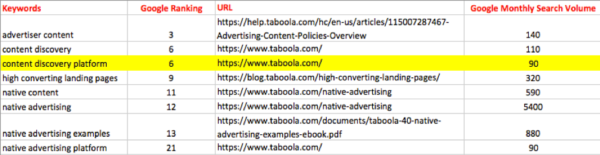
Taboola is probably in the best shape with a domain authority of 72 (Jellyvision is 43 and Catalant is 36).

Although Taboola has first-page rankings on Google, several keywords aren’t hitting the mark and the best ones could do better.

Taboola (like many websites) would benefit from iterative SEO, meaning its team should make distinct revisions to the SEO page titles, content headers, and other text to see whether rankings improve without hurting their top positions. But they shouldn’t make too many changes at one time or they won’t know what worked and could disrupt rankings. They could monitor rankings after testing keyword-placement scenarios. (Most website pages are indexed within days or a couple weeks.)

For example, Taboola might avoid going after both “native content” and “native advertising” on the same page. “Native content” ranks No. 11 with 590 searches, but “native advertising” is No. 12 with 5,400 monthly searches. Both phrases rank well, but “native advertising” may not get much higher with “native content” having a strong presence.

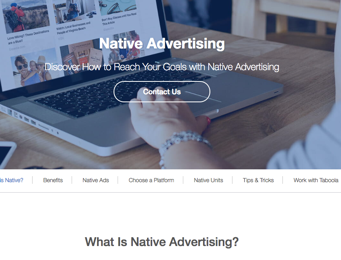
Fortunately, Taboola used an H1 tag with “native advertising,” but it’s possible that phrase is on the page too many times (sorry, there isn’t a foolproof formula). With the high search volume, it might be worth tinkering with the text and the number of keyword references over a couple months.

As for “native content,” Taboola may want to use that on another page or create a new page. Adding content is always a good approach to support a target keyword phrase.

Jellyvision should seriously consider that option. The business only has a few good rankings for low-volume keyword phrases. I’m actually a fan of keywords that aren’t searched often. They can yield good prospects for sales to help the bottom line. But more pages are needed.


Target low-volume keyword phrases for #SEO. They can yield good prospects for sales, says @mikeonlinecoach.
Click To Tweet


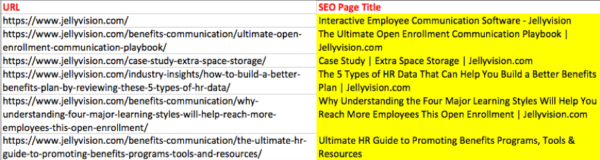
The website has a strong collection of content. Jellyvision understands how businesses can convey critical information to employees. But that content often doesn’t relate to relevant keyword phrases. Sometimes its content keywords aren’t searched at all.

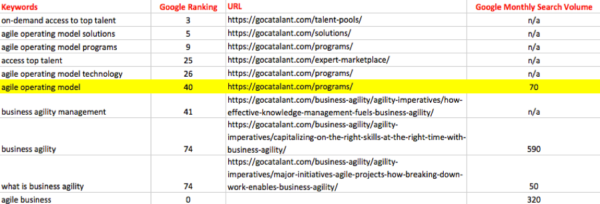
One of its content headers and SEO page titles is: Why Understanding the Four Major Learning Styles Will Help You Reach More Employees This Open Enrollment. The highest ranking for that page is 23rd for the phrase “benefits of learning styles” (30 monthly searches), which appears on the third page of Google. Maybe it’s good content – just not an effective string of words for SEO.

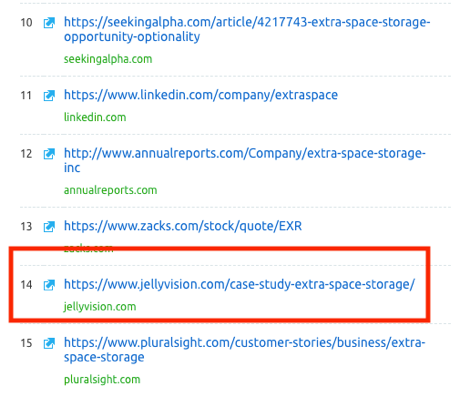
One of their best rankings is “extra space storage” – No. 14 with 135,000 monthly searches on Google. But it’s for a case study featuring a client. I doubt that website traffic helps much with conversions because people searching for “extra storage space” won’t find anything meaningful to them on this page.

Catalant struggles with SEO – at least with its apparent target keyword phrases. For starters, it is centered on a narrow topic – focusing on agility to connect with the right talent. The company has accolades from Forbes, Entrepreneur, and Financial Times. However, Catalant’s site can’t seem to rank well for words it cares about. If you can’t rank in your niche, you have a problem.

Sometimes it’s useful to branch out and look for related keyword phrases that are relevant but not as competitive.


It’s useful to look for keyword phrases that are relevant but not as competitive, says @mikeonlinecoach. #SEO
Click To Tweet


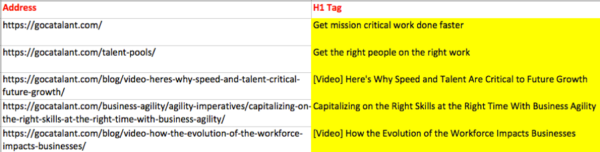
The existing content may speak to core audiences, but it isn’t producing many strong organic results. For example, the content header Capitalizing on the Right Skills at the Right Time With Business Agility may seem OK, but it doesn’t include a keyword phrase within striking distance. The lengthy URL doesn’t help matters. Extraneous words prevent any focus and the URL is bogged down by “business” and “agility” duplication:

Capitalizing on the Right Skills at the Right Time With Business Agility

Catalant still has some hope. It could revise SEO page titles (even doing that can make a difference) and add new pages with keyword-focused content headers, short URLs, and effective SEO page titles.

Featured snippets

Beyond these companies, some marketers will win out if they can qualify for a featured snippet that appears after the paid ads on Google. They’re not easy to get.

You can potentially land some by providing good explanations about a topic. Content built around questions can help (you don’t necessarily need a Q&A format). Although there are no formal requirements to improve your odds, some marketers suggest including details in tables, lists, and numbered steps.

Keep in mind that many featured snippets are for keyword phrases with low volume. Oddly, websites that struggle to rank for many keywords sometimes earn a featured snippet.


#Content built around questions can help your site land a Google featured snippet, says @mikeonlinecoach.
Click To Tweet


Just like other search results, featured snippets come and go. You won’t always be the winner and you can quickly get one back after losing it. Stone Temple Consulting in 2018 explored the volatility and other trends around featured snippets. In 2017, Ahrefs released a study saying featured snippets appear in 12.29% of results.

Again, keep in mind that Google continues to alter SERPs with its Answer Box, People Also Ask, tweets, Image Pack, and more. Your rankings also will often change based on geography when Google introduces different results based on the most relevant searches.

2. Create and modify content for SEO

Not all content will have SEO implications. You still produce videos, infographics, white papers, and blog posts to reinforce your status in an industry while supporting social media, e-mail, and other marketing efforts.

However, if you’re counting on SEO to drive traffic, I wouldn’t recommend producing less content. You might say, “Isn’t quality what matters most?” Of course, quality is important. But I wouldn’t scale back content that could be used for SEO.

Your best bet is to tailor new content to keywords that can rank. If you can get your keyword phrase in the bulk of the page header, you’re golden.

But here’s the deal: Do you even deserve high rankings? I’m all about what I call the SEO keyword “sweet spot.” But you have no business going after keyword phrases searched 1,000 times a month when you can’t even manage to rank on the first page of Google for keywords people search for 50 times.

Remember, SEO is a poker game and it’s all about what gives you an advantage. Look at your keywords and see how many are on the first page of Google. What’s the average search volume? You’ll get a sense of your sweet spot – defined by top rankings and search volume.

With your SEO strategy, you can be a little aggressive. If your average search volume sweet spot is 100, maybe target keywords searched 200 times a month. Why? You can assume your current SEO efforts had fallen short – the wrong combination of keywords in page headers, SEO page titles, etc.

In a few cases, see what happens if you make more risky changes. I’m working with a website that wasn’t even in the top 100 positions for many of its 20 strategic keywords. Based on some data, it looked like the client’s sweet spot for keywords may be in the 10 to 30 range for average search value. We targeted one phrase with 700 searches a month. It’s now ranking No. 12 on Google after making two sets of SEO changes on one page. Ultimately, the client may need a new page to grab a spot among the top 10 positions.

Keywords with low search volumes shouldn’t be overlooked anyway. Collectively, these search queries can drive relevant traffic and leads. Think about what you’re selling, your margins, and the lifetime value of new customers. You might sell a $10,000 or even $50,000 service or product based on low-volume keyword phrases.

Selecting keywords isn’t just about search volume and rankings. You also need to consider searcher intent and where the existing or new content falls within the buyer’s journey.

3. Pursue backlinks

Google has identified backlinks as a top linking factor. Stone Temple Consulting recently updated its in-depth study that details the strong correlation between backlinks and ranking.

Here are a few quick link-building ideas:

  • Build relationships with influencers.
  • Explore your team members’ own connections.
  • Use PR strategies and tactics to connect with notable news media.
  • Become members of more groups that are even loosely tied to what you sell.
  • Launch a series of surveys or industry studies.

4. Take care of the small stuff

In 2019, there is no reason to neglect the small items that impact search engine rankings. Though they’ll never compare to the impact of content, content headers, and backlinks, they still get a lot of play. Consider:


Take care of the small stuff for #SEO – page load speed, internal links, mobile friendliness. @mikeonlinecoach
Click To Tweet


I like how Neil Patel emphasizes that Google can look at an array of metrics like how long people spend on your website compared to other websites and whether users quickly leave your website and return to Google.

“If you want to beat Google, you have to shift your mindset. It’s not about understanding Google, it’s about understanding users,” Neil writes in How Digital Marketing Will Change in 2019.

How will you survive SEO in 2019? Modify content already in place and be strategic as you create new content that you expect to perform on search engines. What kind of cards have you earned for the next poker game?

Get a better grasp on the interplay of content and technology this April at ContentTECH Summit. Register today using code BLOG100 to save $100.

Cover image by Joseph Kalinowski/Content Marketing Institute

The post 2019 SEO Keywords and Google: What’s in Your Poker Hand? appeared first on Content Marketing Institute.

Friday, February 1, 2019

Want to be Trusted? Here’s a Crash Course in Brand Journalism

If your company wants to be seen as a media outlet, your brand journalism can’t be light on ethics, riddled with errors, and sopping with self-interest that suffocates readers.

Real journalism is about building an audience by telling true stories. “Your content needs to meet journalistic standards if you want it to be taken seriously,” says Iris Mansour, a journalist turned content strategist. “Brands that aren’t entirely honest or self-aware have a much harder time building audiences.”


Brands that aren’t honest or self-aware have a harder time building audiences, says @Irisist.
Click To Tweet


Here are four ways your team – like real journalists – can earn readers’ trust.

Name your sources

Cite all your sources. Include a statistic in a blog article? Cite the source. Not including it suggests to readers that the author may have made it up.


Include a statistic in a #blog article? Cite the source. @cgillespie317 ‏
Click To Tweet


Stand out and link to the primary source. Don’t link to a statistics roundup article, which points yet somewhere else. Follow the trail to vet the stat and you’re likely to find, it’s:

  • Misquoted or misinterpreted
  • Created by a source lacking credibility
  • A broken link
  • Hopelessly out of date

And if you find that one of those negatives applies, forgo using the statistic.

Sources say a lot about your brand. Accurately linked, high-quality sources say, “We can be trusted.” Omitted or incomplete sources suggest a company agenda and an organization that can’t be bothered with facts.

“Always tell your readers where your information is coming from,” says Monique El-Faizy, a freelance journalist who has written for The New York Times, The Guardian, and The Washington Post. “That both allows them to determine if they think a source is credible and to delve deeper into a topic should they choose. If you cite a study, tell the reader who conducted it and link to the primary source.”


If you cite a study, tell the reader who conducted it & link to the primary source, says @Moniqueelfaizy.
Click To Tweet


It takes only one lie or misstatement to break a reader’s trust. Because brands rarely get feedback from readers, they can spread misinformation for decades and not know it. Have you heard this statistic, “A 5% increase in retention can boost profits 75%” from Bain & Company. It’s been frequently quoted since the study was conducted … in 1990. The Soviet Union was still around then. Google wasn’t. It’s fair to say the world has changed. And the stat was bad when first cited in 1990. It’s based on a sample size of one – a credit card company that no longer exists.

Cite a statistic like that to support an argument in an unrelated industry and you’re broadcasting, “We picked the first thing we saw on Google because it confirmed our pre-existing notion.” That’s not a good look for brands that want to be trusted.

Be objective

The difference between mainstream media publications and most business blogs is that the former openly strive for objectivity in their articles (and their points of view are reserved for their opinion pages). When newspapers have a conflict of interest, they state it. That may seem counterintuitive to the purpose of brand journalism, like ratting on yourself, but readers already know you’re biased in favor of your company. The only thing you can choose is how honest (or dishonest) you want to be seen.

Just look at the bastion of journalism, The Washington Post. Though owned by Jeff Bezos, CEO of Amazon, the paper didn’t let that relationship stop it from running a story about how Amazon’s smart speaker Alexa eavesdrops on customers. The article’s author discloses the Amazon connection (as The Washington Post does with all articles mentioning the CEO or his portfolio).

Most brands don’t have the stomach for that sort of transparency. But that transparency leads to trust. You have to be unafraid to tackle true, sometimes sensitive topics, in your industry even if they don’t directly serve your interests.


You must be unafraid to tackle topics in your industry even if they don’t serve your interests. @cgillespie317 ‏
Click To Tweet


For example, the analytics software startup Mixpanel admitted it had been pricing its product wrong. And the CEO of messaging platform Drift publicly admitted its marketing had lost its way. Rather than express outrage, readers of both blogs responded positively on social media and appreciated the honesty.

(Disclosure: The author sometimes writes for Mixpanel but wasn’t involved in the article linked above.)

Write for the reader

The primary purpose of content is to interest readers. That can be difficult because we’re predisposed to believe that if we find something interesting, then everyone does. It’s known as projection bias. This thinking leads companies to write overtly self-promotional articles about things few people care about. Consumers ignore selfish drivel content like they do ads.

Journalists, on the other hand, write with their reader in mind. They have no choice – their readers or viewers are the central cog of the business. They invest their time meeting the people and companies they report on and receiving torrents of critical feedback – something Abraham Lincoln called “public opinion baths.” And then, journalistic publications use editors to gut-check topics before they’re published for their audiences.

You’re on the wrong track if you choose topics without consulting customers and decline topics that don’t expressly mention the brand’s products. This is a death knell for an audience-building content program.

Can you spot which company blog gets it right?

Freshdesk Blog

  • Our Journey Towards Cross-Platform Development
  • Why We Are Taking to The Skies Over San Francisco
  • Kicking Off Our Bengaluru Office With A Bang!

Relate by Zendesk

  • Tips for Staying Safe When Traveling on Business
  • The Only Guide to San Francisco That Includes Unicorn Tartare
  • On Being the Human Behind the Chat Widget

Both companies sell the same thing. But while the former drones on about itself, the latter focuses on what matters to its readers. The latter is a blog sponsored by the parent company that lets its brand journalists write about whatever pleases readers. Each month, around 13,000 people visit the first blog, according to SimilarWeb data, while 54,000 visit the second blog. I can’t speak to conversions, but one certainly has more traction and mindshare.

Write like an adult

Brands and bloggers now attempt to “hack” people’s attention by writing in abbreviated colloquial babble that’s riddled with clichés. These hacks sometimes attract attention, but attention isn’t the same as comprehension.

Compare the breezy, web-friendly writing of a growth marketing agency (QuickSprout) to that of an analytics software firm (Mixpanel). Both seek to explain AI.

QuickSprout

“I know what some of you are thinking. Sure, some companies use AI, but you don’t need to yet, right? Wrong. I see this mentality far too often when I’m working with business owners. The reality is that machine learning is reshaping marketing. Think about the marketing strategies you were using ten or even five years ago. I’m willing to bet they have changed over the years.”

Mixpanel

“If private companies are any indicator, some billionaires think AI is so dangerous that they are trying to escape to Mars. But there are other perspectives. Beneath all the doomsaying and dystopian science fiction, many of the smartest AI algorithms have rather banal jobs. They’re trying to convince consumers to click ads, entice people to spend more time on social media, or they’re recommending new running sneakers.”

QuickSprout may get your attention by talking like a chatty bus driver, but it conveys little, whereas Mixpanel conveys much more with the same word count. Mixpanel is both intriguing and information dense and improves the reader’s understanding of the topic. Its writer did the hard thing and actually invested in having real things to say.

Brand journalism is a marathon and winners travel light. They name their sources, aspire to objectivity, think like readers, and write like adults. It’s a combination that creates a sense of trust between reader and writer, and the only way you’ll grow your brand in an age where trust most definitely still matters.


Brand journalists name sources, seek objectivity, think like readers, & write like adults, says @cgillespie317. ‏
Click To Tweet


HANDPICKED RELATED CONTENT: Content Readability: A Primer

Think like a journalist at Content Marketing World 2019 Sept. 3-6 in Cleveland, Ohio. Grab a reporter’s notebook, ask questions, and document what the hundreds of speakers have to say. And return to the office with a notebook full of helpful advice. Register today using code BLOG100 to save $100. 

Cover image by Joseph Kalinowski/Content Marketing Institute

The post Want to be Trusted? Here’s a Crash Course in Brand Journalism appeared first on Content Marketing Institute.