Friday, February 23, 2018

The 10 Most Annoying Types of People on Facebook

the 10 most annoying types of people on facebook

Social media amplifies humanity.

Have you ever been to a barbecue and had to listen to someone prattle on about themselves for hours? Attended a cocktail party and had the most intriguing conversation with a tall dark stranger? Been invited to a friends place and viewed so many baby photos that you felt compelled to have a vasectomy!

Facebook, Twitter and social media take those conversations and multiply it via the crowd. Facebook is insights, conversations and news on steroids.

It  is a reflection of what makes us human, except that it is visible to billions of people. We are different, fun and sometimes boring. It is a kaleidoscope of emotions, events and the bizarre. That’s why we tune into Facebook. Its a voyeur’s paradise. Never dull and often entertaining.

So what entices us to reveal our lives online? Is it narcissism, vanity or just wanting to get something off our chest. Annoyance is noticed and often shared.

Here are the results of a fun survey to find the 10 most annoying types of people on Facebook.

The 10 most annoying people on facebook

Infographic source: Lovemyvouchers.co.uk 

Who and what annoys you on Facebook?

Is it the loved up couple? The shameless self promoter? Or is it the update addict?

Look forward to hearing your views and experiences in the comments below.


Want to learn how to make your blog a success with social media marketing?

My book – “Blogging the Smart Way – How to Create and Market a Killer Blog with Social Media” – will show you how.

It is now available to download. I show you how to create and build a blog that rocks and grow tribes, fans and followers on social networks such as Twitter and Facebook. It also includes dozens of tips to create contagious content that begs to be shared and tempts people to link to your website and blog.

I also reveal the tactics I used to grow my Twitter followers to over 195,000.

Download and read it now.

The post The 10 Most Annoying Types of People on Facebook appeared first on Jeffbullas’s Blog.


Read Full Article: http://bathseoexpert.tumblr.com/post/171207890851

The Business Story Argument: A Working Framework to Pressure Test Your Story

business-story-argument

Storytelling.

It’s got a bit of a buzz these days doesn’t it?

It seems every technology provider, agency, and consultant promises to help you tell a better story. But what does “telling a better story” even mean?

To tell a better story, do marketers need to be edgier and differentiate themselves to an audience numb to everything except the completely outrageous? Maybe. But that ultimately seems like a zero-sum game. How many more over-the-top content ideas do you produce before you jump the proverbial shark? Is BuzzFeed, with all its cat-video and which-Game-of-Thrones-character-are-you-quiz “trending buzz,” a huge success? Or, is it failing to differentiate?

And, the way things are going lately, today’s mainstream news headlines are probably going to be more outrageous than your brand ever will anyway.

Does “telling a better story” mean you just need to put more and more detail into your content? Give away all the thinking and bombard your audience with so much quality and detailed facts that they must appreciate the sheer amount of content (#AllTheEducation)?

No.

Neither of these approaches is at the root of getting to a better story. As so many of my mentors in storytelling drilled into my head – the heart of a great story is an argument for the truth. And, the truth has little to do with the number of facts or what happens, no matter how outrageous. As one of my mentors – the great storytelling coach Robert McKee – has written, “What happens is fact, not truth. Truth is what we think about what happens.”

If the last 24 months of the daily news cycle haven’t illustrated this “truth” in spades, I’m not sure what will.

Put simply: A great story is a well-crafted, entertaining, engaging, and (ultimately) convincing argument. With a fulfilling story, if I’m successful as an author, I’ve taken you on a journey and you believe (or are at least open to believing) something different at the end of it.


A great story takes you on a journey where you believe something different at the end, says @Robert_Rose.
Click To Tweet


This is something you as a marketer can test as you create your content.

Prologue: The Business Story Argument Framework

I’ve worked with hundreds of marketing professionals and storytellers over the last 10 years. I’ve employed and customized a number of borrowed “tools” to help them get to better stories. If you read my first book, Managing Content Marketing, written with my colleague Joe Pulizzi, you might remember how we used a modified version of Joseph Campbell’s Hero’s Journey to help structure what we called the Brand Hero’s Journey.

brand-hero-journey

If you read my book with Carla Johnson, Experiences: The 7th Era of Marketing, you might remember we’ve used the classic “5 why’s” as a means of helping content marketers get to a deeper, more meaningful story.

While I still use both approaches in coaching and in the content creation process, I recently found another approach that helps marketers pressure test a story to see if it has all the components that make it a good one rather than just an outrageous situation or a collection of facts. With a huge hat tip to my friend and writers’ coach Jeff Lyons and his Anatomy of a Premise Line, I customized a framework that I call the Business Story Argument Framework.

Now, the key utility of this framework is to know that it doesn’t write your story nor serve as a template. Its usefulness is in how it can help you pressure test an idea for a story you already have.

Getting to a satisfying story can be truly difficult. Add to that the fact that marketers are often pressed for time, and it’s just near impossible to truly settle in and think about how to create a meaningful, engaging, and convincing story that illuminates some greater truth about the world.

But if you can pressure test your ideas more quickly, perhaps you can at least improve the chances of focusing only on the best ideas or provide clearer direction for your existing content marketing initiative. Are you ready for the adventure? OK, let’s do it.

Act 1: Every great story has 4 parts

We all know creative ideas come from random places. I love the quote from Nicholas Negroponte who asked, “Where do new ideas come from? The answer is simple: differences. Creativity comes from unlikely juxtapositions.”

You may come to an idea for a content marketing story from any number of places. The lightning of an idea may strike you in the shower or while you’re walking the dog. Or you might be inspired by an idea that comes out of your team’s latest brainstorming standup. Or you may inherit a story because your company just acquired a brand that has a digital magazine.

However an idea comes into your possession, know that every great story has four distinct parts:

  • The human – Every great story has a human soul at its core, even if that human is a talking Lego character. Nobody wants to hear the story of industrial manufacturing. They want to hear the story of Jane, the enigmatic heroine who finds herself challenged with leading a new industrial manufacturer.
  • The goal – A goal is a conscious or unconscious desire of the human. The desire to achieve a goal is what propels our human hero through the story journey. When the goal is conscious it is related to the greater “truth” (as detailed below). The superhero team’s goal, for example, is to simply defeat the monster. When the goal is unconscious, events transpire in the story that ignite the illuminated truth in our human hero. Think of the classic detective story, where the hero feels she’s getting too old and just wants to solve the last case so she can retire. However, by solving the most difficult case of her career the hero also discovers it’s the work that keeps her young. The best stories have both conscious and unconscious goals.
  • The resistance – Every great story needs a seemingly insurmountable obstacle. Occasionally, this comes in the form of a great human villain petting a white cat in a secret lair. Other times the resistance is simply a “mountain” that must be climbed or a giant shark that must be killed. The bigger the resistance and the more relatable to the hero, the better the story.
  • The truth – The truth is your argument – what you believe in and what you are arguing. Some might call this the “theme” or “message” of the story, but at its core the truth is simply the belief you are trying to inspire in the audience of your story.

Every great story has 4 parts: human hero, a goal, resistance, and the truth, says @Robert_Rose. #storytelling
Click To Tweet


Now, if you are a fan of Joe’s book Content Inc., you can roughly map these four attributes to what he calls the anatomy of a content mission.

  • Human = core target audience – In most cases your business story’s hero is the audience you are targeting. At a broader storytelling level, your human hero must simply be relatable to your target audience. In every great story, the audience can see themselves in the hero.
  • Goal = what will be delivered – The content must meet the desire of your audience consciously or subconsciously. If it is conscious then you promise what the audience said it desired. If it is subconscious then you either illuminate something previously unknown by your audience or challenge a core belief and work to successfully alter it. Again, the best stories satisfy both conscious and unconscious goals.
  • Resistance = outcome for the audience – As content marketers, you help deliver challenges and adventures for the audience to go through. The bigger the challenges and the more satisfyingly you pull the audience through them – the more satisfying the story and the more convincing the argument.
  • Truth = content tilt. Joe calls his “content tilt” the “sweet spot.” This is the differentiator and should be the greater truth that you illuminate. This is your unique point of view, and ultimately what you want your audience to believe. As Joe points out, entrepreneur Ann Reardon started a blog called How To Cook That. Her truth, or content tilt, is that she believes that “a qualified food scientist and dietician who likes to cook (should teach you to make) ridiculously unhealthy desserts!” He didn’t make that up. It’s the first line of her About Us page.

That brings us to Act 2 – the tests and challenges.

Act 2: The challenge of the 7 questions

To get to the four parts of a great story, break down this framework further and pressure test the component elements of your story. I created seven questions to which satisfying answers should be present in your story.

When you’ve created a great story, you should be able to provide satisfying answers to these questions:

  1. Who is your human hero? Identify the person who will be on the journey.
  2. What is the hero’s constriction? What is pressing the hero to action? Something in their world is broken and the hero is being pushed or pulled to fix it.
  3. What is the hero’s desire? What is the conscious or unconscious desire of our human hero?
  4. What relationships can help? What (or who) are the important relationships that will help your human hero move through this adventure?
  5. What is the resistance? What is the active resistance to your hero? What seems impossible to overcome?
  6. What are the adventures? What are the series of tests and challenges that must be overcome? Have you truly tested your hero? If you have holes in your story – where your audience will disbelieve your argument – it is usually because you haven’t truly tested your hero.
  7. What Is the truth? – What is your argument? It may be connected to a conscious desire or the hero may discover the truth through the adventures that transpire.

The answers to these questions can be combined to get to your content mission or to pressure test the story you have in mind.

Act 3: The framework in action

Once you have identified answers to the seven components, you can combine them into the four parts of the great story to get to the anatomy of your content mission. To help put this into context, let’s look at an example.

Recently, I was privileged to work with an institutional financial services company on a new content mission. It was looking for a new and clearer focus for its digital magazine. The publication was working, but the articles from different parts of the business were becoming broader and less valuable. The team wanted a clearly defined – and differentiating – story for the magazine that they could communicate.

We worked through the answers to the seven components and combined them into the four parts of their new story. As you’ll see below, the components are well detailed but certainly not perfect. The team is still working on using this to polish the mission for internal and external audiences.

  1. The human (combines the hero and the constriction) – The hero is the financial advisor who is under increasing pressure to perform for clients and to prove expertise and ability to manage money is better than an algorithm.
  2. The desire (combines the desire and relationships) – These advisors need and want continuing education. They don’t need more noise; they need unique perspective and guidance from expert portfolio managers, trusted colleagues, and true thought leaders in the industry to remain relevant to their clients.
  3. The resistance (combines resistance and adventures) – The advisor’s world is in danger of becoming automated by algorithms and artificial intelligence. It’s an atmosphere that increasingly devalues the human investor. Time is pressure. Today’s advisor must get to deeper meaning, perspective, and the long view as quickly as possible.
  4. The truth. Human investing is the only investing. It is a higher calling. And once the advisor has this ability, he can not only deliver the long-term value for clients, the advisor can deliver sustainability in his career.

Can’t you see better stories, better posts, and overall a differentiated value coming from that framework? Remember, the framework and how you construct it isn’t itself meant to be the mission. It’s meant to help you convey the mission. You can use the four parts of your great story as the anatomy of a wonderful and differentiated argument, the heart of a great business story.


A wonderful and differentiated argument is the heart of a great business story. @Robert_Rose #storytelling
Click To Tweet


To be clear, it’s not a template. I very much see this as Christopher Vogler, author of The Writer’s Journey, described Joseph Campbell’s Hero’s Journey. As he writes, the Hero’s Journey “is not an invention, but an observation … a set of principles that govern the conduct of life and the world of storytelling the way physics and chemistry govern the physical world.”

In other words, not every great story will have some earth-shattering, differentiating answer to every question. But the better the answers, the better chance you have something truly worth exploring. So, the framework can be a tool of expedience; getting to a better story more quickly. Or over a longer time, the framework might help you develop a bigger and better story where none existed.

Overall, I just hope it becomes another tool in your skill box, helping you to become an amazing storyteller in a world that will increasingly value that talent.

Discover more systematic frameworks and processes to help your content marketing program’s success at Intelligent Content Conference. Reserve your spot for the March 20-22 event in Las Vegas. Use code BLOG100 to save $100.

Cover image by Joseph Kalinowski/Content Marketing Institute

The post The Business Story Argument: A Working Framework to Pressure Test Your Story appeared first on Content Marketing Institute.

Thursday, February 22, 2018

How to Connect With Influencers and Dramatically Boost Your Conversions in 2018

How to Connect With Influencers and Dramatically Boost Your Conversions in 2018

Influencer marketing may seem like a new trend.

But it has actually been around since at least 1760 when Robert Wedgwood of Wedgewood China boosted pottery sales with endorsements from the Royal Family.

The purpose of influencer marketing (boosting sales) hasn’t changed since then. But how we go about using it has changed drastically.

You don’t need to collaborate with the royal family to increase conversions.

More people have more influence than ever before due to the rise of social media. We can now automate our outreach efforts and measure their impact with a number of tools.

By turning influencers into brand advocates, you can improve your brand’s image and create a sense of trust with your target audience.

Here’s how to connect with influencers to increase your conversions.

The value of influencer marketing

It has been estimated that brands will spend more than $1 billion on influencer marketing in 2018.

Image Source

In 2017, 86% of marketers said that they used influencer marketing, and 39% of them intend to increase their budget for it in 2018.

Influencer marketing is clearly on the rise. But what exactly is an influencer?

Influencers are usually industry leaders or celebrities with a large following. And they have a heavy “influence” on their following.

Their followers trust and value their opinions, statements, and recommendations.

With the rise of social media, many regular people have become social media stars with a large, engaged following. Because of this, anyone can become an influencer.

Popular social media influencers like the Kardashians make as much as $500,000 per sponsored Instagram post.

And DJ Khaled makes more than $21,000 per post. But the opportunities don’t stop there. Khaled recently took over Poshmark, a fashion marketplace, to create a pop-up shop for charity.

Image Source

Poshmark ran an entire campaign for the event and even held a Snapchat giveaway. This is a classic example of influencer marketing gone right.

In case you’re not already convinced, take a look at the average earnings for influencer posts on the top social media platforms:

Image Source

Even if you work with an influencer with under 100,000 followers, you can still make thousands of dollars off of each of their posts.

Why is influencer marketing so effective?

Len Markidan, CMO of Podia had this to say:

“The reason influencer marketing is so useful comes down to simple math. It’s a lot harder to build relationships with 100,000 people, one by one, than it is to build relationships with 50 people, who will each want to tell 2,000 others about you.”

Now, you might be wondering, “How can I find influencers to reach out to?” A few tools can come in handy, and we’ll talk about those later.

But first, you need to know what influencers can help you accomplish.

What can influencers help you do?

There’s truly no limit to the roles that an influencer can play in your marketing campaigns.

They can share their products or services with their audiences and followers in a way that matches your brand’s goals.

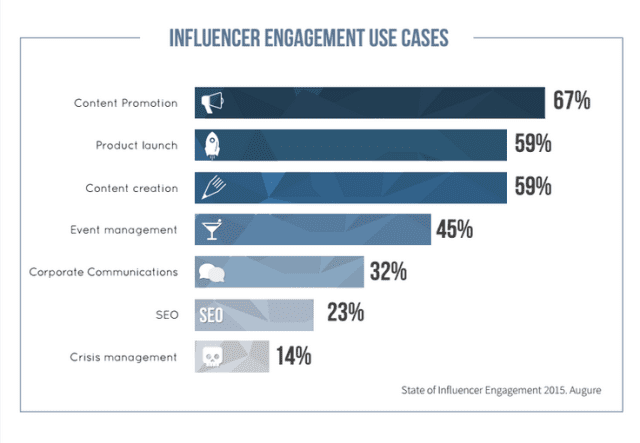
Content promotion is the most common use case for influencer engagement, according to the State of Influencer Engagement.

Image Source

An influencer can also add some of your links to their blog posts or website. These links can direct users to your products or services.

This can be anything from an image link to a contextual content link.

Image Source

Influencers can also promote your product or service by speaking about your company during a segment or by wearing your brand’s clothing during an event.

Brad Paisley has done this in the past with Corvette apparel.

Image Source

You can even ask an influencer to write a review about your product or service. This can be an independent review or a comparison post of your brand to a competitor.

Image Source

Be sure to send them a free package of your products that they can review.

The most common form of digital influencer marketing is through social media posts about services or products.

This usually includes a caption and an image or two explaining why they love your brand/why their followers should try out your products or services.

These posts usually look something like this:

Image Source

The cost per post usually depends on the number of followers that an influencer has.

These posts are also “sponsored posts.” They drive up engagement and make your brand look even more authentic.

They also allow influencers to share detailed descriptions with followers beyond a short social media caption, which boosts interest and traffic.

Just look at the Twitter video this influencer posted for Mastercard:

Image Source

Or the YouTube video that this creator made for Puls.com:

Image Source

They can also showcase your services or products by selling them in their marketplace. BigCommerce does this in their Theme Store:

Image Source

Another way that influencers can help you out is by collaborating with you on a project, such as a blog post.

They can write a guest post on your blog or work with you to create something valuable like an eBook.

Then, they’ll be more likely to share the content with their audience. You probably won’t have to ask (or pay) for them to share it at all.

From there, you can repurpose or recycle it into another format like an infographic, webinar, or email.

Image Source

As you begin to onboard more influencers, you can use a sales CRM tool like Salesmate to help organize your influencer onboarding process.

Image Source

If you still aren’t convinced, here’s the real proof of why collaborating with influencers boosts conversions.

Why collaborating with influencers boosts social proof (and thus, conversions)

Influencers filter and curate the trends in the world’s industries. By sharing the content that they find relevant, they pave the way for what becomes popular.

And their followers trust them. A lot. In fact, influencers are found to be more trustworthy than traditional advertisements.

According to Nielsen, 84% of consumers across the world are more likely to take action because of reviews or recommendations from trusted sources above other forms of advertising.

At least 72% of B2B buyers use social media to research purchases. According to a McKinsey & Company study, word-of-mouth leads to 20% to 50% of all purchasing decisions.

As if those statistics aren’t convincing enough, a study by Nielsen Catalina Solutions and TapInfluence recently found that the ROI of influencer marketing is:

  • 16x higher than the average digital marketing campaign
  • 11x higher than traditional banner ad campaigns

Image Source

The study found that for every 1,000 viewers, the influencer campaign generated $285 in sales.

And the ROI and conversions don’t stop on the day that an influencer mentions you. The content lives on.

Tweets and Instagram posts can be viewed and shared at any time. So can blog posts and YouTube videos. Eric Enge refers to this as the Influencer Trust Factor.”

The concept explains that influencers organically amplify the message of your brand in much less time than it would take you on your own.

Seven influencer marketing tools to try

Brands that perform their own influencer outreach like WallsNeedLove tend to find more success with their influencer marketing campaigns than those that don’t.

But how do you go about finding the right influencers to partner with?

Len of Podia suggests uncovering the right influencers by directly asking your customers. He recommends asking questions like, who do you learn from? What blogs or podcasts do you look forward to most? This will let you know who your customers already find influential.

Alternatively, you can use tools to source potential influencers. For everything from finding influencers to partner with them and tracking all of your outreach efforts and campaigns, here are seven influencer marketing tools to help you from start to finish.

First, to find a few potential influencers, use a tool like Buzzsumo.

1. Buzzsumo

Buzzsumo can help you find influencers in your industry to promote your content. To get started, search for an industry-related topic.

Image Source

Then, click on the “Influencers” tab. You can search bios or content shared to find influencers to work with.

Buzzsumo will even give you statistics for each influencer like their retweet and reply ratios.

Image Source

Followerwork is a similar tool for finding relevant influencers.

2. Followerwonk

This free Moz tool helps you find influential Twitter users by location and topic. Create a Twitter list to reference the ones you want to partner with or compare later.

Image Source

Hootsuite is a free tool that you can use to monitor industry conversations.

3. Hootsuite

Use Hootsuite to find out who your target audience is engaging with, what content they’re sharing, and more.

Then, reach out to those brands and influencers.

Image Source

Demographics Pro for Twitter doesn’t cost a thing, and you can use it to analyze an influencer’s audience.

4. Demographics Pro for Twitter

If you’re unsure whether an influencer’s audience is a good fit for your brand or not, then run their account through this tool.

You can find out the average age, location, income, interests, profession, and more of a user’s following.

Image Source

TrendSpottr is a tool for Instagram that you can use to find trending hashtags.

5. TrendSpottr for Instagram

Use TrendSpotter to find videos, photos, and influencers for any topic or tag. Select from a list of several popular tags, share trending posts, and use your findings to engage with key influencers.

Image Source

Insightpool optimizes your @mention streams.

6. Insightpool

If you have crowded, busy @mention streams, it can be hard to engage with key influencers through all the noise. You might even miss their tweets if you don’t look hard enough.

Insightpool’s single-click response feature makes it simple to connect with influential users without having to search for their replies.

Image Source

Gmass helps you send outreach emails to influencers once you’ve selected the ones you want to work with.

7. GMass

In order to start working with influencers, you first need to learn how to streamline the process.

Tools like GMass can help you send outreach emails in bulk and save time by automating follow-up emails directly from your Gmail interface.

If you don’t receive a reply, you can schedule a follow-up email to go out automatically within a certain number of days after your initial email.

Also, GMass has one of my favorite features, which allows you to track what part of the inbox your email landed.

Wrap up

Influencer marketing has been around for hundreds of years. But in the digital age, the sky is the limit.

With social media, anyone can connect with influencers to amplify their brand, gain trust, and increase conversions.

In 2018, brands will spend $1 billion on influencer marketing. The spending is all for a good reason: the ROI of influencer marketing is 16x higher than the average ad campaign.

Influencers can share links back to your brand, create product reviews, share posts on social media recommending your company, collaborate with you on projects, and more.

By sharing all of this with their followers, they help you build trust with target audiences and boost social proof. This means that your conversions will skyrocket.

You can identify influencers with a tool like Buzzsumo or Followerwonk. Use Hootsuite to monitor industry conversations and Demographics Pro for Twitter to analyze an influencer’s audience.

Try out TrendSpottr for Instagram to monitor trending hashtags and topics.

Insightpool lets you track mentions on Twitter without missing any replies, while GMass is perfect for automating your influencer outreach emails.

The longer you wait to collaborate with influencers, the more conversions you’re missing out on. Reach out to an influencer today.

Guest Author: David Zheng is the Founder of Growth Wit and Wisemerchant and the Head of Growth at BuildFire. He specializes in growth and content strategies to help influencers, ecommerce brands, venture-backed startups, and Fortune 500 companies grow their traffic and revenue online.

The post How to Connect With Influencers and Dramatically Boost Your Conversions in 2018 appeared first on Jeffbullas’s Blog.


Read Full Article: http://bathseoexpert.tumblr.com/post/171165021006

How to Grow Your Audience From Zero to Millions in Less Than 5 Years

grow-audience-from-zero-to-millions

You’ve just been hired. Your boss comes to you and says, “We want millions of people regularly viewing our content within the next five years. Go.”

You make it happen.

Riiiiight.

Well, Jay Lauf, co-president and publisher of Quartz, made this happen with his team. He told the story of how they did it in his Content Marketing World talk, Deconstructing Quartz (QZ.com): How One of the Most Popular Mobile Destinations Grows Audience, Extends Reach in Digital, and Creates a Superior Content Experience.

If your brand is trying to build an audience for your content, you can learn from the Quartz team’s experience. Think of your content team as a media company within your company.

What is Quartz?

A news company owned by Atlantic Media, Quartz launched in September 2012 with the website qz.com. The founding team members came from news organizations, including Bloomberg, The Wall Street Journal, The Economist, and The New York Times. These folks create content people want.

Also contributing to Quartz’s audience-building success:

  • The company continually grows its content team – 150 journalists on five continents.
  • The content is all digital.
  • The content is designed first for tablets and phones.
  • After establishing a following on its website, Quartz added ways to distribute its stories: an email newsletter, an app, and social media (Facebook, Twitter, LinkedIn, YouTube).
  • The content lends itself to aggregation by news platforms, such as Apple News, Flipboard, and Google Newsstand thanks to the versatility and insight of the reporting as well as the design of Quartz’s products.
  • The content includes several video series.

quartz-video-series

Rapid growth

While it’s impossible to pinpoint the number of people who regularly consume Quartz news via all these channels, Jay estimates the company accrued 100 million regular viewers in its first four and a half years.

To give you a sense of the magnitude of that reach, here are some metrics as of January 2018 – five and a half years after the company got its start:

  • 20 million visitors to qz.com
  • 700,000 subscribers to the Quartz newsletters
  • 800,000 downloads since February 2016 app launch
  • 5 million readers through news aggregation platforms
  • 3 million followers on social media
  • 155 million unique people watching Quartz videos on Facebook

More important than how many people they reach is whom they reach, Jay says. The audience is business decision-makers. “We’re at parity with all the bellwethers – The Wall Street Journal, Financial Times, The Economist, Bloomberg, Fortune, Forbes – but with a younger audience: median age around 40 and majority female. We’re attracting the right kind of audience for what we’re trying to do both journalistically and as a business.”

To what does Jay attribute this kind of success? What did Quartz do that the rest of us might want to copy?

For starters, it tells stories that people “freaking love,” as expressed in comments like this tweet (raving about how the random motions of a lava lamp can be used to encrypt digital data and other things you never realized you wanted to know about lava lamps):

quartz-tweet

How many exclamation-point-packed tweets does your content get?


How many exclamation-point-packed tweets does your #content get? @MarciaRJohnston
Click To Tweet


There’s so much to say about the quality of Quartz content that I’m working on another post on that topic alone – stay tuned!

Meanwhile, here are some other tips from Jay, which the rest of this post details:

  • Design with your audience in mind.
  • Find your sweet spots for content length.
  • Use third-party platforms to your advantage (but don’t depend on them).
  • Make big decisions with your gut, small decisions with data.

Design with your audience in mind

Since Quartz researchers found that executives throughout the world (its audience) consume news more on phones than on desktops, Quartz designs for mobile devices first and desktop second. “These are deeply intimate devices on which people are now consuming content, so there’s a great opportunity to engage them,” Jay says.


Design for #mobile devices first and desktop second, says @jlauf of @qz.
Click To Tweet


quartz-mobile-content

Because Quartz launched in “the age of acceleration,” Jay says, quoting Thomas Friedman, it owes some of its success to being “unshackled” from a lot of the considerations traditional publishers have had. “A lot of publishers have to wrestle with how to port their print content into a digital environment, never mind trying to figure out how to take the desktop expression of what you’ve done and fit that into a mobile environment. We had the luxury of starting from scratch,” Jay says.

He goes on to say that mobile is “scary to a lot of people because (they) don’t know how to port what we’ve been doing on other platforms into this smaller, more intimate screen.” Still, he says, the opportunity – if we embrace it and think deeply with the human element – is tremendous.

Find your sweet spots for content length

For Quartz readers, content needs to be either long or short – a classic smile curve. On the y-axis is traffic or impact, such as the number of people who have read a piece, tweeted it, or otherwise indicated that they found it engaging. On the x-axis is the length of the piece.

quartz-content-length

Quartz publishes content on either side of that curve – “not in that middle trough” like the 500- to 800-word articles that news operations have cranked out as the common unit of production for over a century and that often die on the social web.


Go long or short - avoid medium length #content, says @jlauf of @qz.
Click To Tweet


Average-length content typically does nothing distinctive. As Jay says, “It is not rewarded with the thing we’re all after with content marketing, which is word-of-mouth writ large, the attempt to share and engage with that content in a meaningful way.”

Quartz goes left or right on the curve. “That’s where the content sings,” Jay says.

  • On the left side of the curve (short length), Jay says, “you skip the throat-clearing and paragraphs of setup and all that nonsense.” You use images – for example, infographics – to convey a lot of information quickly. “Get in and get out. Make somebody smart quickly. They’ll reward you for that. They’ll share that.”
  • On the right side of the curve (long form), content is the most likely shared by the executive audience, Jay says. “Charts and data are number two, but, by a wide margin, our readers value – and share – long-form pieces that give them deep insight into something while also telling a narrative story. These people read 10,000-word New Yorker stories on their phones.”

Long form #content is most likely shared by the executive audience, says @jlauf of @qz.
Click To Tweet


Naturally, in-depth pieces take time to develop. If a writer sends Quartz an 800-word piece, the editors may kick it back and say, ‘Why don’t you spend another couple of weeks – or months – on this piece and say something definitive?”

When’s the last time your company insisted that a writer spend another couple of months on a piece of content?

Of course, your audiences’ sweet spots for content length may not line up with the sweet spots for Quartz readers. Sow your research and see what you discover.

Use third-party platforms to your advantage (but don’t depend on them)

Quartz has learned to go where its audience is.

Zach Seward, one of the co-founders of Quartz, early on thought about Quartz as an API (application programming interface). “Quartz can go anywhere our readers are, in whatever form is appropriate,” he says.

In fact, news stories are blobs of content that can live on any platform – wherever the target readers can be found. “We’re not precious about trying to pull you back to qz.com,” Jay says. “We’ve embraced from the beginning that our users are going to be out there in the ecosystem and in the world, so we go out and try to be in those places.”

In the beginning, out of necessity, Quartz launched with a website, qz.com, and a daily newsletter. Today the product portfolio looks like this:

quartz-website

Today, Quartz has many elements in its network:

  • Atlas, a platform for building and sharing charts
  • Regional editions in India and Africa
  • Email newsletters
  • Quartz app
  • Amazon Echo (so people can use Quartz as a morning news briefing with Alexa)
  • Other platforms, such as Flipboard, Apple News, Pocket

While Jay understands that some marketers feel a need to keep people on their owned channels, these other channels can serve as on-ramps to the brand. “Millions of people are on those platforms, so I encourage you – in whatever capacity fits your business – to think beyond your owned channels. I know that’s hard sometimes when you’ve got people you’re answering to who are fixated on that. But try to get them comfortable with the fact that marketers need to go with where the readers are.”


Think beyond your owned channels - marketers need to go where the readers are, says @jlauf of @qz.
Click To Tweet


For example, in 2016 Quartz published a series of videos to Facebook, doubling the number of Facebook followers and driving people to qz.com.

Jay’s takeaway: Use third-party platforms to your advantage, “but don’t overoptimize and become dependent on a single one.”

Make big decisions with your gut, small decisions with data

“Quartz” has become an adjective or a verb. People have said to Jay, “OK, I want to Quartzify this” or “That’s very Quartzy.” The Quartz tone, design approach, subject matter, and story angles are that distinctive.

How did it achieve this distinctiveness? “We make big decisions with our gut,” Jay says, “and little decisions with data.”

People on the content team use their intuition to create stories they think their audience will find engaging, interesting, and unique. “We’re writing for humans,” says Co-President and Editor-in-Chief Kevin Delaney. “If all you’re doing is optimizing for algorithms and robots, you lose the magic.”


If all you're doing is optimizing #content for algorithms & robots, you lose the magic. @delaney @qz.
Click To Tweet


Intuition also inspired the company to launch the app last year that does something that other news apps weren’t doing: It makes news stories literally engaging. You must interact with the interface to get from one story to the next. The stories float up from the bottom of the screen in chat-style bubbles sprinkled with gifs, emojis, and quizzes.

Here’s a screenshot I took while writing this post:

intution-app

Which blue button would you click here: Next? Or the banana button?

Seriously. A banana button. In a news app. News = grimness. Bananas = things people slip on in cartoons.

“All of that was intuition,” Jay says. “We didn’t grind the science on that.”

But the Quartz team doesn’t go by gut alone. After it published the app, the team “got really interested in the data,” Jay says. “Were people downloading it? What were the interaction rates like? What were the open rates like? Were people spending time with it? All of that reinforced that, yeah, wow, we’ve created something special.”

Conclusion

What would your boss say if you grew your audience by millions of people in the next five years? You could do worse than mimic what worked for the news team at Quartz:

  • Design with your audience in mind.
  • Find your sweet spots for content length.
  • Use third-party platforms to your advantage.
  • Make big decisions with your gut, small decisions with data.

Has your team done some of these things? What has worked for you?

Here’s an excerpt from Jay’s talk:

Learn firsthand how companies are successfully growing their audiences at Content Marketing World Sept. 4-7 in Cleveland. Register today and use code BLOG100 to save $100.

Cover image by Joseph Kalinowski/Content Marketing Institute

The post How to Grow Your Audience From Zero to Millions in Less Than 5 Years appeared first on Content Marketing Institute.

Wednesday, February 21, 2018

10 Types of Visual Content On Instagram That Get Shared Like Crazy

10 Actionable Copywriting Tips That Will Make Your Content More Powerful

10 Actionable Copywriting Tips That Will Make Your Content More Powerful

There are over 87 million blogs published on WordPress.com every month.

If you want to stand out from the crowd, your content has to be powerful. It has to drag people in, entertain them, and get them to take action.

If it isn’t, all your hard work will have been for nothing. Instead of making a big splash, it will be just another drop in the ocean.

So how do you make it more powerful? How do you take a piece of content and turn it into something that not only gets read but gets results as well?

That’s what this article is about. I’m going to show you 10 actionable copywriting tips you can use to turn a bland piece of content into a powerhouse of an article.

Let’s go.

1. Make them experience it

Ever seen master storytellers at work?

It’s amazing how they can capture your attention and make you forget what’s happening around you. When they’re telling a story, it feels like you’re in that story.

And the cool thing is: your brain thinks you are. When someone tells you a story, your brain couples itself to that of the person telling it. You don’t just imagine what they’re saying, you experience it as well.

It’s that ability to generate emotions within your reader that makes storytelling so powerful. If you can make people experience what you’re saying, your content will stand out head and shoulders above your competition.

Now, turning every article into a story that’s worth an Emmy nomination is going to be a challenge, to say the least. But there are a couple of ways you can add more storytelling elements to your content.

Use metaphors

Researchers in Spain found that when they gave test subjects metaphors like “The singer had a velvet voice”, the subject’s sensory cortex – the part of the brain that is responsible for perceiving texture through touch – lit up.

Use strong verbs

Strong verbs can help you visualize an action. Saying someone “slammed his fist on the table” is a lot more powerful than saying someone “put his fist on the table”.

2. Use the power of open loops

In 1927, a Soviet psychologist by the name of Bluma Zeigarnik was sitting in a restaurant with her colleagues when she noticed something weird. When their waiter took their order, he remembered every single one without a problem.

But once they were done eating and everything was paid for, the waiter couldn’t remember what each of them had for dinner.

She decided to study this in greater detail and found out that people have a much easier time remembering unfinished tasks. In psychology, this became known as the Zeigarnik effect. In copywriting, it’s known as an open loop.

Open loops are everywhere. From advertisements to movies to blog posts. If you’ve ever watched or read any form of entertainment, you’ve encountered open loops.

They work incredibly well because they instill curiosity and create anticipation for what will come next. When someone opens a loop, we want to close it so it’s off our mind.

They aren’t hard to create. In fact, you’re doing it every time you write a headline. Headlines are the most basic form of an open loop.

Unfortunately, that’s the only time most people use them. If you sprinkle in open loops throughout your content, it packs a bigger punch. You can use them in:

Introductions

Adding open loops to the intro of your content can be one of the best ways of getting people invested in your content.

Subheads

Adding open loops to your subheads will help pull in the people who just scan your content and move on.

3. When in doubt, read it out loud

A good way to make your content more powerful is to start reading it out loud. This is because, unless you practice speed-reading, you use your inner voice to read words “out loud” in your head.

This is called sub-vocalization and it makes it easier for your brain to understand what you’re reading.

By making sure it sounds good, you’re making it easy for your readers to digest what you’re saying. They’ll be able to focus on the message instead of the words.

Reading your content out loud also helps you iron out any kinks in your content. You’ll quickly realize when paragraphs don’t work when sentences are wonky, or when words don’t flow.

4. Use the rule of three

The rule of three states that ideas and concepts presented in threes are more interesting, humorous, and enjoyable.

It’s another one of those things that are used absolutely everywhere. It gets used in:

  • Jokes (“A German, an Englishman, and an Australian walk into a bar…”)
  • Movies (The good, the bad, and the ugly)
  • Declaration of Independence (Life, liberty, and the pursuit of happiness)

The reason it’s so effective is that humans have evolved to recognize patterns. They help us make sense of all the information that’s thrown at us. Three is simply the smallest number needed to form a pattern.

It’s that combination of brevity and patterns that make it so powerful.

The rule of three has a couple of benefits:

5. Use deliberate repetition

Have you ever listened to some of history’s most important speeches and wondered how they managed to make them so powerful?

Speeches like Martin Luther King’s “I have a dream” have the ability to touch people at their core, to create movements, to give people hope.

One reason they’re so effective is that they use deliberate repetition. At certain points in the speech, the speaker repeats certain words or phrases. Take this speech from Winston Churchill, for example:

“We shall fight on the beaches, we shall fight on the landing grounds, we shall fight in the fields and in the streets, we shall fight in the hills, we shall never surrender.” -Winston Churchill

You can apply this to content as well. Adding deliberate repetition to your content adds flair and makes it more dramatic and makes it stand out from the crowd.

This does a couple of things:

  • It adds rhythm and flair to your content
  • It makes it more dramatic (more emotional)
  • It makes it more memorable

6. Start with a punch, end with a kick

In 1962, a psychologist by the name of Bennet Murdock conducted an experiment where he gave a group of people a list of words. Afterward, he asked them to recall as many words as possible.

He found that when people had to recall items from a list, they’re more likely to remember the first and last items. The first item because it gets the most attention, the last item because it’s the most recent. This became known as the serial positioning effect.

When you’re writing content, your intro and your conclusion are the two most important sections of them all.

Your intro gets the most attention and needs to drag people in. Your conclusion is the last thing people see and contains your call to action.

7. Use short first sentences

55% of your audience only reads your content for 15 seconds or less.

It sucks, but it’s the truth. They check out the headline, subheads, conclusion and then decide whether or not your article is worth it. If it isn’t, they’ll leave.

Now, if writing is a hobby of yours, this is something you can live with. But if your income depends on people reading your stuff, a statistic like that can make you start sweating bullets.

Legendary direct response copywriter Joseph Sugarman realized early on it was crucial to drag your readers in from the start. If your intro failed to get someone’s attention, the rest didn’t matter.

One of the ways Joe managed to get people reading is by writing very short first sentences. He figured that if you can get someone to read your first sentence, they’re more likely to read the second one. If they read the second one, they’re more likely to read the third one and so on.

Jon Morrow from Smart Blogger does this really well. His first sentences are usually so short you can’t help but read them. What makes it even more powerful is that he opens a loop that we can’t help but close.

8. If you have to choose between clear or clever, choose clear

Did you know that 80% of ads shown during the Superbowl have no impact on sales?

Even though they have a huge reach and a higher than normal percentage of people paying attention to them, they don’t do anything sales-wise. Why?

One of the reasons is that, during the Superbowl, advertisers work overtime trying to make their ads as entertaining as possible. And often times, they succeed.

The problem is that people end up remembering the ad, but they have no clue what product it was for.

With content, you can fall into the same trap. You can end up writing an article that makes you sound smart, but no one knows what you’re talking about.

If you have to choose between sounding smart and delivering a clear message, choose the clear message. There are a couple of ways you can make your content more clear and concise:

  • Use simple words
  • Use short sentences
  • Use an active voice
  • Put the action in the verb

There’s cleverness in being clear. If you can boil down a complicated topic into easy to understand chunks, you’re doing an amazing job.

9. Use delayed transitions

Transitions bind sentences and paragraphs together. They make it easier for your readers to go from one thought to the next. For example…

“You want to make your content more powerful, but you don’t know how.”

The sentence above uses the word “but” as a transition. It takes two different thoughts and turns them into a sentence.

A delayed transition is a little different. With a delayed transition, you stick the transition at the beginning of a sentence. For example…

“You know you need to grab people’s attention if you want them to keep reading. But you don’t know how. So you check out what other people are doing.”

The main advantages of these type of transitions are:

  • They allow you to use shorter sentences, which improves readability.
  • They open a small loop we want to see closed.
  • They add a level of unpredictability to your content, which keeps people on their toes.

Here’s another example, this time from Copyblogger:

Copywriting tips - Copyblogger

10. Steal your reader’s words

Every audience has its own sayings, its own inside jokes, and its own language. If you can replicate the way your audience talks, your content becomes instantly more powerful.

Now the question is: how do you figure this out?

The best way is to just talk to them and ask them what they’re struggling with. Specifically, you want to know:

  • What goals they’re trying to achieve.
  • What pain they’re trying to get away from.
  • What obstacles are preventing them from getting to their goals.

Knowing the answers to these questions will allow you to write content that connects with your reader on a deep level.

But what if you’re just starting out and you don’t have anyone you can interview?

In that case, you can still figure out how your target audience describes their problems by going to Amazon and checking out the reviews for books related to your niche.

Nothing beats talking to your customers, though.

Stop letting your content be ignored

Now that we’ve gone over 10 copywriting techniques that will help make your content more powerful, it’s your turn to implement them.

Here’s what to do next:

  • Pick one or two techniques from this list.
  • Implement them into your next piece of content.
  • Let me know in the comments which one helped you the most.

Guest Author: Robin Geuens is a freelance copywriter who helps online entrepreneurs write better content. You can download the powerful content checklist to see how you can make your content pack a bigger punch.

The post 10 Actionable Copywriting Tips That Will Make Your Content More Powerful appeared first on Jeffbullas’s Blog.


Read Full Article: http://bathseoexpert.tumblr.com/post/171128591471

Instagram Marketing: 4 Features You Should Be Using [Examples]

instagram-marketing

It’s obviously not enough to create an account on Instagram and start shooting photos to share. Successful content marketers on this social platform tailor their content to take advantage of the channel’s strengths, from hashtags and Stories to advertising and live video.

Let’s explore how to use these features to maximize your content marketing strategy.

Powerful hashtags

You can use two types of hashtags in your Instagram campaigns – branded or community.

Branded hashtags make your post easier to find for people who already know your company and are looking to find out more about it. Branded hashtag examples from Bullet Journal, which has over 260,000 followers, include #bulletjournal #bulletjournaling, and #bulletjournalcollection.


Branded hashtags make your @Instagram post easier to find for people who already know your company. @katairobi
Click To Tweet


bullet-journal-hashtag

Community hashtags are commonly used or created by Instagram users to follow a topic, interest, or other unifying theme. In the Bullet Journal example, community hashtags include #writing, #stationery, #plannermom.

TIP: Instagram limits users to 30 hashtags per post.

This Instagram post shows how Mercedes Benz uses hashtags.

mercedes-benz-hashtags

Observe the hashtags Mercedes uses besides the branded ones: #GTfamily, #DreamCar, #Cartastic, #InstaCar, #Luxury, #Lifestyle, #Performance. The community following those hashtags is interested in vehicles or products fitting in those categories. This is how prospects can find your brand and how they relate to your products in a quick and easy way.


Find the most relevant community hashtags to get discovered on @Instagram, says @katairobi.
Click To Tweet


In The Ultimate Guide to Best Instagram Hashtags for Likes, Andrew Roach offers several tools to help generate effective community hashtags, including:

I like Display Purposes because I simply enter my topic and it generates a list of the most relevant existing hashtags.

display-purposes-topics

Don’t want to spend time coming up with the perfect hashtags? Oberlo reports the 10 best hashtags for Instagram:

  • #love
  • #instagood
  • #photooftheday
  • #fashion
  • #beautiful
  • #happy
  • #cute
  • #tbt
  • #like4like
  • #followme

Dynamic Stories

The Stories feature allows you to interact more directly and transparently with your audience, but these Stories are deleted after 24 hours from the top of the feed. Nobody expects you to invest significant time and money to create content for such a short time. However, last year Instagram added a way for Stories to last forever. It now automatically saves your Stories in your archives. You can choose to share them again through Instagram’s Stories Highlights feature.

Instagram Stories help you grow your audience and keep it engaged with your brand because it allows you to keep your profile in their feeds not once but several times during each day. More Stories mean more chances to attract the audience’s attention.


Posting multiple @Instagram Stories lets your profile appear in feeds several times a day, says @katairobi.
Click To Tweet


Vogue Magazine uses Stories, such as this one from the presidential inauguration last year, to drive traffic to its website.

vogue-magazine-stories

The approach is simple. Post a series of pictures and integrate a call to action inviting people to view more on Vogue’s website.

TIP: The swipe-up feature is available to those who have at least 10,000 followers – another great reason to concentrate on building your community first.

Cheerios uses Instagram Stories to keep people engaged with the brand through a series of personal messages. They are intended to make people feel good about themselves and the brand by triggering positive emotions.

cheerios-instagram-story

Skillful Instagram Live

Eighty percent of people prefer to watch live video from a brand than to read a blog, and 82% prefer live video from a brand to social posts, according to research cited by Livestream.


82% of people prefer live #video from a brand to #socialmedia posts, according to @livestream #research.
Click To Tweet


Instagram allows you to do live video, but you must take an extra step and share it to ensure that it shows up – and stands out – in Stories feeds. Live videos also can be featured in the Explore section, which expands your audience to possible new followers.

A great example comes from Tim Coppens, creative director and founder of the fashion brand that carries his name. He is one of the first designers to use Instagram Live to stream his show of menswear at Pitti Uomo in Florence, giving his followers a chance to see the show without traveling to Italy.


.@TIMCOPPENS is one of first designers to use @Instagram Live to stream his fashion show, says @katairobi.
Click To Tweet


tim-coppens-instagram-live

On a more personal level, you can do live video with a follower or group of followers, giving you the ability to deliver your content one on one or one to a few.


Adaptable Instagram Ads

Ads offer a flexible opportunity to achieve your brand’s objective. Not only can they be used to market a product or service, they can also be used for calls to action such as:

  • Install now
  • Book now
  • Download
  • Learn more
  • Play game
  • Sign up
  • Watch more
  • Apply now
  • Contact us

Instagram Ads are not intrusive because they look similar to other posts. And, unlike other social media platforms, they allow you to deliver full-screen ads.


Instagram Ads deliver full-screen ads, unlike other #socialmedia platforms, says @katairobi.
Click To Tweet


A great example of an Instagram advertising success is Russia’s S7 Airline campaign, which delivered ads on Instagram Stories through a series of videos showcasing new features of the planes.

s7-campaign-instagram

As Instagram reports, “It reached 60% of the target audience and saw a 20-point lift in ad recall, which rose to 24 points among 25- to 34-year-olds.”

On the other hand, Vitaly earned success with more traditional ads on Instagram. As a lifestyle and fashion brand, Vitaly knows the power of visual imagery. To re-engage people who visited its website but didn’t make a purchase, Vitaly invested in dynamic ads on Instagram.

vitaly-traditional-instagram-ads

Instagram Business reports the retargeting campaign reached more than 243,000 people and achieved a 3.9 multiple return on the ad spend.

Conclusion

Instagram is a perfect channel for brands to deliver visual content customized for its followers and delivered in the best ways to attract their interest. Whether it’s a branded or community hashtag, a Story shared from your archives, live video, or inconspicuous ads, you can select the formats most relevant to your audience and your messaging.

What are your experiences with Instagram? What tips do you have?

Please note: All tools included in our blog posts are suggested by authors, not the CMI editorial team. No one post can provide all relevant tools in the space. Feel free to include additional tools in the comments (from your company or ones that you have used).

Get expert insight into maximizing your social media content experiences at Content Marketing World Sept. 4-7 in Cleveland, Ohio. Register today for the best rates. Use code BLOG100 to save $100.

Cover image by Joseph Kalinowski/Content Marketing Institute

The post Instagram Marketing: 4 Features You Should Be Using [Examples] appeared first on Content Marketing Institute.